Monthly Archives: January 2010

Caprica – “Rebirth”

“Rebirth”

January 29th, 2010

I was warned ahead of time that Caprica’s pilot was not necessarily representative of the series, and that the two additional episodes sent to critics seemed to offer something very different. However, all of those people who had seen the episodes seemed excited but in a way that was at the same time quite cautious: when I chatted about the episodes with Todd over at Media Elites, he indicated that, while he was quite taken with the episodes, not everyone is going to fall head over heels in love with the show that Caprica has become.

I, however, have. What surprised me about Caprica was that it managed to resist diving straight into melodrama, despite a premise that lends itself to that sort of interaction. After a pilot that felt steeped in the complexities of holo-bands and avatars, “Rebirth” takes that scenario and investigates the human consequences: stories that are big philosophically, like the fate of Zoe Graystone’s Avatar, are small in the context of the story, while the stories which go public are those which are more personal and thus more devastating. Rather than focus on creating conflict between characters, the episode allows the characters to start developing independent of that conflict, discovering new ways to adapt to a world without a daughter or a family shattered by tragedy.

It’s an episode that manages to subtly investigate the show’s premise while also triumphantly proclaiming that Caprica is a place of great complexity, and a place that has no idea the changes that the next decade or two will bring; in short, it’s a damn fine start for the series at hand.

Continue reading

3 Comments

Filed under Caprica

Series Finale: Dollhouse – “Epitaph Two: The Return”

“Epitaph Two: The Return”

January 29th, 2010

In the eyes of ardent supporters of Joss Whedon, Dollhouse is a continuation of his legacy: an interest in female protagonists who kick ass, an engagement with complex philosophical issues, a unique sense of humour, and an early cancellation at the hands of the villainous FOX.

However, not to be dismissive of those fans, I have to wonder Dollhouse actually has any sort of legacy of its own. We tend to view the show in terms of Whedon’s past successes, whether favourably or unfavourably, but has the show had time to do anything substantial on its own? As someone who has seen relatively little of Whedon’s work (Buffy and Angel are sitting on my DVD shelf waiting for me to get to them), I have struggled over the past few weeks with the question of what Dollhouse will leave behind for those without extensive knowledge of its creator.

It is a show that struggled to find a way to get to its big ideas in the early going, and that simply didn’t have enough time to live up to their full potential. They wanted to tell a story about the end of the world, but that world was never fully formed; they wanted to depict the tragic fall of some characters, but had to rush others to achieve its full effect. The second season has had moments of brilliance (“Belonging,” in particular), but it has had this pervasive sense that this would all be better if the show had more time, that they were trying to tell too much story to “wrap things up” and in the process missing out on some intriguing parts of this universe.

Heading into “Epitaph Two,” I lacked anything close to excitement: I was curious, there’s no question about that, but I wasn’t on the edge of my seat excited for what happens next. Instead, I was anxious to see just how a show that came in like a lamb and rushed its transition to lion plans on saying “bon voyage” to its miniscule but devoted fanbase.

The answer is with an hour of television that introduces too many new concepts too quickly, and which proves incapable of grounding all of them on realistic character motivations. However, in true Dollhouse spirit, there are enough moments of legitimately compelling drama to lift the episode to the point of being satisfying…or, more accurately, as unevenly satisfying as the show has been all along.

And that’s all we can really ask for.

Continue reading

3 Comments

Filed under Dollhouse

Burn Notice – “Friendly Fire”

“Friendly Fire”

January 28th, 2010

Noel Kirkpatrick put together a post on “formula TV” over at Monsters of TV yesterday, and in highlighting Burn Notice he points out the following:

…each episode will also find Michael trying to get back into the CIA (originally to find out who burned him and why), often near the end of the episode or throughout the episode while trying to help the Client of the Week.

And while this is ostensibly true, it’s important to note that not all such efforts are built to the same standards: Carla was a distraction which forced Michael to multi-task, while the police detective at the start of the season was a nuisance that forced Michael to be more cautious. And while I thought Carla felt as if she created character-driven drama, in that Michael was distracted and perhaps too focused on returning to his position within the CIA (the same goes for Strickler, to some extent), Moon Bloodgood’s detective was just a barrier who made the show less interesting, a muzzle that kept Michael Westen from being Michael Westen.

It’s too early to judge Gilroy yet, but “Friendly Fire” is the ideal demonstration of how fun Burn Notice’s formula can be: a compelling story is made more explosive and more enjoyable by the presence of an external figure who is looking for a good show. And while it might not be as psychologically complex, it presents no barrier to the show being its fun, high-energy self, which makes it a story with quite a bit of potential.

Continue reading

Leave a Comment

Filed under Burn Notice

Friday Night Lights – “Injury List”

“Injury List”

January 27th, 2010

Friday Night Lights is a show about convergence.

Really, all ensemble dramas end up driving towards climaxes which tend to bring various story elements together, so this may not seem overly remarkable. However, as the show heads towards the conclusion of its fourth season, the show is doing a lot to bring together stories, simplifying in some instances and complicating in others.

And while some of the tension created by this convergence is engaging, what I tend to enjoy more is the sort of indirect effects: this is the first time in a while where the show actively demonstrated the show’s central dilemma of ignoring the football in order to service the characters on a personal, non-football level, and that tension (when used, as opposed to simply created and elided) is part of the show’s tragedy.

“Injury List” is about capturing the tragedy of stories converging at the worst possible time, although the show manages to keep (most of) that convergence from seeming too convenient in the show’s late season push.

Continue reading

1 Comment

Filed under Friday Night Lights

The Scourge of Fandom: Why Lost Owes Us Nothing

The Scourge of Fandom: Why Lost Owes Us Nothing

January 28th, 2010

If you haven’t seen it yet (which seems unlikely, but whatever), The Onion’s fantastic bit of satire surrounding the final season of Lost making fans more annoying than ever is a wonderful piece of work. With the help of executive producers Damon Lindelof and Carlton Cuse, they capture the sense of obsession that surrounds the show’s fans, and there’s just enough nods to the show’s mythology (and to other fandoms: check out the ticker for a shout-out to The Wire that slayed me) to make even the most obsessed crack a smile.

Final Season Of ‘Lost’ Promises To Make Fans More Annoying Than Ever

However, I believe that the Onion has failed to represent an even more annoying segment of Lost viewers that will threaten to destroy the internet as we know it come February 2nd (which is, let’s remember, only five days away). These are the viewers who have either predetermined how producers Damon Lindelof and Carlton Cuse must end the show or predetermined that they absolutely cannot end it to their satisfaction. These are the people who believe they deserve to have their questions answered, and that they are in some way owed a finale that lives up to their precise expectations.

And they’re the real problem here.

[Before reading the remainder of this particular article, you are required (okay, okay - urged) to go check out Maureen Ryan's fantastic, spoiler-free interview with Damon Lindelof and Carlton Cuse, which I'll be referring to liberally throughout the piece. You can find Part 1, Part 2 and Part 3 at her blog]

Continue reading

15 Comments

Filed under Lost

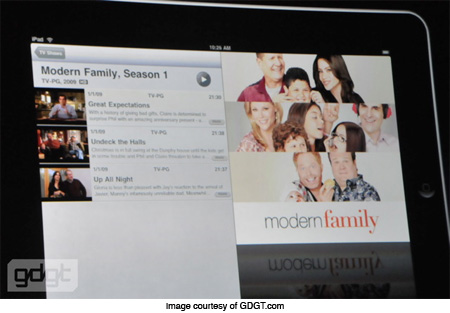
The Apple iPad: Still Not a Television, But That’s Okay

The Apple iPad is not a television, but it wants to be one.

Of course, you could say the same thing about the iPod, and the iPhone, and the Macbook, and the iMac, and the AppleTV (Which is, of course, a small media player that hooks up to your TV as opposed to an actual television). The fact of the matter is that nearly every Apple product, by nature of its connection with iTunes TV downloads, wants to position itself as a replacement for your television (or your cable box). And the iPad, you could argue, is the closest the company has come so far to creating a device that bridges the gap: with a 10″ screen and wireless portability, the device offers respectable size and versatility to be able to sit on the train, download last night’s episode of Glee, and enjoy the ride.

However, the question on my mind is whether the iPad is anything more than a large iPod, and whether the problem plaguing efforts to expand television viewing en masse towards other platforms has nothing to do with size or usability and more due to habit (or problems with the distribution model as a whole). I think there’s a compelling argument that the iPad could offer new ways for people to experience the internet (especially its news capacities) “on-the-go,” and I think positioning the machine as a more portable, more usable netbook is intelligent. However, in terms of the medium I tend to spend the most time with, I don’t know if the iPad would actually change how I want to experience television, even if its price point means that I might end up purchasing one eventually.

I’m no tech writer, but some TV-specific thoughts after the jump.

Continue reading

5 Comments

Filed under Television

Scrubs – “Our Dear Leaders”

“Our Dear Leaders”

January 26th, 2010

J.D. and Turk are not entirely dissimilar characters: they’re best friends, after all, and both have their quirks which make them quite enjoyable to watch in a “look at how immature he can be” sort of way. However, what I always found interesting was how Turk was always capable of better balancing the two: while the show struggled at the start of this season to position J.D. as both a mentor and a source of comedy, Turk has always been taken somewhat more seriously, which meant that he could be a bit more over the top without losing our respect or the respect of his new Med Students.

Ultimately, though, I think “Our Dear Leaders” didn’t entirely work because there is a point the Chief of Surgery needs to have moved beyond these types of stories. While it may be thematically helpful to have all of the stories play into a sense of leadership, to lump Turk in with the med students is problematic in terms of the necessity to exaggerate his character’s response to particular actions. It’s not that Donald Faison is no longer funny, or that there isn’t a story to be told about the fact that he’s too old to be acting like a Med Student, but the story never really gave him much material to work with, and it never quite connected the dots in terms of making this a story about Dr. Turk needing to come to terms with his maturity (instead suggesting he suck it up so the source of his jealousy would keep donating money to the hospital).

It wasn’t a terrible episode, but it seems as if the show still struggles when it tries to straddle these two worlds as opposed to capturing the points at which they interact.

Continue reading

2 Comments

Filed under Scrubs

Better Off Ted – “Mess of a Salesman”

“Mess of a Salesman”

January 26th, 2010

Normally, we tend to view Better Off Ted as a sanctum of comedy genius, a show we measure in terms of how often we laugh more than anything else. Yes, the show has enjoyable characters, but it isn’t a show that we often consider at that level, at least not in terms of the lead in a review of this kind.

And yet “Mess of a Salesman” first brings to mind the word “sweet,” and not in terms of the use of the word as a synonym for “awesome” or “rad.” No, I thought that this episode was perhaps most defined by its sweetness, a winning quality that made what was potentially one enormous sitcom cliché (the no-good brother showing up and making the protagonist’s life hell) into something that never headed down that melodramatic path. While it meant that the episode was less ridiculous than usual, and perhaps less funny than the recent stretch of episodes, it was grounded in a way that shows the versatility to be found in this show’s universe.

By combining its usual corporate satire with some rather positive depictions of humanity and mentorship, the show may have stayed on the rails more than one might like, but I thought it was an enjoyable turn (if not quite the note the show should go out on, should this truly end up its final airing on ABC as is currently scheduled).

Continue reading

Leave a Comment

Filed under Better Off Ted

Life Unexpected – “Home Inspected”

“Home Inspected”

January 25th, 2010

Alan Sepinwall has a good review of this week’s second episode of Life Unexpected where he discusses the curse that is the never-ending pilot, where a network puts pressure on a show to restate/revisit its premise in early episodes in order to hook in new viewers (like, for instance, those who tuned in tonight when they found out the CBS comedies were in repeats). He points out that, at TCA, Liz Tigelaar argued this actually made sense for this show, as a situation this complicated would actually be quite unstable, and it would be unrealistic for it not to in some way repeat the initial tension we saw in week one.

I think she’s right, but I think that “Home Inspected” also manages to find a couple of intelligent shortcuts to navigate its way through the challenges of this process. I wouldn’t argue that the episode is perfect, or that some of those shortcuts aren’t a bit overstated/melodramatic, but the episode manages to maintain the show’s pilot momentum even in its redundancy, which is something any show in its position should strive for.

Continue reading

2 Comments

Filed under Life Unexpected

Human Target – “Embassy Row”

“Embassy Row”

January 25th, 2010

I don’t have a whole lot to say about this week’s new episode of Human Target, which aired in its normal Monday timeslot on CTV and which airs Tuesday at 9pm (due to the State of the Union on Wednesday) on FOX: it’s another fun episode that continues to care very little about believability, but because each hour is its own self-contained 40-minute action film it isn’t really that big of a deal. I don’t have any sort of fancy or complex thematic introduction to my thoughts on the show, so I’ll just suggest that people enjoying the show so far should tune in.

However, I do want to say a few things about where the show sits at the moment, and whether the episodes we’re seeing out of order are adding up to a distinct impression of Christopher Chance and his universe of sorts, so I shall nonetheless analyze the episode after the jump.

Continue reading

2 Comments

Filed under Human Target