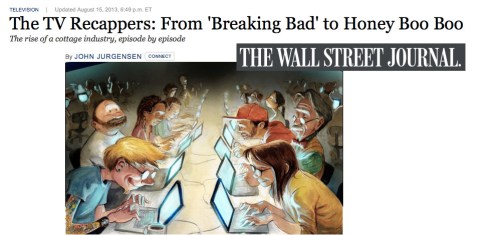
In the wake of Brett Martin’s Difficult Men, which itself comes in the wake of Alan Sepinwall’s The Revolution Was Televised, there has been new scrutiny placed on the culture of television criticism. In Ken Tucker and Phillip Maciak’s reviews of Difficult Men—Maciak also covers Sepinwall’s book—they each delve into the culture of “TV recaps” as a rejoinder between the shows being canonized by the authors and the culture with which those shows are being analyzed. It’s an acknowledgement that how we write about television matters, which extends Jaime Weinman’s argument that we are in a “golden age of taking TV seriously.”
In Tucker and Maciak’s reviews we see an interesting crosstalk, where Maciak ably dissects Tucker’s broad dismissal of what Martin refers to as “the strange and telling practice of ‘recapping.'” Tucker picks up Martin’s dismissal and runs with it, expounding on “the challenge of creating diverse aesthetic principles that rise above the Internet’s limited range of extracritical responses, which typically run the gamut from this-is-awesome! blog posts to fitfully edited twelve-thousand-word essays about this or that show’s elaborate ‘mythology.'” While citing a number of—great—critics who are indeed capable of “rising above” the apparent limitations of the form, Tucker largely paints recap culture as the venue for “the adoring gaze of online fanboys and fangirls.”
Maciak picks away at Tucker’s case, not so much disagreeing with his call for more serious television criticism as he is claiming that “the culture of online television commentary has expanded, rather than degraded, our critical culture.” With more space than Tucker to explore the nuances of the current landscape of television criticism, Maciak finds a larger sample of diverse writing about television that ranges in terms of genre, focus, and audience. Rightfully picking away at Tucker’s emphasis on asking “proper artistic questions,” Maciak makes a strong case for how the culture of instant responses to television has proliferated not as a dichotomy of fanboys and obsessives but rather as a spectrum of incredible breadth and depth (even if sometimes in a shorter form than the critics Tucker cites from other media).
It’s a rich conversation, one that reflects some of my own thoughts on the rise of episodic television criticism from a number of years ago. However, it’s also a conversation that bears the mark of our culture’s mass acceptance of “recap” as an acceptable term for this diverse range of ways of writing about television. If Tucker were speaking about the actual practice of night-of “recapping” which manifests as a basic plot rundown with minimal commentary, I agree with his argument; when he extends to the suggestion that most episodic criticism fits under this umbrella term, his argument is reductive. Maciak, meanwhile, goes so far as to acknowledge Matt Zoller Seitz’s use of “overnight review,” but ultimately accepts “recap” as an acceptable term for describing all types of episodic criticism while arguing for the critical capacity of that form.
I have long stood as the standard bearer of drawing a distinction between recaps and reviews, to the point where it’s kind of a joke. I made the distinction initially because I was seeing the work of critics I admired being forcibly labeled as recaps based on the belief from websites that the term was better optimized for search engines. However, over time my concern has grown to pieces like Tucker’s and Maciak’s which beyond the goal of SEO optimization accept the term’s ubiquity (if critically, in Maciak’s case), which was my real concern when considering the web practices of sites like AOL—now Huffington Post—or HitFix. I was the crazy person signaling an alarm bell over something that—while certainly still a first world problem if ever there was one—has had a negative impact on a larger public understanding of television criticism.
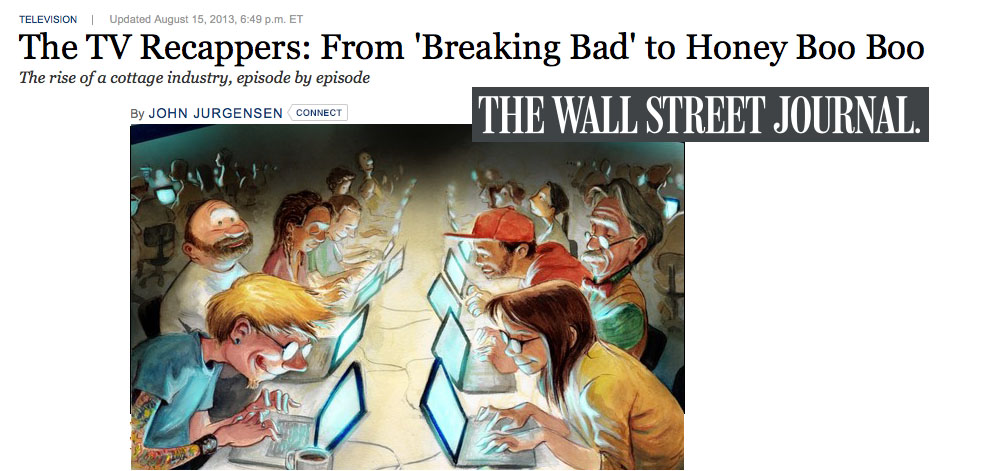
While I’d argue Tucker and Maciak’s pieces together represent a productive and ultimately constructive conversation (even if Tucker’s brushstrokes are too broad), today’s Wall Street Journal trend piece from John Jurgensen—entitled “The TV Recappers: From Breaking Bad to Honey Boo Boo”—is more problematic in its claim to be capturing the broader culture of writing about television. While rightfully tracking the lineage of episodic television criticism from its TWoP origins (although oddly addressing neither the fact those recaps are posted days after an episode airs nor the way the site has evolved in a contemporary moment), the article accepts “Recap” and “Recapper” as blanket terms to describe every single form of writing that emerged in what Jurgensen terms a “cottage industry.”
Continue reading →



 Cultural Learnings