
Monthly Archives: March 2015

Series Finale: Glee – “2009”/”Dreams Come True”

GleeTitle2

“2009”/”Dreams Come True”

March 20, 2015

When I used to write weekly reviews of Glee, it was during a period where I would often search through each episode looking for a quote to use as an anchor for my analysis. Glee was a show that wore its heart on its sleeve, and so it wasn’t a particularly difficult task with the show; in fact, the biggest challenge was choosing between the numerous moments where characters said exactly what the point of it all was.

It’s therefore not a huge surprise the same could be said for Glee’s two-hour finale. The last hour, in particular, was unabashed: whether it’s opening us up to joy, or Blaine telling Kurt that he’s “the only one I know who would do something like this,” or Rachel Berry standing on the stage of a 3/5 scale recreation of Radio City Music Hall telling all of the children to believe that dreams come true, Glee could never be attacked for a lack of synergy between the message it started with and the message that constituted its ending.

Glee could be attacked for many things, most recently a haphazard final season that understood its strengths and weaknesses and kept pretending they didn’t matter, but that central message has always been strong. Even as someone who wrote about the show critically, a task that will inevitably drive a person to madness, I always believed the core message of Glee was powerful, and I wasn’t surprised to see stories emerge this week that sought to celebrate those principles. I was emotional during this finale because no matter how many wrong turns the show took during its run, the place it kept landing in was a place of hope, and it was hard to root against that.

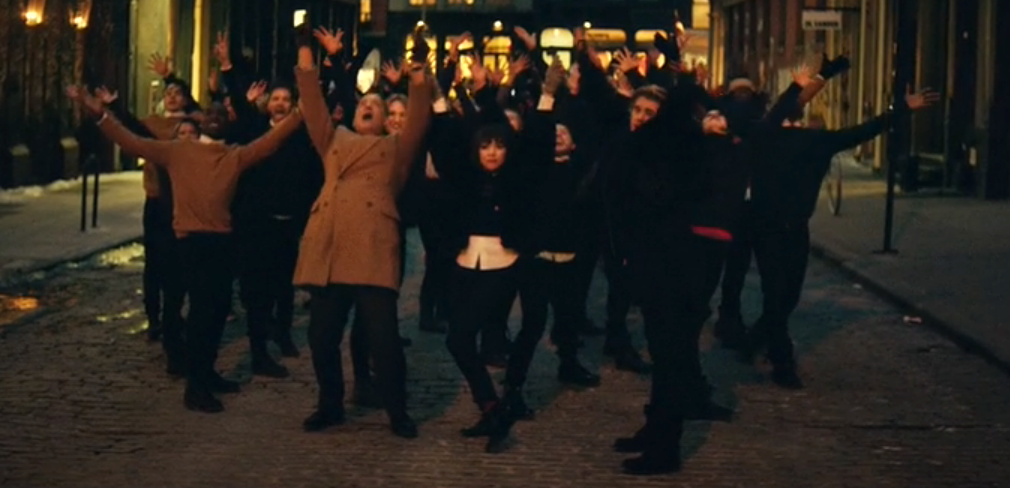
However, it was also hard to focus on it. During the final performance of OneRepublic’s “I Lived,” with a huge collection of past and present members of New Directions and ancillary characters, the show seeks to paper over a complicated history of characters it served poorly, characters who were ignored then forgotten, and plot twists that sought to fundamentally undo the good work the show was doing in other areas. It was a moment that understood the transcendent power of “hope” and human perseverance, but—like the final season as a whole—simultaneously reminded us how rarely Glee calibrated itself properly to be the beacon of hope it believed itself to be.
Continue reading

3 Comments

Filed under Glee

Reality Spoilers: Why The Jinx Can Be Spoiled (Even If It Should Be)

Screen Shot 2015-03-16 at 12.19.59 PM

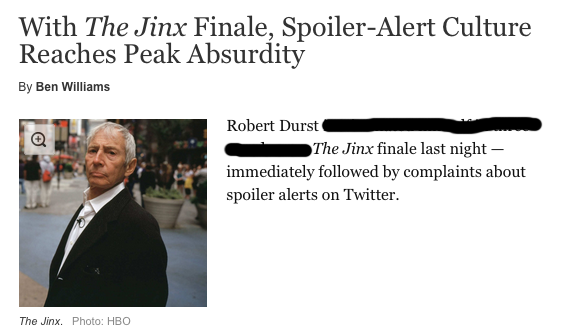
Last night, The Jinx ended its six-episode run on HBO. The documentary series came to a conclusion with a stunning sequence of events, building a tremendous amount of suspense: would the second interview with Robert Durst happen? What would happen in that interview? And what would happen after that interview, when Robert Durst will have been confronted by the second “Beverley” envelope?

If you were watching live, the answers to those questions were an escalating series of events, culminating in a final scene that had me yelling at my television. However, if you weren’t watching live, that yelling may have been directed at The New York Times, who pushed an alert to their app users and wrote a breaking news tweet quoting Durst’s words and promoting their reporting on their connection to Durst’s Saturday arrest in New Orleans. It could have also been directed at the various outlets—Vulture, Buzzfeed, etc.—who subsequently tweeted the news as news, all of whom fielded complaints about “spoilers” from Twitter users.

In a piece this morning at Vulture, Ben Williams suggests that this marks “spoiler-alert” culture reaching “peak absurdity”:

“The key difference here is that The Jinx isn’t fiction. It is a docu-drama about a real man who is very probably a murderer multiple times over and whose cases have been covered in the media for decades. When a famous murder suspect all but confesses, it is news, and the fact that the confession happened within the confines of a television show does not mean that that news becomes subject to the same etiquette as the latest Game of Thrones killing. Because that’s fiction, and it doesn’t really matter.”

Beyond the fact that I would contend Durst’s statements in the finale of The Jinx in no way constitute a “confession,” Williams’ point is well-taken: the fact that Andrew Jarecki’s documentary series is making a contribution to an ongoing news story independent from the series itself means that the New York Times reporting is less spoiling the series itself—which they clearly had advance access to, in order to support the reporting—than they are extending the series’ impact to a broader audience, most of whom did not watch The Jinx (which drew only 446k viewers in the first airing of last week’s episode).

And yet while Williams’ distinction between a real life criminal investigation and Game of Thrones is valid, and would clear The New York Times in a court of ethics, I also think that the New York Times—and the other publications in question—could have crafted an equally provocative headline that did not actively spoil the events of the series’ final scene. I believe that the news could have been framed in a way that still broke the news in question without revealing in concrete detail the climactic moment of the series.

Continue reading

Leave a comment

Filed under The Jinx

Go Away, Justin: Carly Rae Jepsen, “I Really Like You,” and the Business of Bieber

Screen Shot 2015-03-06 at 10.36.42 PM

In January, Scooter Braun—the head of Schoolboy Records and manager to Justin Bieber and Ariana Grande, among others—gave us our first indication of how Carly Rae Jepsen would be following up “Call Me Maybe.”

True, she followed it up with a really great pop album that got unfairly ignored, but this is different. This is the follow up to a song of the summer, an earworm on a scale we rarely see from a “debut” artist (the quotation marks referring to her previous success in Canada, typically erased in her media narrative following her breakout success). And as Braun’s comments to Billboard indicate, there was pressure on Jepsen to recapture the success that started it all:

“Her new single is coming in March. I told her that she couldn’t come out with anything unless it was on the level of “Call Me Maybe.” And, now we have a new one that is on that level.”

That’s a lot of pressure for a new single, and I would argue that “I Really Like You” delivered as best it could: it’s not “Call Me Maybe,” but nothing can recreate the sense of discovery that came with that song. The narrative of an unsung artist being elevated to the status of sudden stardom through the help of some famous friends was not just about Justin Bieber/Selena Gomez lipdubs—it was that the song was something people discovered, and then shared, and then acted out themselves and shared again. It became, for lack of a better term, a “cultural phenomenon” in a way we rarely see, and in a way that makes creating something on the same scale nearly impossible.

“I Really Like You” succeeds in being catchy, and got the type of attention it deserved: lots of headlines debating whether or not it lives up to “Call Me Maybe,” with none of them being able to definitively claim the single lacks the same DNA musically. The issue is that there’s no way to recreate a cultural phenomenon, which is a big part of why my personal interest in Jepsen’s followup has more to do with the album—packed to the gills with interesting producers and collaborators—than with the single, which based on Braun’s comments is engineered to tap into a vein that I would argue was a product of a specific time and a specific set of circumstances.

Continue reading

Leave a comment

Filed under Music