Category Archives: Mad Men

Season Premiere: Mad Men – “For Those Who Think Young”

“For Those Who Think Young”

July 27th, 2008

The breakout success of Mad Men has been a huge surprise – when I started watching the show last summer, it was a cable show from a network that didn’t do such shows. It had the pedigree of Matthew Weiner, and it had some positive kudos from the critics, but what person would have predicted sixteen Emmy nominations, two Golden Globes, and a cultural firestorm so powerful that it even compelled the Canadian networks with the rights to the series to air the second season premiere before the first season has even completed airing?

But the time for kudos, set visits, really fancy DVD sets and excessive hype is over: while last season’s finale seems like ages ago at this point, it’s time to see whether the emotional resonance of “The Wheel” can be rekindled as the show picks up fifteen months later and in a whole different critical context: once a show without expectation, it has become perhaps the most closely watched sophomore session of the year.

And the series is showing its age, to use the opening episode’s central theme: it is a show that allows its characters to feel all of their insecurities in a way that ages them. If we look back to each character’s trajectory, and the series’ central transportation back to another era, a lot of it is about time and the way it changes people: whether it’s Betty Draper looking back to her modeling days or Roger Sterling having an affair with Joan, the voluptuous secretary, it’s all inevitably about returning to a younger self, a younger identity.

As the show begins its second season, it strongly and intelligently hits on this note, framing a story of a Valentine’s Day where “Young” is in and where those feeling time slipping away from them are hoping to hang onto everything they can. With a large ensemble cast and a number of emotional cliffhangers to deal with, the jump forward in time brings new facial hair, new jobs, and new rumours; in the process, it’s a new season of one of television’s finest dramas.
Continue reading

4 Comments

Filed under Mad Men

Mad Men – “Babylon”

“Babylon”

Season One, Episode Six

In the world of Mad Men, normalcy is the goal: for Don Draper, it’s bringing his wife breakfast in bed on Mother’s Day. Of course, as he travels up the stairs, he losing his footing and everything smashes around him. Cue the flashback to his brother’s birth, and another sign that Donald Draper’s life is a giant lie just waiting to be smashed like the falling breakfast tray.

Yes, the opening of “Babylon” is not exactly subtle, but this is an episode that is all about the hidden becoming revealed, the secrets becoming part of common knowledge. The central attempt to commodify Israel into a tourism destination for Americans is about taking a secret and turning it into common knowledge, but there the ad men get to put their spin on it; the facts are one thing, but with the right treatment they can become something far more profound. This episode is about the people who need to spin their own lives, and the one person who’s about to start spinning for others.

And in the meantime, you’re stuck in exile; and as a series about people who find themselves searching to avoid such a position, Mad Men flourishes.

Continue reading

5 Comments

Filed under Mad Men

Mad Men – “5G”

“5G”

Season One, Episode Five

To say that “5G” is uneventful or unrevelatory isn’t really doing it justice, but the point could probably be made. Of the episode’s major story points, none of them are all that surprising: yes, they fill in some blanks in Don Draper’s past and present, but elsewhere the episode plays much into the same things we already know. Pete is unwilling to share the spitlight, Draper has a lot of secrets, and Peggy is still just a little in the dark when it comes to how to handle her new position.

What “5G” does, though, is make these elements more starkly real: it displays the pettiness of Pete and the desperation of Draper. Pete’s attempt at being famous is a bit of a simple little plot point until you consider the implications on her marital relationship, but Draper’s actions take his character to a new level. The relationship between his old life and his current one is what paralyzes him, and here we see that seeing those two worlds collide creates a volatile situation.

Continue reading

2 Comments

Filed under Mad Men

Mad Men – “New Amsterdam”

“New Amsterdam”

Season One, Episode Four

[I’m a week late on this one, but forgive me: I’ll have a piece on tonight’s episode done sometime tonight, probably]

By the time Mad Men got to its fourth episode, it had filled in a lot of its gaps: we are thoroughly compelled by Don Draper, interested in seeing more of this world from Betty’s perspective, intrigued at the inner workings of Sterling Cooper, and curious as to how all of these people intersect in the historical mediation the show presents.

All except Pete Campbell, that is. To be honest, Pete Campbell was pretty much a snake before this point: a spineless, ungrateful punk at his worst, and certainly not the kind of character that any of us relate with. His insistence on rising the corporate ladder could be passed off as mere capitalist determinism, a selfish attempt to take for himself and to leave others in his wake.

What “New Amsterdam” provides is a new perspective, a glimpse into the fact that Pete Campbell’s life is just as complicated as everyone else’s in terms of the series’ primary characters. Over time, the show reveals the truth behind other characters as well (Joan and Roger Sterling are next up), but the familial and spousal pressures facing this character are some of the most eye-opening. No, it isn’t exactly surprising that he has some serious family issues, but it does explain at least some of his past behaviour while leaving plenty of qualities on the table that we as viewers will take issue with.

Continue reading

3 Comments

Filed under Mad Men

Mad Men – “Marriage of Figaro”

“Marriage of Figaro”

Season One, Episode Three

One of the strengths of Mad Men is its ability to capture lightning in a bottle, taking moments or elements of the 1960s and building off of them. In the pilot, this felt clunky and forced, but as time has moved on things have changed: these small elements have become an important but not integral element of the story. The plot doesn’t rely on these little moments, but rather uses them to help explain and expand upon both story and characterization.

“Marriage of Figaro” is not yet in the shape of a normal episode of the series, still needing to clearly point out the show’s central divide: in a way that few episodes mimic, the action is split directly in half as we first follow Don’s life in the city before transitioning into his daughter’s birthday party in the suburbs. The only thing connecting these two parts, on the surface, is Don Draper, but little bits of information and intrigue follow (Whether it’s romantic entanglements or the impact of the Volkswagen ad that has everyone talking).

The result is that the episode is indeed a Don story, never quite fully diving into the series’ other various narratives. There are some pieces laid down here, though, that will become very important for the future; plus, when I say it’s a Don story, that’s not a bad thing in the least.

Continue reading

4 Comments

Filed under Mad Men

Mad Men – “Ladies Room”

“Ladies Room”

Season One, Episode Two

One of the complications of using a pilot as a piece of misdirection, in this instance not revealing Don Draper’s wife Betty until the very end of the episode, is that the need for exposition (a necessary evil in a series’ first episode) lingers on.

In that sense, this is Betty’s pilot, a chance to get a view into the life of a housewife in an era of uncertainty and confusion perpetuated by new-age psychiatry and the elusiveness of her own husband. Betty is a woman who just lost her mother and who feels as if she’s missing a side of her husband (or five) that he never shows to her, without knowing that a few of them remain hidden even to his co-workers and his mistress.

With her introduction, the narrative of Mad Men’s female characters comes fully into view, as Peggy’s struggles on the job reflect upon the challenges women faced during the era in a frank and honest perspective. When jumping into this series, you really need to get through the second episode before you can understand where Matthew Weiner is taking us, with a whole new side to the story and continued subtle hints at the stories to come.

Continue reading

2 Comments

Filed under Mad Men

Mad Men – “Smoke Gets In Your Eyes”

“Smoke Gets In Your Eyes”

Season One, Episode One

[As part of getting in the groove for the second season premiere in late July, figured that CTV’s decision to air Mad Men’s first season in Canada this summer is as good an excuse as any to revisit this fantastic summer series. (For those who don’t know, AMC (A U.S. Cable network) aired the series last summer). I’ll only get so far before the second season premieres on AMC, but we’ll cross that bridge when we come to it.]

When the Emmy nominations roll around in July, one thing is for certain: the Mad Men pilot will be responsible for many nominations, although not for the people we see on screen (who have more showcases later in the series run) but rather the people who created the look and feel of the series.

This is not to say that “Smoke Gets In Your Eyes” is a poor episode for any of the series’ actors, as I’d argue it’s a great showcase for almost all of them, but this is a pilot that’s all about setting: in time, in place, and to a certain extent within the psychological mind frame of these people. Although Freud gets a bum review from the people that matter in the episode, psychology largely serves as a way of orienting us to the way these people think and why they think that way.

What the episode does is create this setting, the smoke-filled and complicated sixties where tobacco is only recently a bad habit, where African Americans perform only the most menial of service-based tasks, and where women are never executives or able to act like them. We watch the characters weave in and out of these concepts: those who enter into them with a naive world view, those who have become inhabited by them for the sake of fitting into this world in which they seem uncomfortable, and those who are them.

On these levels, Matthew Weiner and Alan Taylor and their team have created a masterpiece.

Continue reading

4 Comments

Filed under Mad Men

CTV Picks up ‘Mad Men’ for Canadian Broadcast

I’ve been loathe to post news notes over the last six months or so because, ultimately, I just don’t have the time – stopping mid-day to post the latest television updates is satisfying but also time consuming. However, as a rather busy schedule has the final two portions of the 10 Shows to (Hopefully) Watch in 2008 being pushed into Sunday/Monday, I figure I should share some news for my Canadian brethren about one of the shows that already made the cut.

CTV announced on Thursday that they have acquired the broadcast rights to Mad Men’s first season as well as its unaired sophomore session. This is a great boon for the series North of the Border, as it is sure to be a strong performer should the strike continue. CTV is in a far superior position to Global post-strike, as the loss of 24 will severely damage the latter while the former has Lost and American Idol returning. This is just one more drop in their bucket, especially in terms of quality.

My only concern is that they’ll treat the series as they treated Veronica Mars – after airing part of the show’s second season (Or was it the first?), they basically gave up on the show even as it continued on the CW. CTV’s schedule is usually so full that there isn’t room for smaller series, but Mad Men’s strike timing and its potential summer return could spell success.

If you’ve yet to see the series, and want to learn more, you can check our Cultural Learnings’ coverage of the series. It’s really not as definitive as that statement made it sound, but there is a lengthy essay on its portrayal of women there that could provide some incentive for academics amongst us.

Leave a comment

Filed under Mad Men

10 Shows to (Hopefully) Watch in 2008: #7-5

If 2007 saw the downfall of Heroes and The Office, it also saw the emergence of these three series as critical favourites. In different season, critics were adamant that these series would be the future of television. Now, with the fate of each up in the air considering the Writers’ Strike, let’s take a look at what to expect from some more fresh faces.

Of 2007’s drama series, only one has made this list. Ultimately, while there are a few series I enjoyed during the fall season, none have been able to supplant other series except for Pushing Daisies. Bryan Fuller’s series has managed to earn him his first full-season order, and it is perhaps one of the only series which might actually benefit from the writer’s strike. While I have remained fairly consistently entertained over the first nine episodes, I will have to admit that the long-term longevity of the series has yet to be decided.

This is on both creative and commercial sides of the coin. In terms of ratings, the series hit some road bumps during the latter portion of the fall, and the result is that the naysayers are rampant. But really, did anyone expect the series to maintain its 12+ Million viewers from the premiere? This was always going to be a divisive show, and the fact that it maintained as much of that audience as it did (Especially compared to other series like NBC’s Bionic Woman) is a success story.

However, the creative question is far more intriguing. While I’ve enjoyed the series’ laidback procedural flow, as it has allowed Chi McBride and Kristen Chenoweth to turn in some dynamite supporting turns sadly unnoticed by recent award shows, others raise concerns regarding the longevity of this atmosphere. It does have the danger of relying on quirkiness for too long, but I have faith that the emotional investment the viewer has placed in these characters is strong enough to sustain whatever format Fuller moves forward with. Plus, I am looking forward to seeing if Fuller is able to pull together a musical episode in the new year – fingers crossed.

Pushing Daisies has received a full season order, but only finished 9 (Already Aired) episodes out of 22. The show will return to production once the writers’ strike resumes. 

YouTube – “Hopelessly Devoted…” from Olive Snook

Matthew Weiner’s drama series debuted on AMC in the summer of 2007 with extremely little buzz. It was only the prodding of various critics that convinced me to give the series a shot, and what I discovered was something quite interesting. I’m on the short list of those who will in the future be forced to catch up on the entirety of The Sopranos, but Matthew Weiner proved his worth for me with Mad Men, perhaps the sharpest new drama of 2007.

Continue reading

1 Comment

Filed under Friday Night Lights, Mad Men, Pushing Daisies

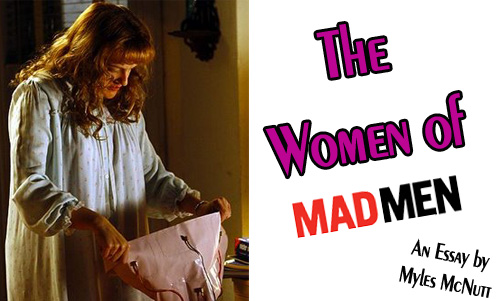
The Women of ‘Mad Men’: An Essay

[So, admittedly, I had wanted to write about Dexter today, but I am simply not going to have time. In short, finale is good, but I have some serious issues with the season as a whole that keep my from joining the hype train. However, I can offer you the following: it’s my Lit. Theory essay about ‘Mad Men’, one of my favourite series of the year, and recently nominated for two Golden Globes. I wanted to throw in a couple of YouTube videos here and there to spice it up but there’s no time; so, it’s just 2800 words of me intellectually rambling! Enjoy!]

From a twenty-first century perspective, the 1960s present a strange and foreign environment in which social interaction was defined by an entirely different set of rules. Man Men, a television drama from Matthew Weiner, takes place in the world of advertising during an era where smoking is natural and where segregation defines African-Americans as ‘the help’. While these social issues are used to locate the show within this specific time, largely remaining unchallenged within the show’s narrative, the presentation of women within Mad Men is a more deconstructive element. The series presents two women, in particular, who find themselves intertwined with this fast-moving world dominated by male figures: Peggy, a young secretary turned copy writer who struggles with her weight, and Betty, the wife of the Head of Creative who is defined by her domestic role. The series may be focused on an industry and a time period where the role of women was marginalized, but it represents an opportunity for the show’s writers to emphasize how this marginalization impacts these two women in particular.

Specifically, the daily activities of the Sterling Cooper agency are particularly worrisome: the discourse of advertising speaks to all audiences but is written and created almost exclusively by male writers. This environment provides a fertile ground for an investigation of the role language plays in reaffirming or challenging the patriarchal order. Peggy’s attempts to break into this industry may provide the most extensive representation of feminist literary theory within the series, but Mad Men also emphasizes the level to which phallocentric discourses bleed into the life of a young wife struggling to come to terms with her own identity. Mad Men is not a feminist television series, as its dedication to realism keeps either of these characters from emerging in defiance of all their unfair treatment. However, that attention to realism allows the series to demonstrate the level to which patriarchal discourse was dominant in life and language during this period, historicizing this period of feminine experience.

Continue reading

30 Comments

Filed under Mad Men