
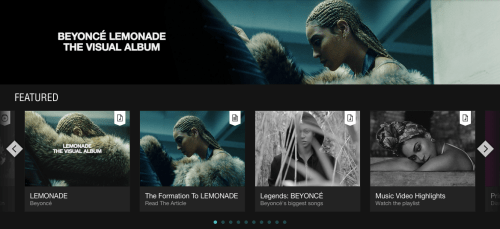
As has long been expected after Beyoncé released “Formation” and announced a tour in support of a single song, the full album Lemonade debuted exclusively on TIDAL last night, alongside a visual album debut on HBO (which will also be exclusive to TIDAL after a 24-hour streaming window on HBO’s own services).
Like Kanye West’s The Life of Pablo and (to a lesser extent) Rihanna’s ANTI before it, Lemonade’s TIDAL exclusivity fed into the internet’s running joke about the streaming music service, which has struggled to gain a foothold in a marketplace where Spotify was “first” and Apple Music benefits from pre-existing cultural saturation. TIDAL first attempted to differentiate itself based on its streaming quality, but has since focused on its exclusive content, helped by both the immediate social circle of founder Jay-Z and an artist-friendly policy that helps the service attract exclusives like Prince (whose absence from more established streaming services was a significant discourse following his death).
But TIDAL has struggled for a variety of reasons: those who already subscribe to other services (and who have built playlists, gotten used to interfaces, etc.) don’t see the logic of subscribing to more than one, given the relatively small number of exclusives (whereas TV has reached a point where this idea is more palatable); those who don’t subscribe to any services because they listen to music for free on YouTube are growing ever more resentful of paying more music in general; those who actually prefer to buy music resent the fact that exclusive albums like The Life Of Pablo and Lemonade are not (at least initially) available through outlets like iTunes or formats like Vinyl where they prefer to make those purchases. And while The Life Of Pablo did convince some people to subscribe, the album’s eventual release on Apple Music and Spotify (which you can use for free, with ads, unlike TIDAL) actually spurred talk of a class action lawsuit from those angry they’d been tricked into subscribing to the service.
That lawsuit foregrounds how the discursive construction of a TIDAL exclusive has yet to be wholly defined: it’s true that West and TIDAL were never clear whether the deal was long term (not that West is ever clear about anything), but I’m more interested in the way the reasons behind the choice can be articulated. Cynically, exclusive content exists to boost subscriptions, and to help the company’s bottom line when a significant number of the people who sign up for free trials forget to cancel their subscriptions or, in TIDAL’s ideal scenario, enjoy the service and continue to subscribe by choice. But West also used the time The Life of Pablo was streaming on TIDAL to continually tweak the album, the streaming window becoming an extension of the lengthy public tinkering with the album West performed on social media. TIDAL exclusives might be there to drive subscriptions, but they can also serve the artist-friendly brand, giving artists—or, at least artists who are Kanye West and intimately connected with the site’s founder—and their fans hope that it can become a platform for experimental modes of distribution.
The same does not apply to Lemonade: this, like ANTI, is a complete and finished album, and is similar to the surprise release of Beyoncé in 2013 that still launched exclusively, but to the industry standard iTunes Store. The logic there was the presence of the visual album, which required digital distribution, and which at that point precluded the use of streaming services: with both TIDAL and Apple using video—and soon television—as significant parts of their streaming platforms (with Apple the home to exclusive music video debuts like “Hotline Bling,” along with Taylor Swift’s 1989 concert film), Lemonade is an experience fit for the current streaming era, but not one that would have been impossible as a more traditional album release on iTunes. Therefore, it’s easy to read its placement on TIDAL as the most significant effort yet at driving subscriptions through exclusive content (with no clear window on if or when the album will be moving outside of TIDAL*).
* Well, there wasn’t a clear window. Hours later, The New York Times reports that Lemonade will arrive on iTunes at midnight tonight (Monday), per inside sources. Less clear, however, is whether or not the visual album will also be available for purchase as part of the bundle, or whether that content could remain on TIDAL exclusively, which seems like an option. The album, meanwhile, is also now available to purchase on TIDAL, as eventually happened with The Life of Pablo.
But in addition to thinking about the cynical business-oriented decision-making behind Lemonade’s exclusivity, there’s also a narrative of what is being sacrificed by making this choice. This likely includes, at least for the moment, any type of Billboard chart placement: TIDAL did not report its streaming numbers for The Life Of Pablo to Nielsen, meaning that despite obviously being the biggest album release of the year thus far, Beyoncé may not have the number one album in the country unless TIDAL (conveniently, which makes it possible) chooses to report those numbers this week. There are cynical business reasons for this (like hiding how few people are really streaming music on TIDAL, even with exclusives), but it also helps support the idea that TIDAL is doing things differently, and “challenging the status quo”: West eventually celebrated hitting No. 1 with The Life Of Pablo, so they’re not devaluing Billboard entirely, but he did so noting it was the first album to go Number One off of streaming.
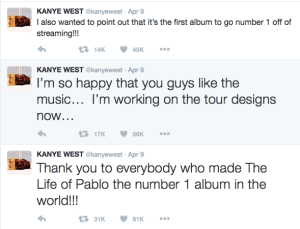 That’s admittedly a bit misleading, given it was available for sale on TIDAL and West’s website and much—and potentially all, as I can’t get a handle on whether or not TIDAL included streaming numbers when the album went wider—of this likely came from Spotify and Apple Music, but it had the highest share of streaming of any No. 1, and Billboard reports noted the impressive feat of reaching “the pinnacle” even after being “available” on TIDAL for six weeks beforehand. It was West and TIDAL saying “We can offer the album on TIDAL, tinker with it for six weeks, and we’ll still go No. 1 when we release the album wider.” Regardless, it creates the potential for releasing an album on TIDAL as appearing “outside” of the traditional industry standard, albeit on a service that very much desperately wants to become an industry standard, and which is run by an artist who is just as much a business at the end of the day.
TIDAL will never be an outright counter-cultural service, but it’s a potential node of articulation as it works to convince the public that its exclusive content is eventually going to coalesce into a competitive advantage in the streaming marketplace. TIDAL is built for a world in which everyone subscribes to one music service or another, but we are not yet in this world, and whether or not the current marketplace can reasonably sustain three major services is still an open question. And while Lemonade cannot alone resolve that question, it certainly brings the conversation around “TIDAL Exclusives” further into the mainstream, and will generate a new wave of free trials they hope we forget about.

 You’ve seen the headlines, I’m sure:


 Cultural Learnings