Why The Homeland Twist Works [For Me] [Mostly] [Okay, Barely]

HomelandTitle

“Game On”

October 20th, 2013

Last year, The New Yorker’s Emily Nussbaum had a theory about Homeland. She argued that Sgt. Nicholas Brody’s panicked communications with Abu Nazir as Carrie Mathison was held hostage were all an act, and that he was in on the plan from the beginning.

It was an interesting theory, one she gave me credit for partially debunking by noting that Abu Nazir and Brody continue speaking in the same manner once Carrie is no longer listening to their conversation. For me, that was the sign that the theory couldn’t work: while an interesting idea, I did not believe Homeland was a series that would so actively mislead the viewer with information that—in hindsight—would contradict the intended truth of the situation.

If you saw last night’s episode of Homeland, and have been following some of the subsequent conversation, the above may sound familiar. Indeed, this season’s central storyline almost feels inspired by Nussbaum’s theory, as though the writers took it as a challenge as to whether the series could sustain a twist that in retrospect contradicts many of the storylines and character actions displayed in earlier episodes and maintain its reputation.

The response to “Game On” suggests that they can’t, but that doesn’t necessarily mean I’m no longer on board.

Continue reading

2 Comments

Filed under Homeland

Homeland – “Tower of David”

HomelandTitle

“Tower of David”

October 13th, 2013

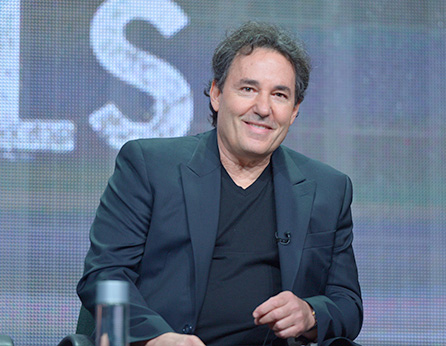
It’s been a few months since I watched the first two episodes of Homeland‘s third season. They were made available to press ahead of the show’s panel at the Television Critics Association press tour, which was logical—in that it allowed those in attendance to ask informed questions rather than random guesswork—but also daring. It was daring because in the two episodes screened for critics, Nicholas Brody did not appear for even a brief sequence, and yet Damian Lewis was seated on the panel at the Beverly Hilton.

I tweeted in advance of that panel that I was interested to see how the room responded to this (among other facts about Homeland‘s third season, specifically the increased focus on Morgan Saylor’s Dana), but Showtime was quick to offer clarification: a trailer revealed early footage of Brody’s first appearance in “Tower of David,” and the panel confirmed he would return in the very next episode beyond the ones we had seen. Part of me had expected them to treat Brody’s return as a surprise, leaving his fate open-ended, but from the beginning Brody was something the series was very open about, creating a certain suspense to see how the show planned on reintegrating the character into the narrative.

“Tower of David” works as a structural exercise in character development, drawing a parallel between Brody and Carrie’s respective prisons. However, it fails to acknowledge and mitigate the issues that plagued the two characters’ development last season, leaving an episode that works up until the point you look into the past rather than the present/future.

Continue reading

1 Comment

Filed under Homeland

Interview: Hell On Wheels Showrunner John Wirth

JohnWirthWhen veteran writer/producer John Wirth took over as showrunner on AMC’s Hell on Wheels, it was a somewhat strangely public process. John Shiban, the showrunner for the show’s first two seasons, backed out unexpectedly after the series was renewed, leading AMC to make the series’ pickup contingent on finding a new showrunner. With series creators Joe and Tony Gayton departing as well, Wirth stepped into a series with established characters, existing storylines, and more or less complete creative freedom to take the show in whatever direction he desired.

That direction has made the show a strange sort of success story for AMC, shuffled off to the prestige-less refuge of Saturday nights where it’s been quietly outperforming expectations (see Kate Aurthur’s report at Buzzfeed for more). It concludes its third season tonight at 9/8c on AMC with the expectation that it has earned a fourth season, and having successfully transitioned from a slightly underperforming prestige AMC drama to a successful translation of their film western audience into original programming on a normally dead night.

At July’s TCA Press Tour before the season premiered, I had a chance to talk to Wirth about his perspective on showrunning, how he came to be involved with Hell on Wheels, his planned use of social media (which I’ll be reflecting on soon elsewhere), and how—despite the strange circumstances—Hell On Wheels marks a meaningful period in his career as a showrunner-for-hire.

This is far from your first time serving as showrunner on a series; in fact, the Internet suggests you were part of a “Showrunner Training Program” at some point? How do you train someone to be a showrunner?

JW: I put together a committee of writer-producer-showrunner types. We did a small book called A Television Writers’ Handbook. And it was the first time in the history of the Writers’ Guild that anybody had codified what it is to work on a TV show and what the various positions are and what’s expected of you when you’re in those positions. And we had a big chapter on showrunners, and how to behave as a showrunner, and so forth.

Out of that, Jeff Melvoin—who I had asked to be a part of that committee—had the idea: is this something we could teach? And I didn’t believe that it was, and he believed that it was. He said “I’m going to try to put together this program, will you work on it with me? “And I said sure, but I don’t want to be in charge—this little book we did took five years, and I thought it would take a couple months.

We put together the Showrunner Training Program, which has been enormously successful. I still don’t believe you can teach someone to be a showrunner, but you can expose them to the things they’re going to experience when they are showrunners. That’s really the goal of that program, to let people know what it is they’re going to be experiencing when they get that job.

What’s that job like?

The job itself is ridiculous. You’re the hardest working man or woman in show business – the hours are incredible, you have to be a writer/producer and manager, you have to manage up down and sideways, you have to be a priest, you have to be a magician, you have to be a wife – it’s nutty.

So why you do you think AMC came to you to fill that job on Hell on Wheels?

JW: I think they got to the Ws in their rolodex and were like “Damnit!” Who’s after this guy? We’d better like him. Continue reading

2 Comments

Filed under Interviews

Series Finale: Breaking Bad – “Felina”

BreakingBadTitle“Felina”

September 29th, 2013

A series finale is different from any other episode of a television show; the biggest test for a series finale is whether or not it feels different from any other episode of that television show.

Breaking Bad has been an often messy show, driven by complex moral agency and characters who seem simultaneously the architect and the victim of chaos. It was a series that continued to grow in scale but largely followed the same principles of tight characterization and almost claustrophobic connections with those characters. In the show’s third season, it delineated between “half measures” and “full measures,” and the series was ultimately a narrative driven by the former: while some were explosive and others were tragic, there was never a moment when one could say that Breaking Bad had solved or even dramatically mitigated its central conflict.

It was this quality that gave the series its momentum, and enabled it to grow an audience of devotees from a series that many people—myself included—had not given much of a chance in its early seasons. It was also this quality that by the very nature of a series finale was forced to change in “Felina,” a clean end to a messy show that very purposefully limits its capacity to embody the series it brings to a conclusion.

Continue reading

27 Comments

Filed under Breaking Bad

It Came In Like a [Carefully Calculated] “Wrecking Ball”

Earlier this year, Billboard announced that it would be including YouTube streaming in its calculations for its Hot 100 chart. The same week, “Harlem Shake” became the number one song in America based on thirty seconds of it being used in thousands of viral videos.

Billboard chose to implement its new rules that week because it saw an opportunity to draw headlines, furthering their relevance while damaging their legitimacy (see the elder McNutt on that particular subject). They could have implemented them a week earlier, or a week later, but I’d bet money on them waiting for a moment to debut the metric when they could claim a song debuted at #1 because of their new streaming numbers that put Billboard on the pulse of how people are listening to music (Billboard’s Silvio Pietroluongo suggests it just happened to be that week, but I call shenanigans).

The impact of streaming has been less dramatic in the weeks since Harlem Shake’s five-week run atop the Billboard charts: One Direction’s “Best Song Ever” broke a Vevo record for most views in its first 24 hours and debuted at No. 2, but the single failed to gain traction and plummeted out of the Top 10 the following week (to No. 15). “Breaking the Vevo record” has become a new way for fans to support an artist, as Miley Cyrus set a record with “We Can’t Stop” (unseating Justin Bieber, who had unseated One Direction, who had unseated Justin Bieber), which was broken by One Direction, then tested—with some controversy—by Lady Gaga, before being claimed again by Cyrus with “Wrecking Ball.”

Continue reading

1 Comment

Filed under Music

Reaching for ‘The Leftovers’: HBO’s Return to Studio Productions

HBOWBEarlier today, HBO announced it was picking up Damon Lindelof’s The Leftovers; this wasn’t a surprising pickup given the talent involved, but what was a bit more surprising was that the series is not being produced in-house at HBO.

Although HBO has been developing drama projects through other studios for a while now—always through big-name producers like Lindelof, or Shawn Ryan, or Ryan Murphy, or J.J. Abrams who are under overall deals with studios like Warner Bros., Sony Pictures Television, or 20th Century Fox—it was still a surprise to see a press release show up in my inbox from Warner Bros. Television about an HBO show. The Leftovers is the first such show to be ordered to series, and thus the first in what is likely to be a string of new HBO shows that they don’t fully own (although as was noted on Twitter, Time Warner owns HBO, so this remains in the corporate family).

It’s not uncharted territory for HBO (who co-produced Sex & the City with Warner Bros., and who entered a similar deal with ABC for Stephen Merchant’s Hello Ladies due to their overall deal with co-writers Stupnitsky/Eisenberg), but it’s a reversal of their more recent policy of owning shows they air and also the opposite of what’s happening in basic cable. At the same time AMC is shying away from working with studios like Lionsgate or Sony Pictures Television in the wake of disputes with those producers on Mad Men and Breaking Bad, HBO is reopening its doors to other studios, an interesting shift that privileges an emerging trend in development while—potentially—de-emphasizing a focus on distribution central to the HBO model.

Continue reading

Leave a comment

Filed under HBO

Demographics of Anarchy: Netflix, Afterword, and Gender

Screen Shot 2013-09-11 at 5.52.52 PMThe return of Breaking Bad this summer drew headlines for its meteoric rise in the Nielsen ratings, transforming from a cult success to a breakout hit for AMC seemingly overnight. Many credited Netflix for this development, rightfully so, but I was struck that pieces like Andrew Wallenstein’s at Variety made no mention of Sons of Anarchy, which is arguably the first drama series to benefit significantly from Netflix in its continued—and trend-breaking for drama series—rise from season-to-season.

The reasons it hasn’t been mentioned range from the statistical (its increases have been more gradual) to the contextual (it isn’t in its final season) to the typical: for better or worse, depending on who you ask, Sons of Anarchy has slipped under the radar when it comes to the prestige drama trend. With Justified and The Americans more beloved by critics in FX’s lineup, and shows like Breaking Bad or Mad Men seen as better representatives of the dark, masculine dramatic series trend, Sons of Anarchy has largely been left to grow its audience outside of conversations like Wallenstein’s that privilege those series deemed most important.

Sutter and his bosses at FX have been expecting these audience increases: Sutter continues to hold a “contest” to hold a special fan screening of an episode late in the season if ratings go up over the previous year, which is more a way of rewarding fans for sticking with and promoting the show than an actual contingency (I expect he’d find a way to hold the event regardless of whether or not ratings had gone up, as it wouldn’t be the first time he’s privileged his relationship with fans over an arbitrary number). Still, one increase that perhaps works against the ongoing trend—gradual 10-15% increases per season—is the fact that ratings for the season six premiere among women 18-49 and women 18-34 were up 35% and 43% respectively.

Variety’s AJ Marechal posed the possibility on Twitter that this could be chalked up to the casting of Sons star Charlie Hunnam in female-friendly franchise 50 Shades of Gray, but I’d argue that’s a web of causality we can’t possibly break down. That being said, the increase in female viewership does tie into discussions of the series’ streaming success, as well as its expansion in non-linear platforms with the online Anarchy Afterword series that debuted following the record-setting premiere.

Continue reading

4 Comments

Filed under Sons of Anarchy

The Race to Address Race in Orange is the New Black

SuzanneOITNB

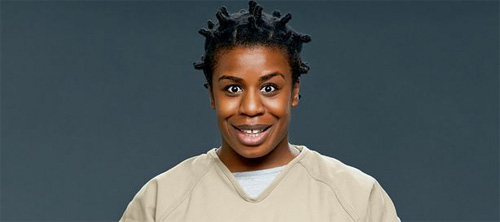
Today I wrapped six weeks of writing about Orange Is The New Black, two episodes at a time, at The A.V. Club. It means I’ve written a lot of words about the show, and lived in its development more than most people, and it’s created some frustration as I’ve read a series of trend pieces that function as an interrogation of its progressive statements regarding diversity in television.

To be clear, this is rarely frustration with the overarching arguments being deployed. The core of pieces at The Nation, the Daily Beast, and Roxane Gay’s piece at Salon—the best of the three—in recent days have been seeking to complicate readings of the series’ diversity as a dramatic step forward. In many reviews, the diversity of the series’ cast has been considered praise-worthy, and Gay nicely captures the sentiment that has similarly driven other authors to resist this critical consensus:

“I’m tired of settling for better instead of truly great. I’m tired of feeling like I should be grateful when popular culture deigns to acknowledge the experiences of people who are not white, middle class or wealthy, and heterosexual.”

It’s an important argument, but it’s one that I’m seeing deployed with Orange Is The New Black not because the series is wholly representative of this problem but rather because it is a text with a degree of cultural relevance in our current pop culture moment that undoubtedly connects with this problem. The Daily Beast’s Allison Samuels didn’t even watch Orange Is The New Black before lumping it in with other pop culture examples. The Nation’s Aura Bogado only watched six episodes before quitting on the show’s first season. My reaction to these articles is not a rejection of the basic principles on which the authors stand, but rather a rejection of their relevance to this particular series as it evolved over the course of its first season.

Continue reading

7 Comments

Filed under Orange is the New Black

“About the Web? On The Web.” – Lena Waithe’s Twenties

I heard about Twenties from numerous people online who shared it with the story of Lena Waithe’s struggle to get the show made: the networks all express their love for the project, but suggest there isn’t an audience for these stories (or that they already exist), which is paraphrasing to hide the fact they’re freaking out over the show’s intersection of race and sexuality.

It’s a sad story, and it’s a solid pilot presentation, but I’ve been somewhat more interested in Waithe’s insistence on distancing the series from the designation of “web series.” It’s in the description of each of the pilot presentation’s four parts (“This is NOT a web series”), she’s corrected people who refer to it as a web series on Twitter, and in an interview with Indiewire’s Shadow and Act she’s even more adamant:

“And just so we’re clear: this is not a web series! I repeat this is not a web series. Not that there’s anything wrong with doing a web series. I’ve done one. My goal is to partner with a network that understands what I’m going for.”

It’s a clear effort to avoid further ghettoizing the series, as Waithe is unwilling to abandon her belief that stories about black women (and specifically black queer women) deserve a space on cable. It’s an admirable position that more people need to take—and more executives need to recognize—in order to impart real change in how African American audiences are served in our contemporary moment. It’s also a position that’s going to be very difficult for Waithe to insist upon given the way her distribution of the series’ four-part pilot presentation and the basic premise of that presentation fit comfortably into web series logics.

Continue reading

3 Comments

Filed under Web Series

Recap by Default: Why Terminology Matters To How We Write About Writing About TV

WSJImage

In the wake of Brett Martin’s Difficult Men, which itself comes in the wake of Alan Sepinwall’s The Revolution Was Televised, there has been new scrutiny placed on the culture of television criticism. In Ken Tucker and Phillip Maciak’s reviews of Difficult Men—Maciak also covers Sepinwall’s book—they each delve into the culture of “TV recaps” as a rejoinder between the shows being canonized by the authors and the culture with which those shows are being analyzed. It’s an acknowledgement that how we write about television matters, which extends Jaime Weinman’s argument that we are in a “golden age of taking TV seriously.”

In Tucker and Maciak’s reviews we see an interesting crosstalk, where Maciak ably dissects Tucker’s broad dismissal of what Martin refers to as “the strange and telling practice of ‘recapping.'” Tucker picks up Martin’s dismissal and runs with it, expounding on “the challenge of creating diverse aesthetic principles that rise above the Internet’s limited range of extracritical responses, which typically run the gamut from this-is-awesome! blog posts to fitfully edited twelve-thousand-word essays about this or that show’s elaborate ‘mythology.'” While citing a number of—great—critics who are indeed capable of “rising above” the apparent limitations of the form, Tucker largely paints recap culture as the venue for “the adoring gaze of online fanboys and fangirls.”

Maciak picks away at Tucker’s case, not so much disagreeing with his call for more serious television criticism as he is claiming that “the culture of online television commentary has expanded, rather than degraded, our critical culture.” With more space than Tucker to explore the nuances of the current landscape of television criticism, Maciak finds a larger sample of diverse writing about television that ranges in terms of genre, focus, and audience. Rightfully picking away at Tucker’s emphasis on asking “proper artistic questions,” Maciak makes a strong case for how the culture of instant responses to television has proliferated not as a dichotomy of fanboys and obsessives but rather as a spectrum of incredible breadth and depth (even if sometimes in a shorter form than the critics Tucker cites from other media).

It’s a rich conversation, one that reflects some of my own thoughts on the rise of episodic television criticism from a number of years ago. However, it’s also a conversation that bears the mark of our culture’s mass acceptance of “recap” as an acceptable term for this diverse range of ways of writing about television. If Tucker were speaking about the actual practice of night-of “recapping” which manifests as a basic plot rundown with minimal commentary, I agree with his argument; when he extends to the suggestion that most episodic criticism fits under this umbrella term, his argument is reductive. Maciak, meanwhile, goes so far as to acknowledge Matt Zoller Seitz’s use of “overnight review,” but ultimately accepts “recap” as an acceptable term for describing all types of episodic criticism while arguing for the critical capacity of that form.

I have long stood as the standard bearer of drawing a distinction between recaps and reviews, to the point where it’s kind of a joke. I made the distinction initially because I was seeing the work of critics I admired being forcibly labeled as recaps based on the belief from websites that the term was better optimized for search engines. However, over time my concern has grown to pieces like Tucker’s and Maciak’s which beyond the goal of SEO optimization accept the term’s ubiquity (if critically, in Maciak’s case), which was my real concern when considering the web practices of sites like AOL—now Huffington Post—or HitFix. I was the crazy person signaling an alarm bell over something that—while certainly still a first world problem if ever there was one—has had a negative impact on a larger public understanding of television criticism.

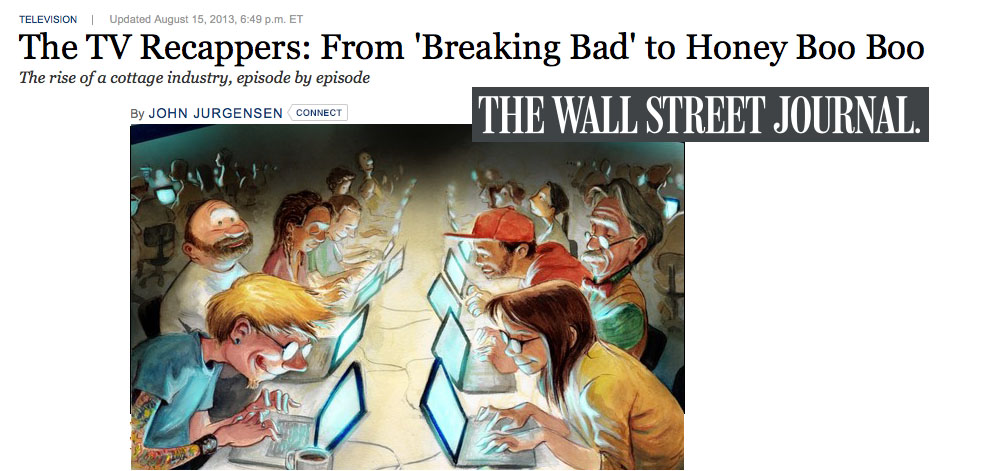
While I’d argue Tucker and Maciak’s pieces together represent a productive and ultimately constructive conversation (even if Tucker’s brushstrokes are too broad), today’s Wall Street Journal trend piece from John Jurgensen—entitled “The TV Recappers: From Breaking Bad to Honey Boo Boo”—is more problematic in its claim to be capturing the broader culture of writing about television. While rightfully tracking the lineage of episodic television criticism from its TWoP origins (although oddly addressing neither the fact those recaps are posted days after an episode airs nor the way the site has evolved in a contemporary moment), the article accepts “Recap” and “Recapper” as blanket terms to describe every single form of writing that emerged in what Jurgensen terms a “cottage industry.”

Continue reading

5 Comments

Filed under Television Criticism