Tag Archives: Analysis

A Box of Influence: Game of Thrones, Social Media, and the Uncertain Quest for Cultural Capital

GameOfThronesTitle2

A Box of Influence: Game of Thrones and Cultural Capital

March 22nd, 2013

Two years ago, HBO shipped a collection of critics, celebrities, and cultural observers a box designed to introduce them to the world of Westeros. The box, which I wrote about in detail here, served as a sensory journey into what was at that point a new televisual universe, one HBO hoped would become a centerpiece of their brand identity. By sending the box out to “opinion leaders,” the hope was that they would share their experiences with the intricately crafted artifact with their readers or followers, setting the tone for a series sold in part on its lavish production design and attention to detail.
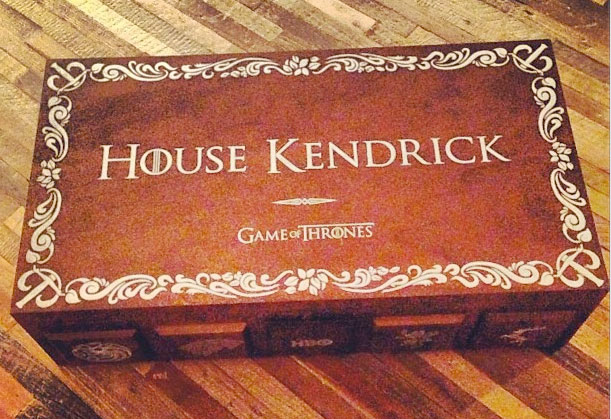
KendrickBoxThis month, HBO shipped a collection of celebrities a box designed to initiate them into the world of Westeros. However, the Westeros of 2013 is different than the Westeros of 2011. If the “Scent Box” of 2011 was designed as an artifact of the fictional Westeros, the various personalized “Influencer” boxes being sent to people like Mindy Kaling, Anna Kendrick, Bruno Mars, Jaime King, Patton Oswalt, Stephen Colbert, and Conan O’Brien are artifacts of the pop cultural Westeros. If the 2011 campaign was designed to establish the authenticity of Game of Thrones’ fictional world, the 2013 campaign seeks to reaffirm Game of Thrones’ status as a cultural phenomenon as its third season premiere beckons.

While the first campaign was largely heralded as a sign of HBO’s commitment to the series’ mythology and helped associate the show with quality discourses valuable to a premium cable channel, the latter campaign has been met with some criticism (although not by the celebrities themselves, most of whom have not been shy about performing their fannish [and NSFW] response to the delivery). To paraphrase sections of my Twitter feed in the past few weeks, HBO is effectively spending thousands of dollars to send rich celebrities personalized gifts to promote a show that is already wildly successful and likely to run for many seasons, all while smaller shows like Enlightened are canceled due to a lack of viewers (and, tied to this concern, a lack of promotional support). In addition, picking up on a discourse that was not uncommon during the initial campaign, some fans simply wonder why “celebrity” fandom is more valued than their own: one fan at WinterIsComing.net wrote “This is really unfair. Why do celebs get this sent to them? We’re the fans. The real fans.”
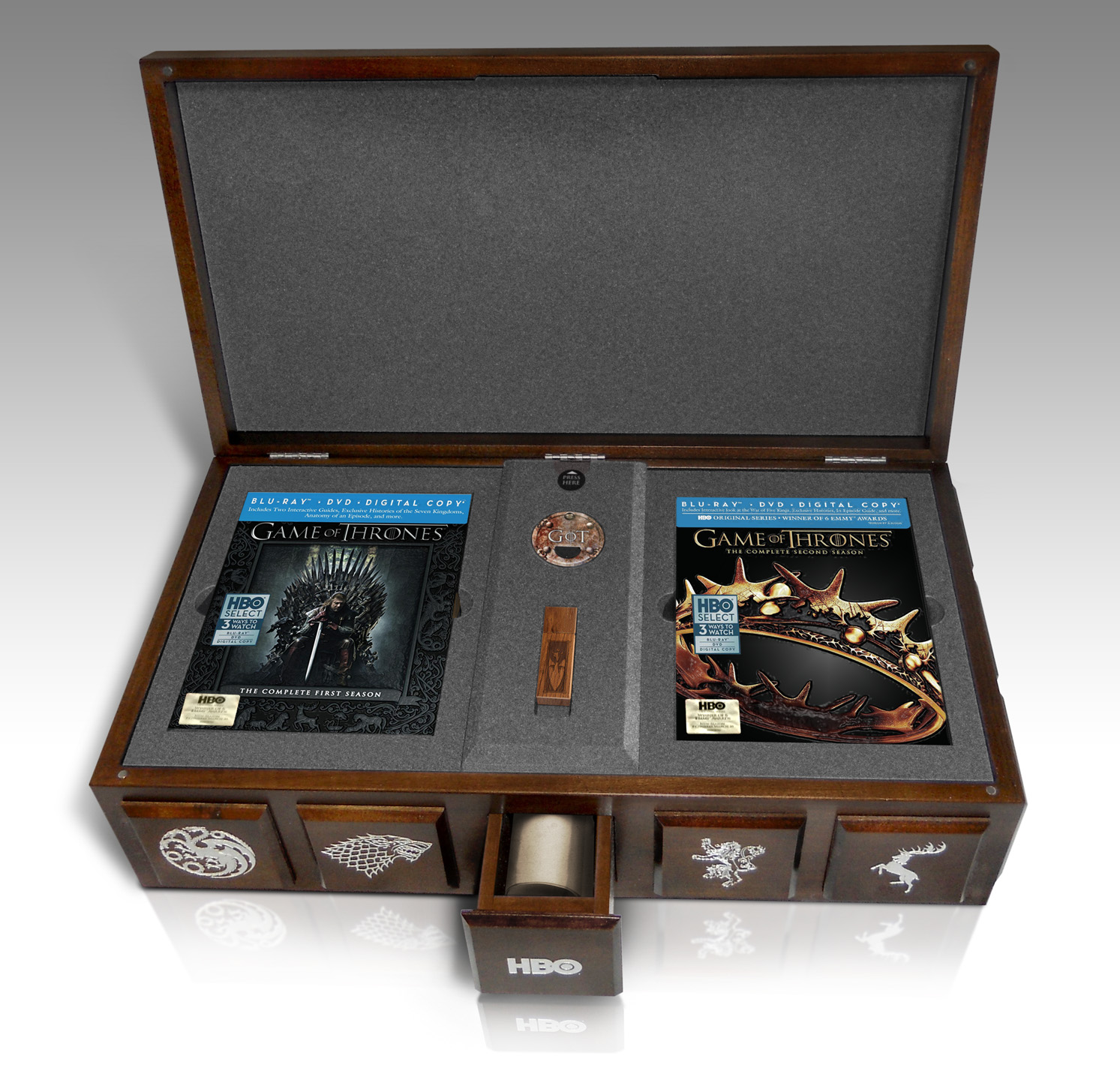
InfluencerInsideHowever, the “Influencer Box” reflects broader shifts in how television success is measured: even since 2011, the perceived value of Twitter and other forms of social media has dramatically increased, even if the industry as a whole remains uncertain as to how to monetize that value. HBO’s decision to turn Game of Thrones loose into the world of celebrity self-disclosure reflects their belief that the best strategy to draw new subscribers is not just to promote the show itself (which they continue to do), but rather the idea of the show as a social media event. While the Influencer Box features the first two seasons on Blu-Ray, ostensibly encouraging those who receive or read about the box to watch the series, it also includes “exclusive extras which the owner can use on their social media sites to show off their fandom,” which HBO is now extending out to the “real fans” through a collection of site-specific giveaways on sites like WinterIsComing.net or Slashfilm. While reminding viewers about the third season premiere is the stated goal of the box— as demonstrated by the “scroll” that accompanies the box urging celebrities to promote the March 31st return date—the larger goal is informing the world that Game of Thrones is bigger than just a television show.

Continue reading

11 Comments

Filed under Game of Thrones

Time After Time: The Carrie Diaries’ Creative Complications

CarrieDiariesTitleThe Carrie Diaries: Season One (So Far)

March 18, 2013

CarrieDiariesTCAI hadn’t seen the premiere of The Carrie Diaries before I was in attendance for its panel at this Winter’s TCA Press Tour. It was during my final day at tour, which meant that I had sat through dozens of similar panels, and I had seen producers and stars who were disengaged with the proceedings. Admittedly, “doing press” is not always going to be particularly natural, and so I’m not necessarily judging those who didn’t acquit themselves in the best possible fashion. However, it makes people like The Carrie Diaries‘ Amy B. Harris all the more unique: someone who came to the event not just with something to say, but rather with something to contribute.

I have no relationship to Sex and the City beyond a few stray episodes: I was a bit too young when it premiered to be watching premium cable series on a regular basis, and it never rose to the top of a list of shows to catch up on. And so I approached The Carrie Diaries less as an extension of a franchise (although see Courtney Brannon Donoghue’s recent piece for more on that), and more simply as a coming-of-age story in the CW mould. However, Harris’ comments during that panel very much shaped how I approached the series: she seemed to anticipate the kinds of questions she would be asked, and had come prepared with answers that were confident without seeming infallible. It wasn’t the kind of panel that was laugh-out-loud funny, but rather a panel that instilled confidence in the creative vision of a show I hadn’t yet had the chance to watch.

I watched the first three episodes of The Carrie Diaries on the trip back from Los Angeles, and enjoyed them. I’ve watched the six episodes since then, and I’ve mostly enjoyed those as well. However, as I’ve been following along with Carrie Raisler’s great reviews over at The A.V. Club, I’ve also realized that I’ve yet to find that moment where I feel the show has become everything that panel made it out to be. There have been moments, and storylines, which have reaffirmed the confidence I had after leaving that panel; there have also been moments that have shown a show still finding its footing, still aspiring to something it hasn’t yet achieved.

And yet I’m not sure my confidence has waned, necessarily. Some of this has to do with the fact that I was at the TCA panel, and watched the show within that context, and may be more apt to focus on the parts of the show that speak to that potential. However, additionally, I’ve come to understand The Carrie Diaries‘ first season as less a cohesive statement of what the show wants to be, and more an uneven platform to explore the question of its identity before moving forward with a greater sense of itself, something I want to explore briefly as the season heads into its final four episodes of the season (or the series, should it sadly not be renewed).

Continue reading

2 Comments

Filed under The Carrie Diaries

Season Finale: Homeland – “The Choice”

HomelandTitle

“The Choice”

December 16th, 2012

When Homeland’s first season ended, it offered what some viewed as a clean slate: Carrie’s memory was wiped, Brody’s secret was safe, and it seemed to set the table for everything to go back to normal as though nothing had ever happened. And when the second season began, there was certainly some semblance of stability, every character going on with the new version of their lives.

“The Choice” draws a similar picture of the post-Nazir era for Brody and Carrie, in that they believe they have a clean slate, that this is the second chance Carrie referred to earlier this season in the motel room. And yet just as the early part of this season exploded any sense of stability more quickly than we would have imagined heading into the season, so too does any post-Nazir calm disappear with great efficiency.

It’s a thematic parallel that fell into place for me as I was watching the finale, one which did little to assuage my frustrations with a central principle of the season but did much to piece together how and why certain storylines were constructed leading up to this point. The season makes more sense as a result of the events in “The Choice,” but it didn’t necessarily become any more successful than the mixed bad heading into the finale, capping off a season of television that I admire for its commitment and question for its choices.

Continue reading

6 Comments

Filed under Homeland

Returning to Glee: “Dynamic Duets” and the Improvements of S4

“Dynamic Duets” and Season Four So Far

November 22nd, 2012

I was at a Thanksgiving gathering today, and an open question was asked regarding the quality of Glee this season. An initial opinion suggested the show was terrible this year, and without any hesitation I disagreed: Glee, to my mind, has been measurably better than last season, and probably the season before.

I don’t know if this is a controversial opinion, but it was met with skepticism by the room, and perhaps rightfully so. Given the sheer number of words I spent laying out my frustrations with the show before quitting weekly reviews, I am all too familiar with Glee’s flaws. And to be clear, the show has continued to have these problems, and I’ve continued to sit on my couch and complain to Twitter about them like a crazy person. But around those problems has grown a season moving with purpose the vague “graduation” theme never offered, pulling fewer punches and forcing its characters to ask questions that occasionally threaten to mean something.

Put more simply, Glee is a better television show this season. Its flaws, while still numerous, feel like the byproduct of trying to do something instead of the byproduct of doing nothing, a constructive shift that helps the show overcome its occasional missteps to reach musical resolutions that feel earned.

Continue reading

3 Comments

Filed under Glee

Alone in a Dark Place: Building Byzantium for Cinemax’s Hunted

When you complete each stage of the process involved in ByzantiumTests.com, an immersive website experience for Cinemax’s new series Hunted (which debuts tomorrow night at 10/9c) that positions the user as a test subject for diegetic organization Byzantium Security International, it asks you whether you want to share your process with any number of social networks.

When I was completing the tests, however, they struck me as intensely personal. Even though the data being collected is far from the precise scientific personality test that Melissa George suggests in the video material accompanying the site, it nonetheless asks us to reflect on ourselves more than anything else, and I’m not sure that’s something I’d want to share with the world at large. One portion of the site asks you to connect the site to your Facebook account, drawing images from profiles—including your own—to probe further into your thought process. The results of the test are rigged in the sense that everyone can make it to the end, but the personalized nature of the test ensures that it’s evocation of the exclusive “1% that matters” highlights the individual nature of the accomplishment (which is part of why I wasn’t interested in sharing my results).

In the previous two campaigns—for Game of Thrones and Bag of Bones—that I’ve discussed from Campfire, who also developed the Byzantium campaign, the goal has been to engage fans and potential viewers in a shared experience of interpreting and participating in a broader activity. We can see a similar strategy in their campaign for USA’s Political Animals this summer—which I didn’t write about given my busy schedule at the time—wherein the community-forming potential for a newspaper’s audience is used to create immersive weekly experiences that nonetheless allow for different people to experience the same basic content. Whether it’s gathering Maester’s for the cause, or working with others to spot the various secrets in the dark stories being told, or sharing fictional political editorials the same way you’d share real ones, the notion of “shareable” speaks not only to the capacity for the pages to be posted to social media, but also the ability for the “experience” to be shared with others like you.

While the Byzantium campaign relies on word of mouth, which is why a wooden puzzle with a flash drive hidden inside arrived at my doorstep late last month, it also relies on potential viewers finding the time to visit the site, take part in the test, and engage with the world-building on display.

Which describes the experience of watching television, in a way. Continue reading

1 Comment

Filed under Hunted

Dexter – “Buck the System” (And Season 7 So Far)

“Buck the System”

October 14th, 2012

*Blows the Dust Off the Dexter Header Image* Well, it’s been a while.

I watched the fifth season premiere of Dexter waiting for a plane, and found it to be your typical episode of Dexter. But as the time crunch of the semester took over, the idea of watching any more floated away, and I hadn’t seen even a few minutes of the show since that point. The show remained “on the radar” as any show does, and certainly the events from the end of the sixth season were more visible than others, but the fact remained that I was content with Dexter being out of sight, out of mind.

This changed when that no longer became possible. During the past two seasons, people weren’t talking about Dexter: sure, there were still record numbers of viewers, but the people on my Twitter feed—people who used to talk about the show—seemed quiet. And then suddenly, there was Alan Sepinwall and Mo Ryan writing about the show again after watching their screeners for the first three episodes of the season. Tonight’s episode, “Buck the System,” was the last episode they saw before writing those pieces, and their support—and the similar mentions of improvement from the rest of my Twitter feed and my students—led me to take a look at the preview disc Showtime had been kind enough to send along.

I discovered a much better show than the one I left, mostly because we’ve reached the point where Dexter is the season’s star. Moving away from the seasonal serial killers of seasons past, the seventh season is invested in exploring Dexter and his impact on those around him, excising entirely unrelated subplots in favor of a web of character beats all focused on the ramifications of his actions. “Buck the System,” on the surface, is the episode where Dexter successfully begins to show Deb the positive benefits of his actions, and the episode where Yvonne Strahovski is introduced as a woman who, as a girl, once fell in with someone like Dexter. However, it’s also the episode where the unintended consequences of Dexter’s actions are equally as clear, at least to someone who is willing or able to think about them (which Dexter, very clearly, is not).

It’s a subtle distinction, but one that won me over, and has me committed to seeing the season out.

Continue reading

Leave a comment

Filed under Dexter

Season Premiere: Homeland – “The Smile”

“The Smile”

September 30th, 2012

Carrie’s life is just getting back on track when we rejoin her narrative. She’s living in her sister’s house, spending time with the family and teaching English as a Second Language. And so when the CIA comes calling, asking her to fly to Lebanon and engage a former contact, it asks her to return to the life she’s been trying to avoid.

Similarly, Brody is moving forward with his life as a congressman hoping that his relationship with Abu Nazir won’t become an active part in his life. He wants to believe that his subtle influence of policy is his role in the larger game, that his way of protecting Isa’s memory is to find ways to keep the same kind of attack from happening again. And so when he is contacted by one of Abu Nazir’s people to play a role in the planned attack in retaliation for the Israeli strikes on Iran, he’s forced back to that moment when he almost pulled the trigger. There, he was killing men responsible for the killing of innocents; now, he’s being asked to play a role in the killing of innocents in response.

“The Smile” asks us who these characters are in light of these new circumstances, testing their new identities based on their old lives. Does Brody still believe what he used to believe? Does Carrie still desire to live on the edge even once she’s spent time on stable ground? By combining the introduction of the season’s over-arching plot with this character study, “The Smile” serves as the perfect reintroduction to this world and the characters operating within it.

Continue reading

3 Comments

Filed under Homeland

Mid-Season Finale: Breaking Bad – “Gliding Over All”

“Gliding Over All”

September 2nd, 2012

It’s actually been two seasons since I’ve written regularly about Breaking Bad—neither last summer nor this summer allowed tackling a show weekly for “fun,” and I’ve now become accustomed to watching the show without having to take notes. It’s a tense show, and something about it becomes less tense when you watch it with a computer screen between you and the television.

I did want to drop in on what we could ostensibly fall the mid-season finale, as “Season Five” will continue on into next summer. “Gliding Over All” is far from the best episode of the season, designed as an epilogue to the half-season and as a transition point into what’s to come. However, while the episode aims to appease cliffhanger fans with a revelation in its final seconds, the episode is more interesting for the way it quite literally glides over months of time. The season started with a marker of time, with Walt’s birthday bacon numbers clueing us in to the fact that Walt’s acquisition of a dangerous weapon was a year into our future. While time has always been a key theme in the show, it’s become more prominent this season, no more so than in this contemplative finale.

Continue reading

9 Comments

Filed under Breaking Bad

Unheard and Unheralded: White Collar’s Problems with Class (and Beyond)

White Collar’s Problems with Class (and Beyond)

July 25th, 2012

White Collar is a show about the elite chasing down the elite. While representing the government, the white collar bureau of the FBI is hardly recognizable as even middle class given that our vantage points are the well-off Peter Burke and the globe-trotting criminal Neal Caffrey. Meanwhile, the people they track down are often business men or men of power, people who have private security firms and operate in high-rises as opposed to slums, meaning its New York City setting is pretty well limited to the most affluent of the boroughs.

However, this only makes the show as classist as most television programming, which tends to focus on the wealthy and well-off as opposed to those of a lower class. USA’s lineup is filled with other examples, whether it’s Royal Pains (where Hank, despite struggling financially to begin the show, is placed in the lifestyle of the wealthy Hamptonites to quickly erase his relative poverty), or Covert Affairs (where Annie lives in her sister’s guest house), or Burn Notice (where Michael, despite having no money to his name, transforms his warehouse-living existence into a sign of humility as opposed to destitution), or Necessary Roughness (where “money problems” mean the slow erosion of college funds by a frivolous ex-husband while continuing to work as a high-paying therapist to wealthy clients), or…well, you get the picture.

However, we’re conditioned to accept the inherent classism of television content, so it’s unlikely these shows resonate as particularly offensive. The past few weeks of White Collar, however, have more directly addressed or failed to address the lower class in their storytelling, and I’ve come to the point where I felt the need to comment on it. Since my off-handed Twitter remark picked up some response, I wanted to expand on it briefly to explain where the show has gone wrong in its evocation of the lower class at the start of its fourth season, and why the show’s “elite” DNA is more capable of addressing issues of class than its execution would suggest.

Continue reading

19 Comments

Filed under White Collar

Bunheads – “Movie Truck”

“Movie Truck”

July 24th, 2012

The concluding scene in “Movie Truck” is offered without any context, a coda in which Sasha performs a dance routine to a They Might Be Giants rendition of “Istanbul.” While the episode has a number of key revelations for Sasha as a character, none of them particular tie into that song, or that performance, and even the co-writer of the episode (Beth Schacter) admitted on Twitter that it was, well, “weird” (in addition to other adjectives).

However, it was a bit of weirdness earned by an episode that did a lot of things right, perhaps because of the fact that the show was finally allowed to breathe without Fanny there to suck the air out of things. When Kelly Bishop was only listed as a guest star in the early going, it felt like a death knell for the series, making it that much easier to jettison the mother-/daughter-in-law storyline in favor of the young teens closer to ABC Family’s target demographic. And yet while I continue to like Kelly Bishop’s performance, the show’s rhythms felt much stronger when she was off vacationing than when she was largely serving as an obstacle for Michelle to overcome.

Continue reading

7 Comments

Filed under Bunheads