Tag Archives: Science Fiction

Mutiny Revisited: Rewatching “A Disquiet…” / “The Oath” / “Blood on the Scales”

bsgtitle21

Mutiny Revisited

February 13th, 2009

With the end of Battlestar Galactica only a few months away, it has come to the point where we are beginning to place into context just what we’re watching. When I wrote a lengthy and esoteric review of “The Oath” in the hours after its airing, I was emotionally exhausted, having been taken to the brink by the pure adrenaline that the series was using to drive its characters to new levels. I wasn’t thinking in that moment about what kind of introduction it was to this conflict, how it picked up on the episode before it, or how it fit into any broader tradition. Instead, it was a hearkening back to episodes of the past, “Pegasus” most directly, and a sign that the show still had the ability to tell these kinds of stories.

And in the process of writing so much, I think I created for “Blood on the Scales” a set of expectations: I expected it would resolve the mutiny but leave the underlying problems quite emphatically clear, and I expected it would give us more of the Cylon side of this story. And as I wrote in my original review of the episode, posted late on Monday morning after a weekend debating tournament kept me incapacitated and unable to blog the episode, I didn’t feel like it met those expectations. There was something about it that felt off to me, and I’ll be the first to admit that in that post I don’t clearly argue for my disapproval. However, in responding to some thoughtful comments, I began to piece together at least some of what was bothering me.

Much of that, ultimately, was confirmed by Tuesday evening’s rewatch of the two episodes that join together to make a most intriguing chararacter study, even if I will argue that they are telling two different stories (especially when you consider them in context with “A Disquiet Follows My Soul,” which we’ll get to later in the post). They are episodes that are filled with amazing moments, but I feel as if “The Oath” is about showing the power of the mutiny over these characters, whereas “Blood on the Scales” is the characters showing their power over the mutiny. I find the latter to be, for all intents and purposes, more problematic, a far more expedient and much less rich way of letting this storyline unfold. I’m not suggesting that the episode was poor, or that its multitude of moments were any less powerful than those in the preceding episode, but rather I believe that the show’s transfer of agency is too easy and that, while the ramifications will continue to be felt for quite some time, not enough was done in the episode to demonstrate that this mutiny was about more than personal retribution and identity.

So what I want to do now is revisit these episodes to create another set of expectations: the things that felt like they should have been given more time here that, ultimately, are going to have to wait to live another day in the remaining six episodes, starting with tonight’s “No Exit.”


Continue reading

2 Comments

Filed under Battlestar Galactica

Season Premiere: Battlestar Galactica – “Sometimes a Great Notion”

bsgtitle21

“Sometimes a Great Notion”

January 16th, 2009

I had to wait over forty-eight hours to watch this, the beginning of the end for Battlestar Galactica as it enters its final ten-episode stretch. I logged onto Twitter in my hotel on Friday evening, as I am in Montreal for the continent’s longest running debating invitational; it was a force of habit really, but I found something I wasn’t prepared for. I saw a tweet that said the words “Final Cylon.” I paused, threw my hands in front of my screen, and immediately went on a self-imposed twitter ban (which failed miserably once I devised security methods to avoid spotting more spoiler material).

I was, regardless of my adverse reaction to spoilers in general, shocked by this news: here is this piece of news that we were so desperate to discover, so apparently integral to this final season that they changed the opening title cards, and all of a sudden we have the answer in this episode’s final moments. It all felt so counter-intuitive, so different from how we expected this episode to go down.

In that sense, it is almost exactly the opposite of the fourth season premiere last year, which felt like the very basic repercussions we had spent a lengthy time imagining. Here, the common trait was that everything was bigger than we imagined: while not outside of the realm of possibility and the breadth of internet predictions, the events which transpired had an extremist slant that never felt sensationalist and more importantly never felt as if they were ending or simply stalling for time. The “who” question for the Final Cylon is not really the show’s preoccupation: instead, their identity is a sharpening of focus, a lynchpin of identity for what we now know is a far more complicated Cylon mythology.

The world of Battlestar Galactica was broken open when we learned the identity of eighty percent of the final five, but what resulted was an isolation of their turmoil to an investigation into their psychological well-being. The irony is that here, as their identity becomes public and the entire fleet becomes part of their journey, their inner trauma only becomes more profound: these characters now have even more complicated questions about their identity, just as humanity does facing the scorched earth they believed and prayed was home, and they have new factors such as history or destiny to consider more carefully.

“Sometimes a Great Notion” feels like another stage of escalation in the season’s general purpose: it is not about who the Final Cylons are so much as who they were, who they are, what they are understood to be, and who they wish to be in the future. Answering those questions is not so much about naming them than letting them loose in a world now even more defined by their unique journey. The result here is an episode that, more than anything in the first half of the season, feels like we’re sifting through the denseness of this serious to the intersection of philosophical and personal interests that will define the series finale.

Continue reading

4 Comments

Filed under Battlestar Galactica

The Search for a Showsaver: Heroes, Bryan Fuller and NBC’s Big Little Problems

heroestitle08

The Search for a Showsaver

November 4th, 2008

In case you didn’t hear (I’ve been out of commission in terms of blogging due to a major presentation, so my Twitter feed has been the best source of information/reaction), NBC over the weekend let go Jesse Alexander and Jeph Loeb, the two head writers at their highest rated scripted series, Heroes. Note how I make the distinction: no longer a hit, the show has been relegated to simply being the highest rated amongst NBC’s anemic fall lineup.

This is a fact that NBC wants to fix, a purpose I find admirable if a tad bit idealistic. At this point, Heroes’ problems are that awful mix of inevitable (that some viewers would tire of the serialized narrative), creative (an admitted lack of quality and consistency ever since the first season finale), and logistical (budget overruns, an overabundance of cast members, etc.). Taken individually, the problems might be easy to handle: you offer more social networking integration to hook in what hardcore viewers you have, you bring in a new showrunner who is capable of bringing some quality writing the show’s solid foundation, and you cut some cast members and focus more on character than action or setpieces.

But, solving all three at once can’t be done: any creative or logistical changes could alienate the existing fanbase, and there is no guarantee that a showrunner will be able to balance the creative side of the series with the budget cuts that NBC is forcing on the series. Plus, at the same time, Tim Kring is still in charge of the series, and while Loeb and Alexander may be the scapegoats I’d tend to think the problem goes beyond them to the man truly in charge.

So while names like Bryan Fuller are bandied about, it begs the question: can NBC save Heroes?

Keep reading to find out.

Continue reading

Leave a comment

Filed under Heroes

Fringe – “The Ghost Network”

“The Ghost Network”

September 23rd, 2008

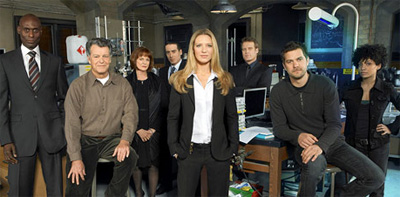
After last week’s review of Fringe was viewed as quite harsh, I want to clarify one thing: I don’t dislike Fringe. I think that the series is struggling to find its own identity, dealing with a struggle to both represent a procedural drama regarding paranormal activity outside of the norm and some type of mythologically-driven science fiction epic on the scale of Lost.

The biggest problem with the series is that the second half of that is impossible (it will never be that type of show), whereas the first part is what the entire series hinges on. The show can pile up on Massive Dynamic or The Pattern all it darn well pleases, but if its characters and its storylines don’t operate weekly in a way that feels like something different from every other crime procedural on television. Last week’s episode felt like Criminal Minds with crazy science, which isn’t something I want to watch every week.

But this week represents a marked improvement: sure, there was still some rather silly exposition, and it was often handled by too smart by half Peter (Joshua Jackson), and the mystery so cleanly bringing things back to Walter’s research is going to get old quickly, but this is a sharper hour: the “Ghost Network” has broad implications for the Pattern, the show is starting to ask the right questions about Massive Dynamic, and Peter’s slow build into something resembling a character half as interesting as his father is something that the show will need to accomplish to remain strong.

And yet, the real reason that “The Ghost Network” is perhaps Fringe’s best episode yet is simple: it is an episode that feels fun, that is willing to balance out melodrama with levity, and that feels like a show I could actually enjoy without having to accept a thesis that presumes that nobody ever smiles except for the crazy scientist who doesn’t know any better.

Continue reading

3 Comments

Filed under Fringe

Season Premiere: Heroes – “The Second Coming”

“The Second Coming”

Season Premiere, Part One

[For my review of the second part of the premiere, “The Butterfly Effect,” click here]

I don’t hate Heroes – I just find it really difficult to like Heroes.

There is a difference: there are elements of the show that I really want to like, and parts which remind me at every turn that there is something unique about what the show offers. But after a while, these can only go so far – I’m to the point where I’m the epitome of a cliche when I start prattling on about how nothing on the show will ever live up to “Company Man.”

So I don’t want to open this review with the new cliche, the understandable if overused complaining about the show’s second season. When it comes to coverage here at Cultural Learnings, the kiss of death is not outright negativity but rather sheer disinterest: I stopped recapping Heroes at a certain point primarily because I stopped caring about its characters. That was the second season’s biggest problem: not that its new characters were amongst the worst I could possibly imagine, but rather that they went so far as to render previously acceptable characters worthless. When even Hiro ends up feeling like we’re wasting time, the show is in trouble.

But as a television critic of sorts, I’ve got to keep an open mind – the end result of this is that the first hour of the evening’s premiere represents an important step forward in that the storylines we are seeing develop as part of “Villains,” in particular within “The Second Coming,” are about discovering what makes these characters tick as opposed to them saving the world. Yes, the show has every opportunity to fall off the rails, but I can understand why the Comic-Con crowd was satiated by this hour: it offers more hope for the future than the show has offered since…well, probably since “Company Man.”

…but that doesn’t mean it doesn’t have some issues.

Continue reading

3 Comments

Filed under Heroes

Fringe – “The Same Old Story”

“The Same Old Story”

September 16th, 2008

“Would you just talk like a person?”

Peter Bishop asks his father this question at the halfway point of Fringe’s second episode, and I couldn’t agree more: except that I’d apply this to Peter, and Olivia and just about every other character on the show. Because at this point, it seems like nothing that happens in Fringe is something that would happen to people, and that nothing they say seems to make any sense to anyone but the crazy person who created it all, in theory, seventeen years previous.

In the show’s pilot, this felt like an introduction into a new world, a world where things would be different and where mysteries would take on new contexts. However, what “The Same Old Story” offers is…the same old serial killer story, just with some fairly gimmicky applications of the fringe science the show is hinging its success on. Now, you could say that this is nothing new: The X-Files was essentially the same process, and Alias was your normal spy-type show but with Rambaldi’s artifacts as the reason behind the missions.

But Fringe buys into its own hype: too often the music bombasts to the point of self-indulgence, the characters talk about their own intelligence in a way that feels entirely unnatural, and the episode’s attempt at creating an emotional connection between Olivia and this week’s case is ultimately undermined by our lack of time spent with these characters in such a context.

More importantly, though, there was absolutely nothing fun about Fringe – the charm of the characters were either forced or so overpowered by the impending dread that the show never had a chance to breathe. The result is an episode that felt overlong, overtired, and an example of a show that still has me wondering just how this will turn into a series…or, even if the parts are present, wondering whether Orci and Kurtzman have the smarts to put it all together.

Continue reading

6 Comments

Filed under Fringe

Screw the Stigmas: Why The Middleman is Worth Saving

Why The Middleman is Worth Saving

In the world of television, it’s not a question of judging a book by its cover; rather, it’s about judging a show by its network.

For How I Met Your Mother, the “CBS is for lame people” stigma amongst some younger viewers keeps them from giving the show a decent shot, and in the process a show that should have been a big success from the beginning took three seasons and stuntcasting to guarantee itself a fourth. The show should have been 30 Rock before there was 30 Rock, and yet still quite a few people who would love this show are staying away.

And this summer, another example has popped up which is even more apparent. When The Middleman debuted back in June, I called it “a science fiction comedy with plenty to enjoy.” Since that point, I’ve grown to love the show, even those elements that I wasn’t so keen on in the pilot. The show has gone to great strides to build great characters and craft strong stories which serve their purpose, all with an added dose of pop culture humour to add to the show’s general charm.

But, a lot of people haven’t seen that. When someone posted about the show’s debut on a popular message board, these are amongst the first responses:

“You piqued my interest until I heard ABC Family.”

“No wonder I couldn’t find the show anywhere last night. ABC Family huh? Probably pass.”

And therein lies The Middleman’s problem: it’s not that ABC Family is a bad network, as Javier Grillo-Marxuach (Formerly an executive producer on Lost) has nothing but good things to say about the show’s treatment on the network side of the equation. Rather, they are a network with absolutely zero cache with the genre audience that the show is appealing towards. In fact, I’d say that they have negative interest: these people are not just unlikely to watch a show on ABC Family, but they are likely to actively avoid such a show thanks to its network affiliation. This means that any attempt to increase the show’s audience, which is miniscule if stable thanks to such issues, is going to take a whole lot of convincing to an audience that has never given the network a fair chance.

But that doesn’t mean that people aren’t trying, and it certainly doesn’t mean that anyone reading this who has yet to sample The Middleman shouldn’t immediately do so by searching through their on-screen guide, unblocking ABC Family, and opening your mind to a new kind of summer show – or, even better, buy it on iTunes, so you can bypass the stigma altogether.

Because this is a show that needs, and deserves, the viewers.

Continue reading

4 Comments

Filed under The Middleman

Series Premiere: The Middleman – “Pilot”

“Pilot”

June 16th, 2008

ABC Family caught my attention with Greek, but the network has been making its own move in the cable television arena over the past few years. The network has had success with shows like Greek, Wilfire or the upcoming The Secret Life of the American Teenager, shows that most easily fit into their teen girl demographics, but they’ve also made a few leaps into genre television. It is in the spirit of Kyle XY, then, that they bring us The Middleman, a science fiction comedy with plenty to enjoy.

Of course, there’s a lot of pedigree behind this project; the series is based on a comic book by Javier Grillo Marxauch, best known to this TV writer as an Executive Producer during Lost’s first season. Here, he’s writing comfortably in a genre that seems to work for him, and one that feels simultaneously fresh and familiar. Yes, it delights in a certain amount of cheese, and its quippy dialogue feels like the director realized that Gilmore Girls and Juno were both big with the kids, but as someone who enjoys both of those things I was thoroughly entertained.

While there’s no telling whether the pilot’s quirks, from its dialogue to its use of roundabout redundancies and on-screen irony, will remain in the episodes that remain, but when you combine a winning premise, an enjoyable cast and a summer where the rest of my TV schedule is catching up on series much more dark and depressing, Chloe from 24 genetically engineering Apes to take over the mafia and being thwarted by a superhero and his art school graduate sidekick is more than enough to keep me watching.

Continue reading

1 Comment

Filed under The Middleman

Pilot Preview – FOX’s “Fringe”

“Fringe”

Fall 2008 Pilot Preview

[As per pilot screener regulations, this is a preview and not a review. The content of the series may change between now and the show’s official airing, so all thoughts are of a preliminary nature pending said changes. For a full review, tune in for the show’s September premiere.]

When Fringe debuts in September, there are going to be a lot of comparisons made: to the past work of producer J.J. Abrams, to television’s last prominent science fiction procedural, and also to the rest of the pilots coming to the networks this fall. In all three cases, the show will play well – in its current form, Fringe is a tight series with a compelling cast, a winning premise and (most of all) the mythological underpinnings that drive any great piece of Abrams drama.

[Warning: The review will not feature any major spoilers, but there could be a few light ones as I make some comparisons to other series, so tread lightly if you’re worried about learning a single piece of the show’s plot.]

Continue reading

2 Comments

Filed under Fringe

Battlestar Galactica – “The Ties That Bind”

“The Ties That Bind”

April 18th, 2008

Speaking to a friend ahead of this episode, I said the following:

“I’m curious to see where it goes from here – the human plot has kind of hit a roadblock, so it’s going to be up to the Cylons to carry the dramatic weight I fear.”

So, considering these expectations, I should have been really frustrated with “The Ties That Bind,” an episode where almost all of the dramatic weight was founded on Cally, one of the most maligned characters amongst certain populations of the show’s fans. While there were a series of intriguing and fairly fantastic revelations on the Cylon side of the coin, it was ultimately a footnote in the episode compared to our central drama.

Now, I’ve never been on the side of Cally haters per se, but rather of the mind that Cally’s character was never given a justifiable reason to exist outside of her relationship to Tyrol. The character was never asked to carry any dramatic weight outside of either being beaten to a pulp or being placed in mortal danger – as a result, we got a lot of screaming and crying, but little in the way of nuanced emotion or any such things.

I’m not saying that what we saw from Nikki Clyne last night was revolutionary performance, but Michael Taylor managed to draw from her past in order to craft, at the very least, an intriguing point of representation. Cally, through anti-depressant fueled journeys, becomes a loose cannon – she is suspicious and paranoid in her altered state, and begins to suspect Tyrol is hiding something. Upon investigation, she stumbles across his biggest secret, and all of a sudden Cally has gone from nuisance to all-out ticking time bomb.

And then it went off, much sooner than I think any of us expected.

Continue reading

Leave a comment

Filed under Battlestar Galactica