Tag Archives: TV

Review: The Disarming Appeal of HBO’s Girls

At a point in the first episode of HBO’s Girls (which debuts tomorrow night at 10:30/9:30c), Lena Dunham’s Hannah suggests that she might be “the voice of [her] generation.”

It’s a clichéd statement, albeit one that Lena Dunham’s age and rapid rise to success within the entertainment industry have foregrounded within the discourse surrounding Girls. However, it’s also a statement that the show itself treats as a cliché, given the fact that Hannah is under the influence of drugs when she says it (and immediately realizes how pretentious it sounds even in her altered state). If her dream of being a writer is anything within the world of Girls, it’s a pipe dream, an idea that sustains her psychologically even as it does nothing for her financially.

I wouldn’t say that the show is about this, however. In fact, I’m not sure I’m comfortable saying what the show is about. While the show’s title suggests a broad investigation of young women, the universality it implies is undercut by the show’s reluctance to draw larger conclusions from these stories. It’s possible for cultural commentators to suggest this stands in for the experience of twenty-something white women living in New York City, but I’m not sure that the show itself ever makes the argument this is the experience for all of those women (or for all women in general).

In other words, Girls is a show about pretentious people, but I don’t find it particularly pretentious. Granted, HBO’s (successful) efforts to promote the show as a cultural touchstone have an air of pretension, but there is something very natural about the show itself that I found disarmed those larger expectations. Girls is a show based around situations more than “issues,” an incredibly isolated portrait of four young women at a very specific time, in a very specific place, and within a compelling televisual framework. Lena Dunham may not be the voice of a generation, but she’s a capable writer and director who has crafted a nuanced comic portrait of the drama of, if not everyday life, than a set of everyday lives, well worth watching.


Continue reading

2 Comments

Filed under Girls

Game of Thrones – “The Night Lands” and Sexposition

“The Night Lands” and Sexposition

April 8th, 2012

People who coin new terms are very rarely trying to coin new terms. When I used the term “sexposition” to describe a particular kind of scene in Game of Thrones, I wasn’t staking a claim to a corner of the cultural lexicon so much as I was trying to be clever. In fact, for a while – and still, really – I refused to believe it was possible to “invent” such a simple portmanteau – all I did was add an “s” at the end of the day. However, the word has caught on, leading to a bizarre couple of weeks in which Esquire magazine and The Guardian were contacting me on the subject, I was listening to Nikolaj Coster-Waldau and writer Bryan Cogman talking about it on the DVD commentaries, and now it even has a Wikipedia page not to be confused with “sex position.”

What I realized in chatting with these journalists, though, is that we (as a larger Game of Thrones-viewing community) had never come to a clear understanding of what sexposition even was. The first thing the Esquire journalist did was run a definition by me, and I realized that I didn’t really have any corrections because I had never actually thought much about it. While I had a number of scenes connected to the term in my mind, expanding it beyond Game of Thrones would require a more rigorous set of criteria, something that became clear when Michael Hann at the Guardian began talking about sexposition in the context of Showtime’s Homeland.

While Hann’s article captured the overall issue quite well, asking broader questions that speak to why the word is useful in considering the implications of this particular narrative device, I was confused by the evocation of Homeland, a show I would not associate with the term (which is a larger conversation that would require spoilers, so if you really want me to expand on that let me know). Also, in following fan discussion around Game of Thrones, I’ve seen sexposition become more of a catch-all term for the overuse of sex and nudity in general, something that obscures the specific implications of the neologism.

“The Night Lands” features what I’d consider the season’s first explicit use of sexposition as a narrative strategy, but it also features other sequences that feature similar amounts of nudity but which I would not associate with the term. Before delving a bit more into the rest of the episode, which features some of my favorite moments in the early parts of the second season, I want to tease out this distinction in an effort to consider what this sex is accomplishing, and what we make of the show effectively doubling down on the practice.

Continue reading

43 Comments

Filed under Game of Thrones

Welcoming the Zeitgeist: One Direction’s Saturday Night Live Invasion

One Direction’s SNL Invasion

April 8th, 2012

One of the (many) perks about being an academic studying elements of popular culture is the ability to turn any obsessive tendencies into “research.” I’ve spent the better part of the last month and a half obsessing over Justin Bieber’s “discovery” of former Canadian Idol contestant Carly Rae Jepsen and her subsequent rise to fame in America, and that became “research” when I wrote about the challenges of transnational stardom (and the awkwardness of an 18-year old mentoring a 26-year-old who has been in the music business longer than he has) for Antenna.

However, I don’t mean to suggest that I felt I needed to “justify” my interest in Jepsen’s rise to sudden fame by writing about it – the people who are following Jepsen as a fan, the Beliebers jumping on the bandwagon at the behest of their master, are just as justified as I am. That being said, though, there is a point where I want to be able to turn my interest into something more productive: while for fans this might mean writing fan fiction or creating a fan page, for me it means writing a scholarly blog post on the subject.

This brings me to the subject of this post, which is another pop culture obsession of sorts. I did not know British boy band One Direction even existed until I turned on my TV one morning to discover the band was performing on The Today Show. It was an unseasonably warm day in New York City for mid-March, but that wasn’t enough to explain the screaming throngs of teenage girls watching the performance. Even if Matt Lauer and Ann Curry weren’t pushing the comparison, it certainly evoked the aesthetics of Beatlemania (complete with the floppy hair), and the performances raised what was (to me) an intriguing question: what exactly does a boy band look and sound like in 2012?

In an internet age, the answer was only a few clicks away: Wikipedia offered some background on the band’s creation (formed as part of the British X Factor, finishing in third place), YouTube offered some clips of previous performances (including a preview of their performance on last night’s episode of iCarly), and Spotify allowed me to listen to their album, Up All Night, in its entirety over the course of the past three weeks. Pop culture curiosities are dangerous in this environment, as it’s all too easy to fall down the rabbit hole and come out the other side knowing most of the lyrics to an album of frothy bubblegum pop.

What I’ve been waiting for is an excuse to discuss the whole situation, which for me often means some sort of connection with television. Last night was therefore a golden opportunity, given both the aforementioned appearance on iCarly (which I’d consider highly logical given the band’s target audience) and their slot as the musical guest on Saturday Night Live (which I’d consider much less logical). And given that Ryan McGee has jokingly identified One Direction as my favorite band in his recap of last night’s SNL, I figure the least I can do is spend a bit of time discussing how this performance fits into my “more expansive than I initially intended” knowledge of their oeuvre, as well as ongoing controversies surrounding the show’s musical guest bookings this season.

Continue reading

7 Comments

Filed under Saturday Night Live

Reduced to a Scheduling Experiment: The Cruel Fate of NBC’s Bent

Parks and Recreation launched as a shortened six-episode order because Amy Poehler was pregnant at the time, and they weren’t able to shoot any more episodes. The show that debuted was effectively an experiment, the first stab at merging together the mockumentary-style of The Office (the show originated as a spinoff before being turned into an entirely disconnected project) with the show’s cast as performers (or thespians, to refer to them with the respect they deserve).

Parks and Recreation was an experiment that NBC nurtured (likely because of its pedigree), giving the show a plum post-Office time slot and renewing it despite continually plummeting ratings. Now finishing its fourth season, and likely to be renewed for a fifth, the show will be heading into syndication with the potential to make NBC Universal a not unsubstantial sum.

Bent was ordered as a six-episode first season, and positioned as a midseason replacement simply because NBC was unwilling to commit to a larger order. The show never quite found the right gear for Jeffrey Tambor’s character, but the cast dynamic was strong and the central chemistry with David Walton and Amanda Peet gave the “romantic comedy” side of things some definite credibility.

Bent was a perfectly solid show that NBC turned into a scheduling experiment, airing the six episodes in three one-hour blocks spread out over three weeks. Although Josef Adalain has NBC sources on record suggesting this was actually an attempt to help the show, that doesn’t change that the choice to experiment effectively doomed the show before it had a chance to become, well, anything.

Given that Walton was cast in another pilot this morning, the chances for a renewal are effectively nil, but I want to expand on this comparison briefly and reflect back on the two weeks and six episodes that are likely to remain the extent of the charming, pleasant Bent.

Continue reading

8 Comments

Filed under Bent

Season Premiere: Game of Thrones – “The North Remembers”

“The North Remembers”

April 1st, 2012

“For the night is dark and full of terrors.”

Game of Thrones is a very different show now than it was when the first season began last April. “Winter is Coming,” the series premiere, was an introduction to the world of Westeros, the characters who inhabit it, and the basic principles of honor which would be torn asunder over the course of the next ten episodes. It was a hint at the dangers that lurked beyond the wall, a glimpse of the paths being forged for those south of it, and a beginning of what would become a much larger, and on some level never-ending, journey.

By comparison, “The North Remembers” tells a very different story. Those dangers are now more real, those paths well trodden, and that journey more expansive than that first episode could have established. Where there was one king there are now four, each staking a claim on power that might well lie in the hands of those who wear no crown and yet play their games behind the scenes, and there are more Kings and Queens waiting in the wings for their opportunity to strike in the future.

However, the strategies of these two episodes are nearly identical, each tasked with providing a bird’s eye – or, rather, comet’s eye – view of the narrative map of the series as it stands at this very moment. While “Winter is Coming” was introducing characters for the first time, “The North Remembers” is fittingly enough about restoring the audience’s memory. Using similar strategies to the series premiere, the episode drops in on the various story threads we left back in June, a helpful reminder for those who haven’t revisited the first season on DVD or HBO Go.

Continue reading

12 Comments

Filed under Game of Thrones

A Westerossi Balancing Act: Game of Thrones Season Two [Review]

Review: Game of Thrones Season Two

March 29th, 2012

What do people really want to know about HBO’s Game of Thrones as it enters its second season?

When the first season premiered, writing a pre-air review was an easy process. Fans wanted to know how well George R.R. Martin’s A Song of Ice and Fire had been adapted for the screen by David Benioff and D.B. Weiss, and non-fans wanted to know if the result still qualified as a television show worth their time. These questions were conveniently interlinked, in that the show’s success as an adaptation (faithful but not slavish, episodic without losing broader narrative complexity) was very much part of its appeal to non-readers.

However, I found myself somewhat stumped as I sat down to write about the first four episodes of the second season. The challenge is that we’ve already answered those broader questions, and to my mind the answer hasn’t changed – the show is still a compelling and worthy adaptation of Martin’s series, and that still results in some tremendous television. I have some specific comments about nuances in the adaptation, and some opinions about how certain stories are being depicted, but I don’t feel as though I have anything new to add to the growing chorus of people praising the show upon its return as a preface to my post-air reviews which will go up over the next four weeks (and which will delve into those nuances and opinions in more detail).

Looking to solve my writer’s block, I opened up the conversation to my followers on Twitter and the users at NeoGAF (where a lively community has been built around the show), asking them whether they had any lingering questions they had which they didn’t feel had been covered by the mass of reviews to date. While I want to address a few directly, the larger takeaway was that readers and non-readers might have more in common as the show goes forward than I had presumed, a notion I’d like to explore further.

Continue reading

8 Comments

Filed under Game of Thrones

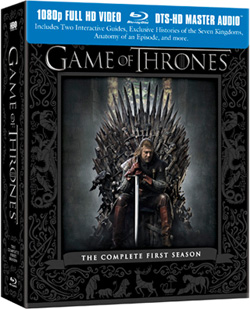
A Gloss of Thrones: Game of Thrones – The Complete First Season [Blu-ray Review]

It is now widely accepted that the way we watch television is a variable – if you’re reading this, chances are that I don’t have to regale you with the myriad ways we can now watch the programming we’ve historically viewed live in primetime, and so I can keep my big “DVRs, Streaming, and Bears, Oh My!” song and dance in my pocket for the time being.

However, I would argue that Game of Thrones represents a specifically complicated television text in this regard. Like all shows, there are questions of how it played on a week-to-week basis compared to how it would play as a marathon, questions that partly inspired the tremendous discourse around television narrative spurred on by Ryan McGee’s essay at The A.V. Club. However, in addition, the variables of consumption around the show are equally divided by the nature of its source material, with perhaps the clearest binary between “reader” and “non-reader” in television history. The result, I would argue, is a complex, diverse audience base who watches the show from different perspectives which make it difficult to generalize regarding what attracts them to a DVD or Blu-ray box set.

However, with Game of Thrones‘ Complete First Season (which I reviewed on Blu-ray), I really think HBO has succeeded in creating a set that has more than a little something for everyone, worth the price of admission for both readers and non-readers alike (along with those who are watching for the first time, for whom this set is a tremendous introduction). The production values are exceptional, the features are fairly plentiful, and the set fits comfortably into the quality aesthetics that both the show itself and the earlier paratexts achieved last year.

And yet, while I can easily recommend this set based on its own merits, there’s still some part of me who was left wanting, if not something more, than perhaps something different.

Continue reading

4 Comments

Filed under Game of Thrones

“This Season, on NBC’s Smash“: The Perils of the Extensive Post-Pilot Preview

The Perils of the Extensive Post-Pilot Preview

January 16th, 2012

It is no longer uncommon for networks to post pilots online in advance of their premieres, with FOX most recently using this strategy to help launch New Girl to some very strong initial ratings (which have since that point slid considerably, but remain fairly solid). It gives the shows increased visibility within an online space, turning savvy consumers (those who will find it on iTunes, or Hulu, or OnDemand) into an additional marketing segment who will put the word out just enough that those 100 million people tuning into the Super Bowl, and tens of millions who will watch The Voice for two hours before Smash premieres on February 6th, will hear whispers of the show before it’s plastered throughout those NBC broadcasts (and, as Mike Stein pointed out on Twitter, a single person who has seen and enjoyed the Pilot at a larger gathering could spread the word quite easily).

Like many others, I sat down with the Smash pilot via iTunes this afternoon – I had not seen the pilot when it was sent out to critics last Fall, so I was more or less seeing this in the fashion that NBC intended. The difference, though, is that I’ve read a lot about this show, and have seen enough trailers to understand its basic premise (and the basic beats of the pilot) more than the average viewer. As a result, while I would say that the Smash pilot is well-made, and there were parts of it I quite enjoyed (mostly surrounding the musical numbers at the heart of the story), I didn’t get that thrill of discovery that you ideally want to have with a television pilot.

NBC isn’t particularly concerned about this, either: while they’re playing coy with the musical numbers themselves, they included an extensive preview of the remainder of the season at the end of the pilot download, providing viewers with a surprisingly comprehensive overview of what is going to happen in the show’s first season (although it is unclear just how many episodes we see scenes from). It’s a move that’s not entirely common in this day and age, but it’s a move that I find eternally frustrating as someone who tries to avoid spoilers at all costs, particularly with reality shows like Project Runway or Top Chef where the basic structure is already so apparent.

The question becomes, though, why a show that does seem to have a strong serialized component (represented by the behind-the-scenes soap component of the series) would be so willing to reveal their cards before the show even begins. While I don’t know the actual answer to this question, I want to suggest (while offering some basic impressions of the drama, and some spoilery details for those who haven’t watched it or the preview that followed) that NBC is admitting up front that watching Smash isn’t going to be about surprise so much as spectacle, mirroring my own experience with the pilot and charting an intriguing if flawed course for the series moving forward.

Continue reading

19 Comments

Filed under Smash

The Search for Significance: The Television Industry and the Golden Globes

Earlier this evening, my brother directed me to a piece at Slate defending the Golden Globes, something that we don’t see particularly often. Indeed, that is very much the impetus behind Tom Shone’s argument, praising the Globes relative to the Academy Awards for a collection of strong choices that the Academy would undo a month later (such as, for example, the Globes honoring Brokeback Mountain only for the Oscars to choose the turgid Crash instead).

Shone’s argument is interesting, primarily because it does little to hide its anecdotal nature. He argues that while we might contest many choices that the Globes have made over the years, they have done enough good in enough instances to be “worth it” in the end. While some might question the value of their existence, Shone believes that looking at even a handful of examples where they were legitimately ahead of the curve, or where their whims happened to match with how cinematic history would remember a particular year in film, justify any travesties they might otherwise commit.

My brother’s question to me, upon informing me of the article, was whether I would suggest the same could be said for television, a thought that I was preoccupied with throughout tonight’s Golden Globes broadcast. Whereas the Golden Globes line up comfortably as a precursor for the Oscars, the Globes’ relationship with the Emmys is complicated by their differing eligibility periods and voting structures. However, building on Shone’s argument, there was evidence within tonight’s broadcast that some of the Globes’ voting habits that we might otherwise vilify in particular contexts proved to benefit shows that I like, and shows that may not necessarily be lauded to the same degree come September.

My takeaway from this is not necessarily a validation of the Golden Globes or the Hollywood Foreign Press Association, but rather an increased belief that our assessment of award shows needs to become more nuanced, both in terms of how we perceive them as cultural entities and in terms of how we consider their industrial – as opposed to cultural – significance as a framework for understanding their greater “meaning.”

Continue reading

6 Comments

Filed under Golden Globes

Season Premiere: Shameless – “Summertime” and Televisual Space

“Summertime” and Televisual Space

January 8th, 2012

After rewatching the entire first season over the holidays with my parents, I found myself enjoying Shameless more than when it premiered (as I wrote about soon after), and I looked forward to checking out the second season. What I wasn’t expecting, though, was to find it so disarmingly different from what we saw last year.

This isn’t to say that the show has dramatically changed its approach to storytelling, although there is evidence to suggest that they are finding better ways of balancing the different character dynamics based on reviews from critics who have seen beyond tonight’s premiere. Rather, the fast-forward to the dog days of summer has created both a temporal shift and, more importantly, a spatial shift in terms of the characters and the world they live in. More generally, though, the long summer days offer a plethora of sunlight, dramatically transforming the aesthetic of the show and signaling a new season in a very direct, meaningful fashion.

I realize that this is not particularly evaluative, and if we were to speak exclusively on those terms I found the premiere promising but uneven, but I want to spend a bit of time discussing these changes relative to the question of space, an increasingly important factor as worlds begin to converge in a new spatial dynamic within the series.

Continue reading

Leave a comment

Filed under Shameless