Tag Archives: TV

Game of Thrones – “Mockingbird”

GameOfThronesTitle2

“Mockingbird”

May 18, 2014

“A lot can happen between now and never.”

This is typically the space where you’d find my review of tonight’s episode of Game of Thrones, but circumstances were such that A.V. Club editor Todd VanDerWerff needed someone to fill in while he was out of town. Accordingly, my review of the episode is located at The A.V. Club instead.

Before I share the link (and a brief taste of the review), though, a warning: while my reviews are typically written for both readers and non-readers alike, this one is definitely more tailored to the specific reader audience, given that Todd does the “Experts” reviews intended for those who had read at least the first three books. So if you’re been reading these reviews as an “unsullied,” be warned that there will be more attention paid to the adaptation and at how it foreshadows future events, even if the outright “spoilers” for what are in a clearly marked section at the end of the review.

Thanks to those who’ve been reading the reviews here this season, and I’ll be back in this space two weeks from now to head into the final three episodes of the season.

Game of Thrones (experts): “Mockingbird” – The A.V. Club

One of the most common complaints about a television season applies to episodes like “Mockingbird.” Whether you prefer “table setting” or “moving pieces into place” as a metaphor, it’s an episode that functions largely to set up events that are likely going to be more exciting or meaningful than the ones within the episode itself.

Such concerns are distinct, however, with Game of Thrones, at least for those of us who’ve read the books (which is most of you, one presumes). Typically, “table setting” episodes are criticized for being too blatant in their machinations, working hard to set up things but resisting pulling the trigger before the stories’ respective climaxes. Personally, I find these episodes interesting when done well, but I will admit that there is something frustrating about an episode that simultaneously feels like a comedown from the episode before and works almost too hard to build anticipation for the episode that follows.

With Game of Thrones, though, we (mostly) know the episode that follows.

3 Comments

Filed under Game of Thrones

Game of Thrones – “The Laws of Gods and Men”

GameOfThronesTitle2

“The Laws of Gods and Men”

May 11, 2014

“We prefer the stories they tell. More plain, less open to interpretation.”

This is why the Iron Bank of Braavos prefers numbers.

They’re strange, in this way: whereas the other groups who jostle for power in Westeros (and across the Narrow Sea) are interested in histories and lineages, the Iron Bank is only concerned with numbers. It’s why they’re unmoved by Stannis’ claim to the throne by blood, and why they’re won over by Davos’ claim that Stannis is the closest Westeros has to a stable ruler should Tywin Lannister meet his end.

Interpretation is at the heart of law, of course, and of the men and women who enact it. Although the majority of the episode is taken up by an actual trial, the storylines that precede it show the reverberations of other forms of justice, in which similarly cruel acts are taken for fundamentally different reasons.

The question becomes whether history will interpret them differently.

Continue reading

9 Comments

Filed under Game of Thrones

Game of Thrones – “First Of His Name”

GameOfThronesTitle2

“First Of His Name”

May 4th, 2014

“I need to be more than that.”

There’s two characters that this week’s episode title refers to, even if only one is made explicit.

“First Of His Name” directly refers to Tommen, who is indeed the first King by that name to rule over Westeros. Tommen doesn’t actually do much in the hour, though, his fate a topic of conversation for those around him more than something he gets to decide on his own. Whether in Margaery’s conversation with her grandmother last week, or Margaery’s oh-so calculated performance with Cersei this week, or Cersei’s careful conversation with her father, Tommen’s future is very much a matter of procedure.

By comparison, however, Petyr Baelish makes his own procedure. There is no coronation for “Littlefinger,” as he operates in the slimy underbelly of the political underworld (yes, underworlds have underbellies). He comes from no strong lineage, with no family to support him or noble deeds to give him claim to glory, and so he has had to toil for everything he’s ever earned. He is the first of his name in a different way, in that he is the first member of his family to be Machiavellian enough to angle his way into a position of power, providing the foundation for a legacy of his own moving forward.

This balance between the self-made Littlefinger and the anointed Tommen sits on the periphery of an episode that functions as a highly logical mid-point of the season. And yet their respective paths are placed as guideposts for other characters who are faced with decisions that could lead them down one path or the other, depending on the choices they make in a moment of transition.

Continue reading

12 Comments

Filed under Game of Thrones

Game of Thrones – “Oathkeeper”

GameOfThronesTitle2

“Oathkeeper”

April 27th, 2014

“You want to fight pretty, or do you want to win?”

Later this evening, a feature will go live at The A.V. Club that focuses on some of the changes between A Song of Ice and Fire and Game of Thrones. [Edit: You can find said piece here.] When completing my own contributions to this feature, my interest was less in discussing whether or not the changes involved were good or bad, but rather to consider how the logistics of making a television series necessitated certain changes that had a clear effect on how this story is being told.

It’s fitting that it’s emerging on a night when there’s plenty more to add to the list. “Oathkeeper” is written by Bryan Cogman, who of the show’s writers had the most to live up to when it comes to the text of the original novels. Now a co-producer on the series, Cogman has been the person in the writers’ room with the closest relationships to the books and their lore, and has been the most active of the show’s writers in engaging with the series’ rabid fanbase. Although he never outright swore an oath to fans of the books regarding keeping their spirit intact, he’s been the most directly tied to fan communities, drawing both praise and anger in equal measure as the two narratives play out.

I say “two narratives” because I think it’s necessary at this stage in the game. Ultimately, I feel safe in saying that A Song of Ice and Fire and Game of Thrones are telling the same story, but they’re following two different narrative paths to get there, as evidenced by an episode that does a lot of labor in the interest of condensing a sprawling narrative into something more manageable for a television series. The result at times feels like pieces on a chessboard being awkwardly pushed together in ways that break the rules, but they’re rules only some of the show’s audience will even know exist, and rules that—unlike oaths—are made to be broken in the interest of a new set of rules that have developed over the course of this new narrative.

Continue reading

11 Comments

Filed under Game of Thrones

Discourse of Thrones: Jaime, Cersei, and Confronting Rape

GameOfThronesTitle2

Discourse of Thrones: Jaime, Cersei, and Confronting Rape

April 21st, 2014

When I wrote my review of “Breaker of Chains” on Sunday afternoon, I certainly knew that the scene between Jaime and Cersei at the Sept of Baelor would cause a conversation.

This is both because of the fact that it signals a departure from how the scene plays out in the books and the fact that it features a character that has become a more inherently likeable character in the series committing an absolutely vile, unforgivable act. On the whole, though, I thought the scene played in the same thematic territory as its literary progenitor, such that any conversation would be more about the impact on—rather than destruction of—the characters in question. I did not imagine the scenario we’ve arrived to, in which the scene is causing a considerable and often ugly debate (provided one makes the mistakes of reading the comments, perhaps even on this piece I’m in the process of writing).

Or, rather, it’s causing two debates.

Continue reading

77 Comments

Filed under Game of Thrones

Game of Thrones – “Breaker of Chains”

GameOfThronesTitle2

“Breaker of Chains”

April 20th, 2014

“I will not become a page in someone else’s history book.”

As is often the case with watching Game of Thrones as a book reader, I left “Breaker of Chains” with questions about how non-readers would receive the episode.

These are not simple evaluative questions like whether readers would enjoy this scene or that scene in the episode. Like most, it’s a compelling episode, with some fantastic scenes in the fallout of last week’s major events. Rather, they are questions of whether or not reveals that are obvious to readers—we know what’s about to happen—are anticipated by non-readers in the way the series would seem to be hoping for.

Continue reading

4 Comments

Filed under Game of Thrones

Game of Thrones – “The Lion and the Rose”

GameOfThronesTitle2

“The Lion and the Rose”

April 13th, 2014

“Blackwater” has often been cited as the definitive Game of Thrones episode, capturing the scale and sheer expense that have come to define the series within television culture. It was also an episode that George R.R. Martin scripted himself, finally seeing the scale he had taken to literature to obtain come to life onscreen (albeit still with a degree of sacrifice to his most ambitious visions for the episode).

At the same time, though, Martin’s scale only rarely manifests as the episode’s bombast. It tends to manifest in minutia, in the sheer detail of individual scenes. This has primarily come in the form of feasts, gallant affairs where Martin revels as much in the food on the table as the people sitting at it. It’s an effort to provide scale not in the form of giant explosions, but in the form of atmosphere—he wants you to feel like you’re there, which is often more about tone than anything else.

It’s something the show has rarely been able to communicate the same way: few scenes have lasted long enough to luxuriate in the environment, and to create that sense of becoming lost in the splendor. The closing sequence of “The Lion and the Rose”—detailing Joffrey and Margaery’s wedding and reception—is one of the first, a carefully designed piece of theater that is all about moving pieces, each more detailed than the next. It’s also a scene that deploys that detail for a specific purpose, crafting a sequence that builds to its conclusion at such a rate that even those who don’t know what’s about to happen know that something is about to happen.

That it’s something both readers and non-readers alike have been waiting for is just the icing on the cake.

Continue reading

9 Comments

Filed under Game of Thrones

Season Premiere: Game of Thrones – “Two Swords”

GameOfThronesTitle2

“Two Swords”

April 6th, 2014

“Killed the right people, I suppose.”

The beginning of Game of Thrones’ fourth season is caught in evaluative limbo.

We are past the point where it is a critic’s job to tell you what Game of Thrones is. At this stage, the show is the show, and nothing in the first three episodes of the season—which were sent to critics—changes that. To write an advance review of a season of Game of Thrones is less about evaluating its quality and more about offering vague previews of what’s to come for those who haven’t read the books but nonetheless want some sense of where their favorite characters are headed in the early-going, or for those who’ve read the books and want a basic gutcheck on how certain details were translated. If something in these first three episodes actually changes someone’s mind regarding the series, it would shock me not unlike the Red Wedding shocked non-readers.

This might be the last time I say this. The fourth season marks the first that will begin to actively and aggressively merge material from multiple books, likely resulting in some of the most substantial deviations from the source material to date. As someone whose interest in writing about the show comes in large part based on how the series approaches narratives, characters, and themes from the book in a different medium, we are on the verge of one of the most exciting periods for the series, one where the discourse will take on considerably higher stakes. Will readers embrace the changes? Will non-readers even notice that something is amiss?

“Two Swords” marks the calm before the storm, hence the evaluative limbo—although we are approaching the moment when I expect we’ll see far more interesting ranges of critical response to the series, the season premiere has the series firmly in transition, still holding onto the familiar instability we’ve come to understand. It’s a delicate transition, mind you, and one that David Benioff and D.B. Weiss—who doubles as director—handle extremely well, but it’s ultimately a familiar feeling returning to Westeros in season four.

Continue reading

10 Comments

Filed under Game of Thrones

Series Finale: How I Met Your Mother – “Last Forever”

himymtitle

“Last Forever”

March 31st, 2014

I want to say upfront that I think the How I Met Your Mother finale was not an abomination. It featured a number of resonant moments, images, and character beats that tapped into what made the series resonate early in its run. When it finally reached the moment the series had been building up to, the chemistry between Josh Radnor and Cristin Miloti was quiet and sweet, and it stands as one of the series’ finer moments. This was a series that set out to tell a non-linear story about love, and delivered a—somewhat—non-linear finale about love, such that no one can claim How I Met Your Mother was a dramatically different show at the end than it was in the beginning.

However, I also want to say that I hated the How I Met Your Mother finale. A lot.

Continue reading

7 Comments

Filed under How I Met Your Mother

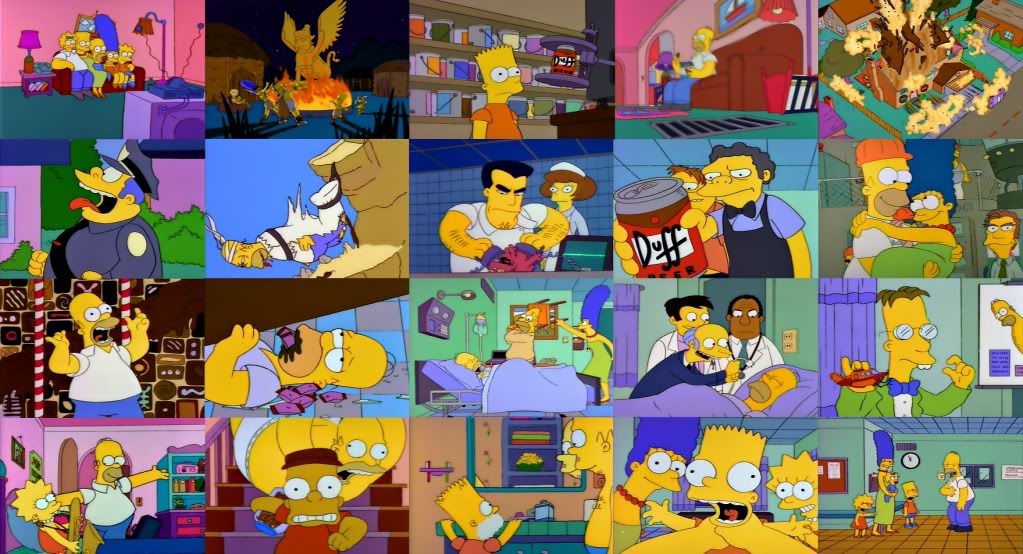
So It’s Come To This: The Case for the Simpsons Clip Database

SoitscometothisaSimpsonsClipshowWe should have known it would be FXX.

Two days after critics questioned the fledgling cable channel’s cancellation of Totally Biased With W. Kamau Bell, and what it meant for its future, FXX joined the long line of cable channels who have chosen to build their brand on the backs of syndication rights. And given that FXX is owned by NewsCorp, who also owns 20th Century Fox, that the channel would emerge victorious in the basic cable channel sweepstakes for The Simpsons is not a huge surprise. The decision allows Fox to keep the show within the corporate family, while simultaneously providing a cornerstone around which the FX brand and FXX specifically can differentiate within the competitive space of basic cable.

It’s not quite the “Simpsons Channel” that had been rumored in previous years, but it comes with what some would consider to be a comparable model: FXNow, the channels’ streaming service, will have exclusive rights to The Simpsons within a non-linear space, which some could argue is the most lucrative part of the deal. As DVD sales plummet and streaming becomes the de facto model through which many young adults receive their content, The Simpsons represents a substantial piece of television history, and one that its fans are likely willing to revisit. When Marcia Wallace passed away last month, how many Simpsons fans rushed to revisit “Bart The Lover?” When you’re standing outside a restaurant talking about the quality of your meal and you give it your lowest rating ever, seven thumbs up—I actually did this last night—there’s a chance you’ll want to rush home to check out “Guess Who’s Coming to Criticize Dinner.” In a world where Simpsons references are a language for a certain generation, the ability to stream this content has tremendous value, and would push use of an app that otherwise would struggle to compete with services like Netflix.

There are obviously some complications: for example, FXNow has commercial breaks within episodes, meaning there will be no space in which commercial-free episodes of The Simpsons will be available to stream. However, more importantly, I remain firm in my belief that the most valuable resource to Simpsons fans is not the ability to watch the show whenever they want, but rather the ability to reference the show at a moment’s notice. Within this deal, The Simpsons is being used as a leverage point to build a channel brand, generate revenue, and maximize potential revenue for a new channel; within popular culture, however, The Simpsons is used as a generator of meaning, a way to communicate that is best served with a different non-linear application that this deal would seem to render impossible (or at least highly unlikely).

Continue reading

5 Comments

Filed under The Simpsons