
Last Thursday, I spent a few hours watching classic Western “Shane” for my Politics of Mass Media class. It was a dreadful film, with huge plot holes and terrible dialogue that could be expected of the genre. However, since it was being screened for the class, our professor had a hidden agenda: it was his belief that the film can be viewed as a microcosm of the Iraq War. The tyrannical Riker gang were the Iraqi government, the timid farmers the Iraqi people, and the heroic Shane the epitome of George W. himself. There was some skepticism as to the validity of this argument, but on a personal level I had been sitting watching it as a representation of the conflict between Israel and Palestine.
I’ve always been open to these kind of interpretations because I think it makes texts like Shane worthwhile. It’s not an issue of changing the film to fit the example, but rather using the film as a way to better understand and analyze cultural perceptions relating to the conflict. A good film is more than capable of standing on its own, but considering the cultural placement of a film has a great deal of value. Viewing Shane as a vision of 1950s American thought allows us to realize that perhaps Bush’s ideologies are ripped straight out of that period. I consider this to be a worthwhile reading of the film, if not a perfect one, and I left that classroom unbothered by the application.
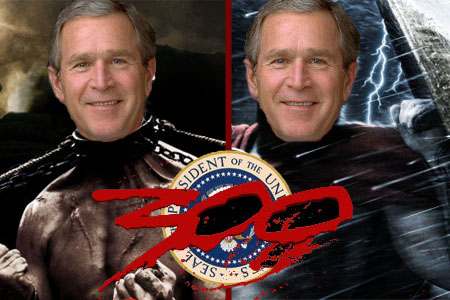
However, I was not expecting for this issue to become quite so relevant this week when, in a rather strange turn of events, it was revealed that the adaptation of Frank Miller’s ‘300’ is perhaps being painted with the same brush.
Link: The New York Times – “That Film’s Real Message? It Could Be: ‘Buy a Ticket’”
While I was fine with the application of modern conflict to “classic” cinema, I can’t help but agree with that article that this is setting a bad precedent. Zack Snyder, the film’s director, was asked which leader represented George W. Bush; the questioner answered Xerxes, the Persian invader. Another reporter, however, felt it was Leonidas, the Spartan hero. When he took the film to a German festival, reporters asked questions as if the American government had financed the film’s production. Unbeknownst to Snyder, his film has become a powerful political statement, which was likely not the attention of the computer-assisted gorefest that is ‘300’.
At one point, I remember ‘300’ as being a cinematic event for the geeks of the world and little more; sure, it’s following in the footsteps of Frank Miller’s ‘Sin City’, but it isn’t the type of film that expects a great deal of general public attention. It was supposed to be a young male bloodbath of epic proportions, with a strong first weekend at the box office and then the typical huge drop in its 2nd weekend.
And yet, somehow it’s turning into a volatile political statement purely because it has to do with a historical battle of some sort? It’s entirely possible to take any famous war and apply it to U.S. foreign policy, I understand this, but this seems like a fairly massive stretch at this point. While viewing Shane, it dealt with values of the American West, and seemed to have real relevance to those principles. This film, however, has no connection to such things, and is meant to be a visually stunning war epic. The simple idea that Zack Snyder, director of the Dawn of the Dead remake, would have such intentions would have seemed crazy a year ago.
In the end, I think that people need to be able to discern those films that aren’t meant to be something political, even though they have things like characters who could theoretically become symbols for every political leader in the history of humankind. And yet, at the same time, I can’t advocate a complete ignorance to subtextual elements with films. It’s a media reality that journalists are going to jump on this, and it would be a pity to see this film defined by this comparison to modern political situations.
Snyder is right to note that he likes this as a by-product of the film, because that’s what it should remain. People should see such elements of a film as being something to think about regarding the text, as opposed to defining it. The article notes that comparisons to the Battle of Thermopylae in regards to Bush existed even before the film, and Miller is all about contemporary examples; however, there needs to be a discourse regarding filmmaking to which one can add subtextual analyses.
So, if you head out to your local cinema to check out ‘300’ this weekend (Reviews are looking good in the early going: Variety, Hollywood Reporter), keep this in some part of your mind, but don’t let it get in the way of the gory violence and epic story you’re really there to see.


 Cultural Learnings
Pingback: ...in which McNutt reviews 300 « McNutt Against the Music