Today, June 21st, the first stage of the Emmy Nomination process ends. Getting nominated for an Emmy Award is not an easy task, and the entire process is ludicrously complicated this year. To help you follow the process as it unfolds over the next month, here’s a rundown on how the decision is made and who benefits from each stage.
Stage One:The Popular Vote
How it Works: Voters select their favourite candidate from all individuals who have submitted themselves for nomination. They read For Your Consideration ads, watch screeners, but in the end likely just pick who they like.
Who it Benefits: Shows that are either perennial nominees or extremely buzz-worthy, and actors that are well-known in Hollywood. Shows like The Sopranos or Desperate Housewives are guaranteed to do well at this stage because they have star power and award show history. Thus, voters don’t really even need to see what these candidates have to offer, they just assume they’re really good. Much hyped new shows, like Heroes and Ugly Betty, will also benefit.
Who it Harms: Ratings-deprived, critically acclaimed programs without any of the above, and actors or actresses who lack star power. While a show like critically acclaimed 30 Rock has a lot of star power (Alec Baldwin, Tina Fey), Friday Night Lights does not and will not perform well at this stage of the competition. Similarly, a show like Jericho lost so much steam in the post-hiatus period that it is unlikely to be on voters’ minds, even with the recent campaign to save it.
Stage Two:The Top 10 Run-Off
How it Works: The Top 10 series from the popular vote are isolated and screened in front of a blue ribbon panel. Each show/actor/actress selects an episode that will be screened for the panel if it makes the Top 10. They also prepare a short written statement explaining their show and the episode in context with the show. For example, should Lost make the Best Drama Series panel (Count on it), they will be screening the season finale, “Through the Looking Glass.”
Then, each member of the panel will rank the shows from 1 to 10, and a final ranking will be decided.
[In Week Three of Cultural Learnings’ 59th Annual Emmy Awards Nominations Preview, we’re looking at possible contenders for the Lead Actor awards in both drama and comedy. Today, we present our sixth set of candidates. For complete listings for the Supporting candidates from the past two weeks, check out our For Your Consideration index]
Lead Actor in a Comedy Series
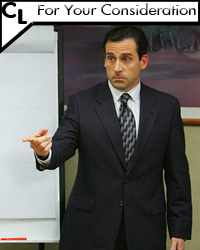
Steve Carell (Michael Scott)
The Office
I don’t really know what to say about Steve Carell that hasn’t already been said. The fact that he didn’t win this award last year was a travesty, as his loss to Tony Shalhoub should have never happened. I wrote about Rainn Wilson two weeks ago that The Office really wouldn’t work without him, and I stand by that statement…but Dwight wouldn’t really work without Michael, and I don’t think that much of the show’s comedy would be as funny if the uncool, trying to be cool boss wasn’t around. What makes Carell so great in this role is his ability to throw everything into his comic performance, but then be able to bring it all back together to appear as a real human being. Without that quality, Carell would be a loose cannon on a show where all firearms must be precision weapons designed to entertain. However, although often giving the appearance of being entirely unstable, Michael Scott is a human being first and foremost, capable of love and loss and friendship and emotions. And with a deft comic hand and a sense of who his character really is, Steve Carell delivers a consistently Emmy worthy performance.
This season has allowed Carell a lot of movement within Michael’s character. He continued to go through relationship drama, struggled to relate to his co-workers as per usual, and had to deal with a convict and a gay man in his office (He didn’t do so well with either of them). And I have to commend him for managing to go through all of this (especially “Gay Witch Hunt”, which I found more disturbing than funny) while maintaining some level of sanity within Michael’s character. At the end of the season as he finds himself caring for a rapidly falling apart Jan and wondering how he got stuck in this mess, we relate to him and his situation. Carell can go through from hapless to empathetic in about two second flat, and he did so admirably throughout the season. While he doesn’t always get the same types of “gags” as Dwight or Jim, I think that his comedy is all in the setup. And this season saw a wide range of setups, and Carell’s performance within them is worthy of Emmy consideration.
Episode Selection:“Business School” (Aired February 15th, 2007)
I’m skipping forward to this section quicker than I might usually because I want to explain that this is where Carell lost the Emmy last year. His submitted episode, where he burnt his food on his George Foreman grill, was Michael at his most annoying. There was no heart, no caring within his character. This wasn’t Michael as an innocent, it was Michael as an ungracious jerk. So, this season he needed an episode that showcased that.
And he bloody well found it. Business School is a great episode for Carell because he is forced to face reality straight in the face, and his emotional side is showcased in the action’s coda. As he speaks to Ryan’s business class, he realizes that people believe he is irrelevant, that he has no future. He finds himself being attacked, and responds with throwing candy bars and ripping apart textbooks. But he is visibly angry at the end, frustrated with his place in his job. And then, at episode’s end, he visits Pam’s art show and proudly hangs the photo of their office up on the wall. It is poignant, it is funny, and it is great television. This is the episode that could win him an Emmy.
YouTube – “Business School”
And another of the episode’s coda, which wasn’t set to Edward Scissorhands or mashed with it in real life, but it makes it even more dramatic.
Lead Actor in a Drama Series
Matthew Fox (Jack)
Lost
Matthew Fox has the rather unfortunate reputation as being someone who fans of Lost don’t really care about. Locke is the badass, Hurley’s the comic relief, Ben is the villain, Sawyer’s the rebel, and Jack is just kind of there. It didn’t help that this season we had to sit through one of the series’ most pointless backstories, a muddled mess of crazy tattoos and other such things from Jack’s past. “Stranger in a Strange Land”, and all of this talk of Jack lacking a hook needs to be put to rest, however. What makes Matthew Fox’s performance so strong as Jack is that, believe it or not, he’s all lies. He was on this island as a man damaged by his past, but he had to become a hero. Becoming a hero basically neutered Jack as a character, which is why there are very few who claim him as their favourite. However, there needs to be recognition for those who step up and who are conflicted heroes struggling to keep it together. Jack Shepherd is one of those characters, and Matthew Fox’s portrayal of him is worthy of Emmy consideration.
If CBS gives the go-ahead, producers of two of the network’s highest rated programs might be switching writing staffs for a week. However, perhaps surprisingly, these two shows are Two and a Half Men and CSI:. One is a light-hearted innuendo-laden comedy. The other is a procedural drama that only occasionally wanders into the comedy realm. This is perhaps the greatest idea ever.
Now, I have no idea how it would work out for either show (Which excites me), but it does have me thinking: which other TV series should swap writing staffs for a week? And I came up with all sorts of options, but here are two to get us started.
‘The Office’ and ‘CSI: Miami’
This would address the question I’ve been dying to have answered: would CSI: Miami be more or less funny if the humour was intentional? Horatio Caine is basically the most ridiculous character on television, and through the joys of YouTube his unintentional humour has become a cult sensation. However, what would happen if the hilarious writers of The Office got to write lines actually meant to be funny, meant to elicit laughter. I’m imagining Horatio talking a lot like Dwight while investigating the recent marijuana incident…and it’s basically cracking me up right now. As for the other side of the coin, I think it would be interesting to see whether the CSI: Miami writers are actually capable of being funny…my bet is on no, but the other side would be totally worth it.
‘Heroes’ and ‘Battlestar Galactica’
Admittedly, this one is somewhat less about comedy. However, I think that this would be a very interesting experiment because I think that Heroes’ writing staff would learn a lot about character development and sustaining multiple storylines. While Battlestar has its slow episodes, its characters have been so well developed that they often don’t resonate. If Heroes writers could pick up on that, they might be able to survive an entire season at a stronger pace. Meanwhile, I would love to see what Ronald Moore and David Eick could do in the Heroes universe considering their success on the Sci-Fi series.
Okay, so that’s it from me on this subject (I have more, don’t get me wrong, but I figure I should give people a cchance). Are there any other shows that you think might be ready for a crossover opportunity? Is there another show you think might benefit from The Office’s hilarity or one that could be helped by Lost’s mythology? What writers do you think should spend time on Wysteria Lane with some desperate housewives? Are there any writers that you think might benefit from spending some time in Jericho? Feel free to comment below.
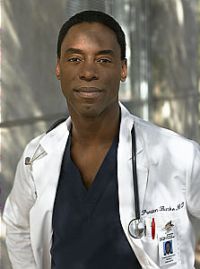
When we last left ABC’s Grey’s Anatomy, Dr. Preston Burke had left his fiance at the altar and had moved out of their shared apartment. As the source of a great deal of controversy over the past year thanks to the use of a hateful slur against gay castmate T.R. Knight, actor Isaiah Washington‘s job was often in jeopardy in the eyes of television media, but Shonda Rhimes always stuck by her star. With the season over, however, that has changed: as of this moment, Isaiah Washington has been fired from Grey’s Anatomy.
There is something fascinating about this whole saga, and I think that it goes beyond the question of homosexual actors in hollywood. Over the past year it seems like “Coming Out” is becoming standard practice: Lance Bass, Neil Patrick Harris, T.R. Knight and most recently David Hyde Pierce have all done so. T.R. Knight, however, was the only one to really be forced out of the closet thanks to a tabloid story, which makes him the most distinctive case. Despite a much more open society, it seems being gay is still seen as an oddity, as something that (when revealed) changes everything. Washington’s use of the ‘f-word’ was certainly an instigative act that resulted in him going into counseling and taping a PSA on the subject of equality.
The media has beaten this angle of the story to death, although not unjustly so. Washington’s statement was hurtful, juvenile, and unacceptable, and if this is punishment for that act then there is reason to be pleased with this retribution. However, I think that Washington’s problems did not stop there, and that as an individual his actions AFTER the event have gone somewhat unanalyzed. If you are Shonda Rhimes, how do you handle an actor whose actions off-screen affect his on-screen character to the point of overshadowing the show itself? And, if you’re that actor, how could you possibly return to work in that scenario? It’s an important question, and one that has been raised in the past. And one that Cultural Learnings will now analyze.
[In Week Two of Cultural Learnings’ 59th Annual Emmy Awards Nominations Preview, we’re looking at possible contenders for the Supporting Actress awards in both drama and comedy. Today, we present our first set of candidates. For last week’s Supporting Actor candidates, and an index of all candidates, Click Here]
Supporting Actress in a Drama
Elizabeth Mitchell (Juliet)
Lost
We first met Elizabeth Mitchell’s Juliet at the beginning of season three, as she became Jack’s all-purpose wrangler if you will. She brought him sandwiches, she played him Bob Dylan-style video tapes in an attempt to seize control, and she assisted in surgeries despite only being a fertility specialist. Throughout that six-episode mini-arc, this was all we knew about Juliet. Mitchell’s portrayal was certainly strong, but the character was just another Other as far as we could tell. However, with “Not in Portland” (The first episode back from hiatus), Juliet was thrust into the centre of the Others’ history, and Mitchell was up to the task. Throughout the remainder of the season, she became an intricate and powerful part of this ensemble, and at season’s end she was still as complicated and engaging as ever. Much like Michael Emerson, Mitchell had an incredibly tough task ahead of her. And, like Emerson, she stepped up to the plate with a performance worthy of Emmy consideration.
Juliet could have been a fairly mediocre character in the wrong hands. She has been used as a disruptive influence in the relationship between Jack and Kate, and became “the other woman” to the castaways as well when Jack brought her back to camp following their adventures. And yet, Mitchell always managed to create a character that we outwardly liked, even when they were doing somewhat evil things. When we learned that she was still working for Ben as she took Sun to the medical hatch, we as viewers wanted it to be false, wanted there to be some kind of explanation. Mitchell’s portrayal made us want to like her, something that could have been difficult considering who the Others are.
This season of Lost was all about humanizing the Others, providing them a perspective on this island. Without performance like Mitchell’s, I think the Others might have remained faceless villains, incapable of becoming part of the show’s mythology. Juliet became someone we outwardly liked through a complex back story, a relatable situation trapped between two sides, and by never completely showing her cards. The show asked a lot of Mitchell, and she stepped up every single time. I was never bored with Juliet, and I’m not sure I will ever be. Elizabeth Mitchell is now an integral part of Lost’s ensemble, and her ability to weave Juliet into the show’s complicated storyline is Emmy worthy.
Episode Selection:“One of Us” (Aired April 11th, 2007)
Juliet’s second episode worth of back story, One of Us is a tumultuous journey through her time on the island, coinciding with her present struggle to become part of the culture at the beach. It is a fantastic portrayal from Mitchell that gives her a wide range of scenes that would pull any Emmy voter into her direction. She has so many that I had an incredibly tough time picking just one. Her nervousness before she heads to the island? Her breakdown after yet another woman dies during childbirth? Her smackdown of Sayid and Sawyer as she gather the medical equipment? All of them are noteworthy, but the one I must showcase is where she confronts Ben about his tumour. He had promised to cure her sister of cancer, and yet he has it himself: Juliet is unpleased, and Mitchell’s portrayal is honest and just fantastic. This is an acting tour de force, and it cannot be ignored.
I believe that one of the greatest disservices of this television season was the character homicide of Jan Levinson on NBC’s The Office. After three seasons worth of strong, subtle performance from Melora Hardin, she was turned into a boob joke and a serious case of the crazies. While it provided some comedy, sure, what was always entertaining about Jan was how she walked the line between neurotic mess and corporate role model. Her relationship with Michael was her trying something new, trying to find stability where there was none. If she was the comedic form of humpty dumpty, she had a great fall at the end of the season. But, I hope that Emmy voters will be able to remember how to put Melora Hardin’s subtle and entertaining comic performance back together when it is time to submit their ballots.
[In Week One of Cultural Learnings’ 59th Annual Emmy Awards Nominations Preview, we’re looking at possible contenders for the Supporting Actor awards in both comedy and drama. Today, we present our last, and seventh, set of candidates. Tomorrow, we’ll begin looking at Supporting Actresses. For all Supporting Actor candidates, Click Here]
Supporting Actor in a Drama
Terry O’Quinn (John Locke)
Lost
I’ve saved Terry O’Quinn until the end not because I don’t know what to say, but rather because it almost feels unnecessary to say it. After unjustly losing the Emmy two years ago, Terry O’Quinn has unfortunately gone unrecognized for his role as John Locke, and in a way it makes sense. The 2nd season wasn’t a big one for Locke, as he lacked a true defining moment. It was more of a general pattern, his obsession with the Hatch being a long, drawn out affair as opposed to a single emotional moment. However, I will make no excuses for the Emmys or any other awards show when it comes to the coming awards season. Because, when it comes to supporting performances, no character had a bigger episode this season than John Locke, and no actor stepped up to the plate like Terry O’Quinn. And for that, my friends, Terry O’Quinn deserves an Emmy.
This season, Locke was given the opportunity to finally reconnect with the island, the very thing that had so tempted him in the first season when he stumbled upon the hatch. Without that hatch to rely upon, Locke was asked to step up to the plate and lead his people after Eko’s untimely death. The result of this was Locke regaining his faith, of sorts, from Eko’s scripture-laden stick, and sending him on a journey to find the Flame Station, the Others’ compound, a certain submarine, a magic box, a gruesome task, a fateful journey, a mysterious encounter, a near fatal shooting, a visitor from his past, and a final plea to Jack to not allow outsiders to enter the sacred island he now calls home. That journey, taking place in the second portion of the season, hearkened back to the Season One Locke we knew and loved.
And O’Quinn was right back with it. Don’t call it a comeback for O’Quinn, though, because he was just as solid in the second season as he was here. However, the content of each season can’t be compared: whereas Locke became marginal in season two, he was the centre of attention in season three. And O’Quinn rose to the occasion, never backing down from a challenge and marking some memorable exchanges with Sayid, with Jack, and with the leader of the others, Ben. At all times, O’Quinn played Locke like the man of faith again, the man who believes when others don’t and, perhaps, might just be onto something. Lost wouldn’t be the same without Locke, and the Emmy Awards will not be the same without Terry O’Quinn. They made a mistake two years ago, and it’s time they made it up to him.
Episode Selection:“The Man From Tallahassee” (Aired March 21st, 2007)
In Season One, Terry O’Quinn should have won that emmy for Walkabout, the episode where we learned he had previously been in a wheelchair (One of the show’s best reveals, perhaps only topped by this season’s finale). In Season Two, O’Quinn was at his finest when sparring with Henry Gale, the prisoner in the hatch who we later learned was the leader of The Others. The Man from Tallahassee takes these two elements (Locke’s past paralyzation and his confrontations with Ben) and puts them into the same episode. The result is a philosophical and powerful hour of television that wraps itself around the island as a character, Locke’s journey, and most importantly: we finally learn how Locke lost the use of his legs. It is perhaps the final chapter in Locke’s journey, that final piece of the puzzle, and Terry O’Quinn knocked it out of the park. If this performance isn’t worthy of an Emmy, I don’t know what is.
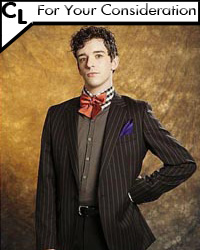
After watching the pilot for Ugly Betty, I felt that the show was far too vindictive. At that time, the various intricacies of the show were tossed aside in favour of fish out of water at its finest. The staff at Mode magazine were downright mean to hapless, unfortunately dressed Betty, and the result was that they all became instant villains from that moment onwards. And, thus, it is to the show’s credit that they managed to take these people and turn them into human beings who we empathize with on a weekly basis. One of those individuals is Wilhelmina’s flamboyant and biting secretary Marc, and Michael Urie’s portrayal of the character has managed to turn heartless into heartfelt. In a show that has transformed itself along with its titular heroine, Urie’s performance is absolutely part of that reason, and for it he deserved to be considered for an Emmy Award.
Television Critics are, for the most part, much better informed on the actual quality of network and cable television as opposed to being completely ignorant to various entertaining programs. As a result, these are awards that actually give us an indicator of who gave the best performances, not just who submitted the best episode. And, let me tell you: the result is an intense race that creates categories impossible to decide upon.
Program of the Year
“American Idol” (Fox)
“Friday Night Lights” (NBC)
“Heroes” (NBC)
“Planet Earth” (Discovery)
“The Wire” (HBO)
“When the Levees Broke” (HBO)
This is such a bizarre category, because it’s really more defined as programming from I guess a…I don’t even know what it means. Either way, you’ve got reality television, family drama, Sci-Fi drama, Nature Documentary, gritty HBO drama, and a Katrina documentary. That’s a diverse mix of shows right there. Are they looking for something new, something powerful…I don’t even know.
Comedy Series
“30 Rock” (NBC”)
“The Daily Show” (Comedy Central”)
“Entourage” (HBO”)
“The Office” (NBC”)
“Ugly Betty” (ABC”)
This category is just unfair, TCA. The Office against The Daily Show? Throw 30 Rock into the mix and you’ve got an impossible decision to make. I really have no idea how I’d decide on this one, and I for one support separate variety categories just to keep this conundrum from taking place.
Drama Series
“Friday Night Lights” (NBC”)
“Heroes” (NBC”)
“Lost” (ABC”)
“The Sopranos” (HBO”)
“The Wire” (HBO”)
We don’t know how much this will coincide with Emmy’s list, but I feel for certain that three of these shows will be named on July 19th. The Wire is one of those shows that has never garnered Emmy attention due to its lack of Network coverage, and without star power or pedigree it might have trouble breaking through at the Emmys. However, the amount of critical attention given to the series might make it something to catch up on this summer.
Umm, TCA? Are you following my viewing habits or something? I doubt they are, but these five shows are likely to make it onto my respective Drama/Comedy Emmy FYCs in July, and are probably my top 5 new shows of the season. I’m especially happy to see Dexter getting some love, it is most deserved.
[In Week One of Cultural Learnings’ 59th Annual Emmy Awards Nominations Preview, we’re looking at possible contenders for the Supporting Actor awards in both comedy and drama. Today, we present our third set of candidates. For all candidates, Click Here]
Best Supporting Actor in a Comedy
Jack McBrayer (Kenneth the Page)
30 Rock
Kenneth the Page is perhaps one of the simplest characters in all of television. A lowly NBC page for the cast of the fictional The Girlie Show, Kenneth believes in the power of television and little else. We see glimpses of him talking to his skeletal mother, we see moments of absolute naivety, and on occasion his innocence can seem quite exaggerated. And yet, what we originally believed was cluelessness was actually just a different perspective, simple without being stupid. Kenneth believes in the magic of television, and I, as a result of Jack McBrayer’s performance, believe right along with him.
What McBrayer brings to the role is just the right balance of simple and smart, which is such a hard thing to balance. When Kenneth becomes a poker all-star, Jack spends days trying to figure out his tell. However, the point is that Kenneth has no tell. He is capable of looking and acting entirely smart, even when he’s really clueless. However, on the other hand, he is often able to be entirely smart even when he seems simple on the outside.
And it is that innocence that makes McBrayer’s performance so difficult: in the hands of the writers, McBrayer needs to walk the fine line between stupid and naïve every single episode. And yet he always achieves: while certain episodes are worse than others, Kenneth always is as endearing as he could possibly be, and completely funny when required. For being able to strike that balance and create a scene-stealing supporting character, Jack McBrayer is worthy of an Emmy Nomination.
Episode Selection: The Head and the Hair (Airdate: January 18th, 2007)
While the episode’s title refers to a storyline unrelated to Kenneth, and there are technically three stories at play within this episode, Kenneth has by far his finest moments within it. The reason is that he gets copious amounts of screentime with Alec Baldwin, who as per tradition is taking over Kenneth’s job for the day. We get to see Kenneth’s dirty work, the things he has to put up with on a regular basis, plus Kenneth gives multiple impassioned speeches about television. And then, at the end of the episode, he sells his game show idea to NBC executives. While Kenneth plays a major role in other episodes, here his story arc is touching, complete, and funny in a way that is deserving of Emmy Attention.
I would not be putting Dominic on this list three weeks ago, which I guess is somewhat contradictory. Charlie has been absent from key storylines for a very long time this year, and I was amongst many who was happy to see that he was fated to die according to Desmond’s flashes. And yet, perhaps spurned on by his imminent departure from the show, Charlie began to become likable again. No longer saddled with nothing of consequence, Dominic delivered a performance towards the end of the season that almost made Charlie likable before finally nailing it by season’s end. And that delivery, making me actually care about his fate, is enough for me to deem him worthy of a potential Emmy nomination.
[In Week One of Cultural Learnings’ 59th Annual Emmy Awards Nominations Preview, we’re looking at possible contenders for the Supporting Actor awards in both comedy and drama. Today, we present our first two candidates.]
Best Supporting Actor in a Comedy Neil Patrick Harris (Barney) How I Met Your Mother
I started watching How I Met Your Mother at the beginning of May, and have gone through the entire two seasons within a month. After watching the pilot when it premiered in 2005, I remember thinking closely about the performance of the former Doogie Howser. In the pilot, you can tell that he was meant to be wacky, with the focus on catchphrases like “Suit Up!” and “Legendary”. And, as a result, part of me wrote the character off as I lost touch with the series. I now realize that this was a terrible mistake, and after a fantastic two seasons of work Neil Patrick Harris deserves an Emmy nomination.
Barney has become something more than a womanizing flack with a high-end job and a lair-like apartment over the past season, and the result was some strong character moments. We saw the inside of his apartment, we learned that he had played a major role in Lily’s return from San Francisco, and we got to become an Uncle to his gay brother’s adopted boy. The character got a fair amount of dynamism in his storylines to go along with his usual strong supporting comedy, and that is the mark of a great supporting actor. When he needs to be simple and foil for the leads or other characters, he is fantastic at quips, comebacks, and all of that fluff. However, when the show asks more of him, Neil Patrick Harris always steps up to the plate. Even in its more derivative moments, Neil Patrick Harris raises How I Met Your Mother to whole new levels of awesomeness.
Episode Selection:Showdown(Airdate: April 30th, 2007)
There is no better example of Neil Patrick Harris’ finest moments than within this tour de force that literally becomes the Barney show in its last act. Believing since childhood that Bob Barker was his biological father, Barney finally gets the guts to travel to Los Angeles and confront him live on the show. From his price memorization (He knows everything) to his fake surprise, it’s all fantastic comedy…but then the moment where he prepares to inform Bob that he is his father is just heartbreaking, and the arc actually means something to him as a character to see that he couldn’t go through with it. If Emmy voters see this episode, I do not see how Neil Patrick Harris won’t be on the ballot.
Last season, Michael Emerson made an impact on Lost as Henry Gale, the captured Other who was kept within the Hatch for an extended period of time. He gave an eerie and compelling performance, but we were not yet truly introduced to the character in question. It is thus impressive that Ben, the leader of the Others, has managed to develop into a full fledge part of this ensemble cast with mysteries, intrigue, and a fantastic performance from Michael Emerson worthy of an Emmy nomination for Best Supporting Actor in a Drama.
This week, ABC Studios is announcing their official release dates for their upcoming season DVD sets. Of these shows, the most anticipated is the Season Three release for ‘Lost’. And yet, it is also the one that would be most difficult to schedule.
On one hand, the series’ third season was its least watched by a wide margin, and yet ended so strongly that it is creating a lot of buzz with people who gave up on it midway through the season. As a result, there are likely a large number of people who want to catch up, and will want DVDs with which to do so.
On the other hand, Season 4 of the series is not premiering until February. In order to best make use of the marketing tools used when launching a DVD series, they are always designed to also advertise the pending return of the show. Launch the DVD set too early, and you lose that opportunity.
In the end, Lost followed the lead of fellow Spring drama 24 by deciding on a mid-december release date (December 11th, 2007) for the Season Three DVD. This puts them in the heart of the Christmas shopping season, and creates some momentum that the network can take advantage of over the following two months before the 4th season begins.



 Lead Actor in a Comedy Series
 Lead Actor in a Drama Series

 When we last left ABC’s Grey’s Anatomy, Dr. Preston Burke had left his fiance at the altar and had moved out of their shared apartment. As the source of a great deal of controversy over the past year thanks to the use of a hateful slur against gay castmate T.R. Knight, actor Isaiah Washington‘s job was often in jeopardy in the eyes of television media, but Shonda Rhimes always stuck by her star. With the season over, however, that has changed: as of this moment,
 Supporting Actress in a Drama
 Supporting Actress in a Comedy
 Supporting Actor in a Drama
 Supporting Actor in a Comedy
 Best Supporting Actor in a Comedy
 Best Supporting Actor in a Drama
 Best Supporting Actor in a Comedy
 Best Supporting Actor in a Drama
 This week, ABC Studios is announcing their official release dates for their upcoming season DVD sets. Of these shows, the most anticipated is the Season Three release for ‘Lost’. And yet, it is also the one that would be most difficult to schedule.


 Cultural Learnings