Tag Archives: Review

Mad Men – “A Little Kiss” & “Tea Leaves”

“A Little Kiss” & “Tea Leaves”

March 25th/April 1st, 2012

When James Poniewozik announced a few weeks ago that he wouldn’t be reviewing Mad Men’s fifth season week-to-week, I quietly made plans to follow suit given a busy semester with a whole lot of Monday deadlines. The idea of covering Mad Men without screeners in addition to covering Game of Thrones (for which I have screeners), all on the night before my busiest day of the week academically-speaking, was simply inconceivable until at least the end of May.

However, a few people sent emails and tweets wondering where my coverage was, at which point I realized that I had never exactly made these plans public. While I’m sad to be in a position where writing about the show weekly isn’t a feasible option, I’m also a little bit glad, if we’re being honest. I didn’t get to watch “A Little Kiss” until Wednesday night, but there was something freeing about watching it without a computer on my lap.

This doesn’t mean that I didn’t have opinions, and I want to share a few reflections on the first two episodes after the jump, but there’s a point at which the exhaustive writeup becomes, well, exhausting. As has become clear this year in particular, I no longer have the time to write post-air reviews of every show I watch, but I also think that with time I lose the inclination. Between the long hiatus and the weight of writing 2000+ words per episode for four seasons, Mad Men has simply transitioned into a show I enjoy more when I don’t feel the need to stake my authority over each episode in the hours after it airs.

However, as noted, I do want to offer some thoughts on the season’s beginnings, and would like to write with more regularity (if not necessarily on a weekly basis) once the semester ends and the season moves into its final episodes.

Continue reading

2 Comments

Filed under Mad Men

Season Premiere: Game of Thrones – “The North Remembers”

“The North Remembers”

April 1st, 2012

“For the night is dark and full of terrors.”

Game of Thrones is a very different show now than it was when the first season began last April. “Winter is Coming,” the series premiere, was an introduction to the world of Westeros, the characters who inhabit it, and the basic principles of honor which would be torn asunder over the course of the next ten episodes. It was a hint at the dangers that lurked beyond the wall, a glimpse of the paths being forged for those south of it, and a beginning of what would become a much larger, and on some level never-ending, journey.

By comparison, “The North Remembers” tells a very different story. Those dangers are now more real, those paths well trodden, and that journey more expansive than that first episode could have established. Where there was one king there are now four, each staking a claim on power that might well lie in the hands of those who wear no crown and yet play their games behind the scenes, and there are more Kings and Queens waiting in the wings for their opportunity to strike in the future.

However, the strategies of these two episodes are nearly identical, each tasked with providing a bird’s eye – or, rather, comet’s eye – view of the narrative map of the series as it stands at this very moment. While “Winter is Coming” was introducing characters for the first time, “The North Remembers” is fittingly enough about restoring the audience’s memory. Using similar strategies to the series premiere, the episode drops in on the various story threads we left back in June, a helpful reminder for those who haven’t revisited the first season on DVD or HBO Go.

Continue reading

12 Comments

Filed under Game of Thrones

A Westerossi Balancing Act: Game of Thrones Season Two [Review]

Review: Game of Thrones Season Two

March 29th, 2012

What do people really want to know about HBO’s Game of Thrones as it enters its second season?

When the first season premiered, writing a pre-air review was an easy process. Fans wanted to know how well George R.R. Martin’s A Song of Ice and Fire had been adapted for the screen by David Benioff and D.B. Weiss, and non-fans wanted to know if the result still qualified as a television show worth their time. These questions were conveniently interlinked, in that the show’s success as an adaptation (faithful but not slavish, episodic without losing broader narrative complexity) was very much part of its appeal to non-readers.

However, I found myself somewhat stumped as I sat down to write about the first four episodes of the second season. The challenge is that we’ve already answered those broader questions, and to my mind the answer hasn’t changed – the show is still a compelling and worthy adaptation of Martin’s series, and that still results in some tremendous television. I have some specific comments about nuances in the adaptation, and some opinions about how certain stories are being depicted, but I don’t feel as though I have anything new to add to the growing chorus of people praising the show upon its return as a preface to my post-air reviews which will go up over the next four weeks (and which will delve into those nuances and opinions in more detail).

Looking to solve my writer’s block, I opened up the conversation to my followers on Twitter and the users at NeoGAF (where a lively community has been built around the show), asking them whether they had any lingering questions they had which they didn’t feel had been covered by the mass of reviews to date. While I want to address a few directly, the larger takeaway was that readers and non-readers might have more in common as the show goes forward than I had presumed, a notion I’d like to explore further.

Continue reading

8 Comments

Filed under Game of Thrones

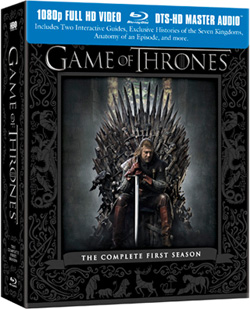
A Gloss of Thrones: Game of Thrones – The Complete First Season [Blu-ray Review]

It is now widely accepted that the way we watch television is a variable – if you’re reading this, chances are that I don’t have to regale you with the myriad ways we can now watch the programming we’ve historically viewed live in primetime, and so I can keep my big “DVRs, Streaming, and Bears, Oh My!” song and dance in my pocket for the time being.

However, I would argue that Game of Thrones represents a specifically complicated television text in this regard. Like all shows, there are questions of how it played on a week-to-week basis compared to how it would play as a marathon, questions that partly inspired the tremendous discourse around television narrative spurred on by Ryan McGee’s essay at The A.V. Club. However, in addition, the variables of consumption around the show are equally divided by the nature of its source material, with perhaps the clearest binary between “reader” and “non-reader” in television history. The result, I would argue, is a complex, diverse audience base who watches the show from different perspectives which make it difficult to generalize regarding what attracts them to a DVD or Blu-ray box set.

However, with Game of Thrones‘ Complete First Season (which I reviewed on Blu-ray), I really think HBO has succeeded in creating a set that has more than a little something for everyone, worth the price of admission for both readers and non-readers alike (along with those who are watching for the first time, for whom this set is a tremendous introduction). The production values are exceptional, the features are fairly plentiful, and the set fits comfortably into the quality aesthetics that both the show itself and the earlier paratexts achieved last year.

And yet, while I can easily recommend this set based on its own merits, there’s still some part of me who was left wanting, if not something more, than perhaps something different.

Continue reading

4 Comments

Filed under Game of Thrones

Smash – “The Callback”

“The Callback”

February 13th, 2012

As is evidenced by the limited output here at Cultural Learnings, I don’t have a lot of free time right now, which is why I’ve been prioritizing watching television (an exercise that I find particularly useful in teaching contemporary television) over writing about television (which, while still something I enjoy, often ends up taking up time that I simply don’t have). As a result, I didn’t review the pilot of NBC’s Smash beyond my initial thoughts after watching the episode on iTunes ahead of its airdate.

However, as Noel Murray has quite rightfully pointed out in his review of tonight’s second episode, “The Callback,” I wasn’t exactly quiet about the show last week. I’m not sure what exactly had me so punch on Monday evening as I watched the pilot for the second time, but I think Noel is right to suggest that I was being “provocative” in my attempts to boil down Smash to its most basic qualities. One of my Twitter followers actually called me on being evaluative so early on, but I did clarify that I didn’t see my tweets as evaluative: the show is still finding itself, which means I’m willing to give it time to grow.

That being said, there is something about the Smash pilot that seemed markedly prescriptive, clearly delineating how we were to feel about the onscreen action despite the inherently subjective nature of musical theatre (and performance in general). While I agree with Noel that parts of “The Callback improved on the exclusivity of the pilot’s narrative, grounding the dueling narratives of Ivy and Karen in more concrete performance styles, the show is still operating with a baseline: while it might be open to your opinion on which of the two performers is better, you need to accept that both of them are world class talents. It’s a notion that I’m still struggling with, and a notion that reflects the problems of narrowly defining and serializing a circumstance that would be considerably more complex (if less immediately marketable) in reality.

Continue reading

Leave a comment

Filed under Smash

The Search for Significance: The Television Industry and the Golden Globes

Earlier this evening, my brother directed me to a piece at Slate defending the Golden Globes, something that we don’t see particularly often. Indeed, that is very much the impetus behind Tom Shone’s argument, praising the Globes relative to the Academy Awards for a collection of strong choices that the Academy would undo a month later (such as, for example, the Globes honoring Brokeback Mountain only for the Oscars to choose the turgid Crash instead).

Shone’s argument is interesting, primarily because it does little to hide its anecdotal nature. He argues that while we might contest many choices that the Globes have made over the years, they have done enough good in enough instances to be “worth it” in the end. While some might question the value of their existence, Shone believes that looking at even a handful of examples where they were legitimately ahead of the curve, or where their whims happened to match with how cinematic history would remember a particular year in film, justify any travesties they might otherwise commit.

My brother’s question to me, upon informing me of the article, was whether I would suggest the same could be said for television, a thought that I was preoccupied with throughout tonight’s Golden Globes broadcast. Whereas the Golden Globes line up comfortably as a precursor for the Oscars, the Globes’ relationship with the Emmys is complicated by their differing eligibility periods and voting structures. However, building on Shone’s argument, there was evidence within tonight’s broadcast that some of the Globes’ voting habits that we might otherwise vilify in particular contexts proved to benefit shows that I like, and shows that may not necessarily be lauded to the same degree come September.

My takeaway from this is not necessarily a validation of the Golden Globes or the Hollywood Foreign Press Association, but rather an increased belief that our assessment of award shows needs to become more nuanced, both in terms of how we perceive them as cultural entities and in terms of how we consider their industrial – as opposed to cultural – significance as a framework for understanding their greater “meaning.”

Continue reading

6 Comments

Filed under Golden Globes

Season Premiere: Shameless – “Summertime” and Televisual Space

“Summertime” and Televisual Space

January 8th, 2012

After rewatching the entire first season over the holidays with my parents, I found myself enjoying Shameless more than when it premiered (as I wrote about soon after), and I looked forward to checking out the second season. What I wasn’t expecting, though, was to find it so disarmingly different from what we saw last year.

This isn’t to say that the show has dramatically changed its approach to storytelling, although there is evidence to suggest that they are finding better ways of balancing the different character dynamics based on reviews from critics who have seen beyond tonight’s premiere. Rather, the fast-forward to the dog days of summer has created both a temporal shift and, more importantly, a spatial shift in terms of the characters and the world they live in. More generally, though, the long summer days offer a plethora of sunlight, dramatically transforming the aesthetic of the show and signaling a new season in a very direct, meaningful fashion.

I realize that this is not particularly evaluative, and if we were to speak exclusively on those terms I found the premiere promising but uneven, but I want to spend a bit of time discussing these changes relative to the question of space, an increasingly important factor as worlds begin to converge in a new spatial dynamic within the series.

Continue reading

Leave a comment

Filed under Shameless

Glee – “The First Time”

“The First Time”

November 8th, 2011

There is something very effective about “The First Time,” a poignant piece which uses the backdrop of the performance of West Side Story to tell three parallel stories of romantic love moving to another level.

There is also something very contrived about “The First Time,” an episode that still feels the need to force the issue of sexual intercourse in a blunt fashion, lest we be unclear what the episode was about.

I’ll admit that the tension between these two elements never quite disappeared throughout the episode, one which I can admire for its simplicity even as I cringe at the way it creates that simplicity through exclusion and a narrowing of perspective. That I ultimately consider the hour a success says something about “The First Time” as an episode, but I’m not convinced that we can suggest this as a key turning point for the series so long as its structure is so exclusively tied to the episodic structure of the hour.

Continue reading

7 Comments

Filed under Glee

Season Premiere: Work of Art: The Next Great Artist – “Kitsch Me If You Can”

“Kitsch Me If You Can”

October 12th, 2011

As we drew closer to the season premiere of Bravo’s Work of Art, I began to get very nervous.

Last summer, I wrote a number of pieces that I think accurately capture my general obsession with this show, a complex and enormously flawed exercise that revealed things about the artifice of reality programming, the perils of reality editing, and the challenge of combining reality competition structure with something as purely subjective as fine art. However, while these difficulties may make it problematic within the fine art community, as a television critic I found Work of Art to be one of the most truly satisfying reality series I had ever seen. Each episode showed us something new about the artist, and their personal narratives were constructed, deconstructed, and reconstructed numerous times over the course of the season. So whether I was writing about the show at large, or about two of its contestants (Miles Mendenhall and Jaclyn Santos), I had a lot to say.

Sadly, I will not have time to say as much this fall simply due to time constraints, but going into tonight’s premiere I wondered if I was going to have anything to say at all. For some reason I became profoundly worried as of late that the show wouldn’t be able to catch lightning in a bottle twice, especially since it didn’t seem like the show did so on purpose last time around. The tension that once sat at the center of the show could easily be diffused with a production staff now aware of the series’ flaws, and a set of contestants who fully understand what it is that the show is trying to accomplish.

While I have not seen beyond tonight’s premiere, I feel as though I can state with some authority that all has not been lost. “Kitsch Me If You Can” is an extremely strong opener, managing to introduce the artists while simultaneously focusing almost exclusively on their process rather than their personalities. Although “The Sucklord” may be larger than life, for the most part the cast seems to consist of artists with points of view who will be tested and tested again over the course of the competition.

And the results, at least in tonight’s finale, were pretty fantastic.

Continue reading

Leave a comment

Filed under Work of Art: The Next Great Artist

Season Finale: Breaking Bad – “Face Off”

“Face Off”

October 9th, 2011

“I won.”

For the sake of the fact that writing an opening without spoilers feels like an impossibility at the moment, let’s throw all of this behind the fold and get to the real meat of the issue.

Continue reading

16 Comments

Filed under Breaking Bad