
Tag Archives: TV

Season Finale: Orphan Black – “Endless Forms Most Beautiful”

OrphanBlackTitle

“Endless Forms Most Beautiful”

June 1st, 2013

When I attended the Television Critics’ Association Winter Press Tour in January, BBC America presented a panel for Orphan Black, a new drama series originating from Canada (where it airs on Space). It was an interesting panel to attend, because none of the critics in the room had no opportunity to watch it: while we were shown a quick trailer to help give us context, most of the questions were actually asking for more information as opposed to specific responses to the series. What we saw looked interesting, and the panel was enjoyable, but it was an exploratory exercise in a space where greater context is necessary to achieve any real insight.

Reading back over the transcript of that panel, and revisiting this fun interview Will Harris did with the three stars in attendance, I couldn’t help but smile. In retrospect, there are plenty of hints there about the show Orphan Black would become: a fearless, balls to the wall science fiction pleasure that’s smart as hell. Co-creator Graeme Manson was asked about the possibility of flashbacks, to which he responded “Yeah, actually, none at all. We really, really like a story that’s like a runaway train that keeps you on the edge of your seat and has you not sure whether the story is going to take a hard left or a hard right.” Tatiana Maslany was asked about the challenge of playing multiple roles, and explained “Yeah, it’s a challenge, the different arcs. You know, there’s so many arcs to it. So it’s a bit of a mind — I keep wanting to say the wrong word.”

The wrong word is the right word in this case: Orphan Black is a mindfuck, and ends its first season with another segment in the runaway train first season, one that becomes four climaxes in one by the time it reaches its conclusion.

Continue reading

7 Comments

Filed under Orphan Black

That was (writing about) Arrested Development: TV Criticism in a Binge-Viewing Era

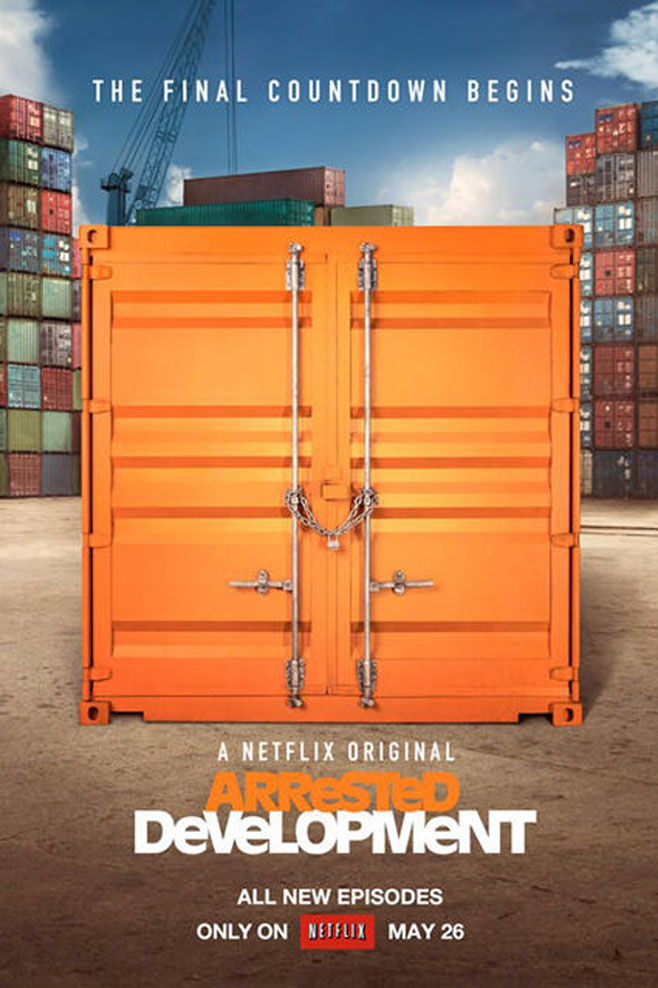
Arrested-Development-Season-4-PosterThere have been suggestions floating around in comment sections that the Netflix model—the decision to release every episode all at once—eliminates the function of traditional episodic television criticism. With viewers now able to choose the pace at which they watch episodes, potentially watching an entire season of Arrested Development in one session if they’re so inclined, the need for critics to evaluate individual episodes is no longer present. This is doubly the case, some would argue, with the puzzle-like structure of Arrested Development’s fourth season, which further confounds episodic analysis through its choice to emphasize each episode’s connection to a larger story arc one can’t truly appreciate until you’ve seen all fifteen episodes.

We’ve been talking about the former ever since Netflix released all of House of Cards at once in February, and there has been further conversation in the buildup to Arrested Development’s this weekend (including the ridiculous theory that critics are biased against Netflix for destroying their cultural purpose, a claim I responded to here). However, I have to admit that I’m not sure Netflix’s paradigm shift is actually anything close to a paradigm shift. Putting aside the fact that Netflix’s claim we will in the future move to a completely mass-release system of television distribution—which I talked about in a CBC Web Chat last week—ignores a lot of functional realities of the television industry which have permeated even webseries distribution patterns, I still feel like episodic and other forms of television criticism are useful and productive within the space of binge viewing habits.

Any suggestion to the contrary seems to be operating with a very limited conception of how and why episodic criticism is written, which functions in opposition to the ways in which binge viewing can allow us to expand—rather than contract—forms of television criticism in the wake of the binge viewing moment.

Continue reading

2 Comments

Filed under Television

Mad Men, The Americans, and Brushes with Everyday Terror

madmen2

“The Crash” and The Americans’ “Trust Me”

May 21st, 2013

Of the shows I fell behind on earlier this year, The Americans is what I’ve considered my first priority to catch up on, although even that has been a slow process; I just finished “Trust Me,” the sixth episode of the FX series’ acclaimed first season, last night.

However, sometimes timing is fortuitous, as I watched it after having watched—and podcast with the folks at the Mad World Podcast—about Mad Men‘s “The Crash,” and I was struck by a shared interest in how the normal manifests within the sensational. Obviously, “Trust Me” isn’t a trippy drug trip, but it nonetheless juxtaposes a form of psychological struggle or torture with scenes of danger that at first manifest as part of the game but eventually appear to be simply a coincidental brush with everyday terror.

Continue reading

1 Comment

Filed under Mad Men, The Americans

Game of Thrones – “Second Sons”

GameOfThronesTitle2

“Second Sons”

May 19th, 2013

“I always have a choice.”

“Second Sons” opens with a choice. Arya wakes up to discover that her captor has fallen asleep, and picks up a rock with which she intends to kill Sandor Clegane, a man she believes to be taking her back to King’s Landing. However, as she grows closer, it turns out the Hound isn’t sleeping at all, and he gives her a choice: she can put the rock down, or she can take one shot at killing him with it. The catch is that, should she choose the second option and the Hound remains alive, he’ll break both of her hands.

It’s not really a choice when you think about it, as Arya’s trust in her own strength isn’t quite enough to make her hands worth the risk. It’s also not much of a choice given that she’s his captive, even if he intends to take her to Robb and Catelyn on the Twins as opposed to taking her to King’s Landing and the Lannisters. As much as Arya struggles against the place in life that was determined for her, and as much as she tried last week to go back to the independence she craves, she still finds herself in a position where choices are not available to her.

It’s far from a complicated theme, but what I like about “Second Sons” is the resignation of it all. Arya sitting on the Hound’s lap as he rides toward the Twins is an evocative image, both because of the beautiful countryside mirroring Arya’s hope at seeing her family and because she’s not bound or tortured or anything of the kind. Rather, she’s accepted her fate as the fate put before her, and will comply if only because it’s the most effective way to survive until the day where you have choices you did not have before.

It’s a position that comes to bear on many episodes as the season goes on, as characters struggle with the lack of agency that comes naturally with being born—or being treated—as a second son.

Continue reading

7 Comments

Filed under Game of Thrones

Game of Thrones – “The Bear and the Maiden Fair”

GameOfThronesTitle2

“The Bear and the Maiden Fair”

May 12th, 2013

“How do the men holding the banners fight?”

I’m always interested by what online conversation refers to as “Filler” episodes. By all accounts, “The Bear and the Maiden Fair” fits the bill as far as I understand it: no major events take place, a lot of storylines are merely ways of reminding us of what’s about to happen and the stakes for those involved, and there’s not that big triumphant moment that takes the story in a new direction.

As a result, “The Bear and the Maiden Fair” never evolves into a particularly exciting hour of television, content mostly to sketch out the boundaries of the season’s storylines in preparation for the oncoming climax. In the hands of A Song of Ice and Fire author George R.R. Martin, the hour functions not unlike the dominant narratives of his books: a lot of people talking about doing something or going somewhere or being someone. At times cheeky in its references to future book material, the episode mostly settles for a sort of muddled clarity, a promise that there is a future even while acknowledging it to be a dark and complicated one.

Continue reading

10 Comments

Filed under Game of Thrones

Game of Thrones – “The Climb”

GameOfThronesTitle2

“The Climb”

May 5th, 2013

“If you think this has a happy ending, you haven’t been paying attention.”

“The Climb” begins with three groups of characters who share a common goal: reaching The Wall. While Jon and Ygritte are with the wildlings as they prepare to scale it, Bran and Sam are moving toward the Wall from opposite directions.

For viewers, The Wall has been a prominent object for the series, one of the first images we saw to introduce a sense of the scale of Westeros. It’s a prominent part of the credits, sure, but it was also key to the series’ prologue. When Jon Snow saw the Wall for the first time, it was a formative moment for the character, just as it’s foretold as a prominent moment for Gilly, who can’t even imagine the stories Sam tells her about the structure. It’s something so large that it persists even for those who have never laid eyes on it, something that holds power even when the vast majority of its expanse lies unguarded. The Night’s Watch may be in charge of protecting the Wall, but the Wall does most of the protecting itself, a single crack in the ice capable of nearly killing the entirety of the Wildling party.

The “Game of Thrones” would be difficult enough if its only threat were static obstacles like The Wall (or the threat of the White Walkers beyond it, which is ostensibly still the most prominent threat to the entirety of Westeros). But “The Climb” isn’t a solitary activity, something that you can survive on your own: there’s always someone there to cut your rope, or stand in your way, or give your life new—often less—meaning at the drop of a hat. With its central metaphor, “The Climb” reminds us that no climb is without the threat of not simply missing a foothold but someone doing everything in their power to make sure that no foothold even exists, a dark and often foreboding episode that despite closing on a hopeful moment offers little evidence of hopefulness overall.

Continue reading

12 Comments

Filed under Game of Thrones

Game of Thrones – “Kissed by Fire”

GameOfThronesTitle2

“Kissed By Fire”

April 28th, 2013

“You swore some vows. I want you to break them.”

As Ygritte seduces Jon Snow in a conveniently located hot springs, I found myself at odds with the story unfolding onscreen. Although I have long known—unlike Jon Snow, of course, who knows nothing—this scene would take place, there was something oddly romantic about the moment that struck me as off. In the books, I always remembered the scene as more complicated, a sort of alternate passage into manhood as contrasted with the vows Jon swore in front of the heart tree. It was still effectively Jon and Ygritte having sex in a cave, mind you, but I always found the moment less romantic and more adolescent.

This is, of course, because it was more adolescent given that Jon was only a teenager. The same goes for Robb Stark, whose decision to chop off the head of Richard Karstark was less an act of determination and more an act of formation, a moment when he stopped being a boy and became a leader. The show’s decision to age up the younger characters made sense, and it has resulted in a number of positive story developments, but Robb and Jon are two characters whose stories have been transformed by nature of their relative maturity.

In the case of Jon’s encounter with Ygritte, there’s no adolescent fumbling to be found here: instead, he’s a masterful lover, his desire to kiss her “there” proving quite well received. And yet whereas I once saw that scene as this brief moment of solitude, of innocence—and the removal of that innocence—in the midst of a coming war, here it just felt like Jon and Ygritte getting it on, following by some pillow talk without the pillows. It all felt too romantic, which is not to say that romance has no place in this show but rather to say that the storyline came at a point in Jon’s storyline where I did not feel it earned that romance, at least not in the way I had understood it previously.

As “Kissed by Fire” unfolded, however, it became clear that Jon and Ygritte’s encounter had been somewhat shifted in meaning. It wasn’t about breaking up Jon and Ygritte’s journey so much as it was giving us a fleeting moment of romance before destroying every other idealistic notion you could imagine. Their encounter gives the episode a brief moment of solitude, but it’s not for the characters so much as it’s for the audience. It is a moment of lust and freedom in a world where lust is punished, freedom is overwritten by family, and “romance” exists only as the enemy of common sense and good strategy.

Continue reading

18 Comments

Filed under Game of Thrones

Game of Thrones – “And Now His Watch Is Ended”

GameOfThronesTitle2

“And Now His Watch Is Ended”

April 21st, 2013

“Influence is largely a matter of patience.”

As Olenna Tyrell sits in her garden at King’s Landing, she schools one of her young charges on the silliness of the House Tyrell words. “Growing strong,” she argues, lacks any of the strength associated with “Winter is coming” or “We do not sow”; the golden rose, meanwhile, certainly doesn’t strike fear in the way the direwolf or the kraken might.

And while Olenna is willfully eliding the thorns of which she is queen, and the way we could see Margaery’s growing power in King’s Landing as evidence of the sigil’s representativeness, I also think there’s something about Game of Thrones’ approach to storytelling here. This is a show where stories don’t always progress like direwolves or krakens, often growing incrementally on a week-by-week basis. Watching the show, you sort of have to take the Tyrell words as your motto: if you give stories time to grow, you may well be rewarded.

“And Now His Watch Is Ended” concludes on one of the series’ best sequences, Daenerys’ overthrow of the slavers of Astapor and her triumphant freeing of the Unsullied. It’s incredibly satisfying, perhaps impressively so given that it is told through a grand total of four scenes over the first three episodes. It’s a unique story structure for the series, as it really lacks any relationship to other ongoing storylines: while Joffrey’s talk of Targaryens certainly reminds us of Dany’s claim to Westeros, her actual storyline has to serve as its own engine. This isn’t a new phenomenon for Dany, but this is the most effectively her storyline has been managed, in part because the four scenes we get are paced extraordinarily well.

It’s a model the show would do well to follow, and one the show will have to navigate at least once more this season.

Continue reading

14 Comments

Filed under Game of Thrones

Game of Thrones – “Walk of Punishment”

GameOfThronesTitle2

“Walk of Punishment”

April 14th, 2013

“A person could almost be forgiven for forgetting we’re at war.”

“Walk of Punishment” opens with something of a comedy routine. Edmure Tully is attempting to send his father off to the afterlife with a flaming arrow, but the arrow misses. And then misses again. And then misses again. It’s only then that his uncle, the Blackfish, steps in to fire the arrow necessary. Edmure is made to look the fool, the Blackfish is made to look like a man who suffers no such characters, and our first glimpse of Riverrun has served its function, in part, through comedy.

Of course, it’s also a funeral, which makes its comedy somewhat dark. It helps that we don’t actually know much about Hoster Tully, a character in the books and more of a symbol in the series. It also helps that the scene works the joke perfectly: I resisted laughter on the first miss, found it on the second, and felt the tragedy sneak back in on the third. The scene never feels at odds with the moment or the episode around it except when it’s supposed to feel like it’s at odds with the moment because, well, it is. A world of war and tragedy is not a world without comedy, but rather a world where comedy is rarely allowed to continue unabated for very long.

Catelyn’s quote above, spoken to the Blackfish, captures Benioff and Weiss’ approach to lightening the mood in Westeros. At any given point, there are characters in situations where they could forget about the gravity at hand, where the inherent humor of human interaction overwhelms the threat of widespread conflict. Sometimes it’s Talisa tending to two young captives, wanting to keep them from thinking about the world around them; sometimes its Tyrion wanting to give Podrick a gift for his loyal service. And in a previous time it was Jaime and Brienne, alone on the road, bantering their way toward King’s Landing.

But banter, like all men, must die.

Continue reading

11 Comments

Filed under Game of Thrones

Game of Thrones – “Dark Wings, Dark Words”

GameOfThronesTitle2

“Dark Wings, Dark Words”

April 6th, 2013

“I try to know as many people as I can. You never know which one you’ll need.”

When HBO’s decision to order Game of Thrones to pilot was first announced, I went back and began rereading the books in preparation. At the time, I wrote a piece thinking about how the structure of the books—specifically the chapters told from specific characters’ points-of-view—would prove a challenge, but how there remained thematic through-lines that could be capitalized upon.

More recently, Benioff and Weiss have said that they aren’t structuring the show around themes, suggesting they’re for grade school book reports. It’s a silly comment, and I will continue to remark upon clear themes that run through both the series and the novels on which that series is based, but I do think that they’re right on one point: this is not, primarily, structured as a thematic story. And yet, given the fact that the narrative has become dispersed from a clearly outlined conflict—the War of the Five Kings—into a scattered collection of individual narratives, a question is raised: how exactly is the show being structured?

To suggest that Game of Thrones is a character-driven show is not exactly groundbreaking, but I was struck during “Dark Wings, Dark Words” how the show is actually organized by character. In thinking about some of my pre-air thoughts regarding how audiences might respond to some characters better than others, I watched the episode thinking through one primary question: who is this scene about? While the fragmentation of the narrative means that no single episode will be about one single person, the focus of a given scene nonetheless often falls to a single character, and not always the character we might presume it to be. And while there is a collection of new characters introduced in this week’s episode, none of them feel like their scenes were about them so much as the existing characters they were meeting. At the same time, meanwhile, some characters whose existence was once defined by their support of other characters have become subjects of their own storylines, even if their role within the larger narrative hasn’t necessarily changed.

Continue reading

15 Comments

Filed under Game of Thrones
