Tag Archives: TV

Cultural Catchup Project: “The Gift” (Buffy the Vampire Slayer)

“The Gift”

October 12th, 2010

You can follow along with the Cultural Catchup Project by following me on Twitter (@Memles), by subscribing to the category’s feed, or by bookmarking the Cultural Catchup Project page where I’ll be posting a link to each installment.

As you may well have noticed, the conclusion of Buffy the Vampire Slayer’s fifth season within the Cultural Catchup Project has been a bit of an anti-climax, if only because of the long delays as we moved towards the finale. In fact, it was a good thing that the Netflix episodes had the “Previously On” segments intact, because I think there would have been some details (like, for example, the “Knights that say Key”) which would have been initially befuddling.

I think, though, that it’s also partially the fact that the fifth season doesn’t exactly follow a logical narrative pattern. I want to talk about both “Spiral” and “The Weight of the World,” but I will likely spend more time on “The Gift” due to its climactic qualities, or its somewhat sudden climactic qualities. I like Glory just fine, and think the season as a whole was quite effective, but we cannot deny that the overarching plot of the season sort of sat still for the back nine or so. Mind you, that was the period where Buffy was preoccupied with her mother’s death, so it’s not as if the show was boring or uninteresting during that period, but it sort of made the conclusion seem a bit sudden (although it does develop over the course of the last few episodes).

In other words, the challenge of “The Gift” (and the episodes before it) was bringing the seasonal arc to its conclusion in a way which ties it to the characters’ personal journeys over the course of that season, overcoming the sense that Glory’s story arc did not necessarily follow a traditional rising action pattern. And while I think that it lacks the sense of climax prevalent in “Becoming” or “Graduation Day,” I think the fifth season finale lives up to this task: it may not be the perfect conclusion to the season, or the perfect note for these characters, but it delivers a meaningful hour of television which demonstrates the complexity (or, depending on your point of view, the flaws) of the series’post-high school structure.


Continue reading

59 Comments

Filed under Cultural Catchup Project

How I Met Your Mother – “Subway Wars”

“Subway Wars”

October 11th, 2010

This is precisely the kind of episode which is particularly dangerous for a show in How I Met Your Mother’s position. “Subway Wars” feels like a gimmick from the very beginning, and the show is at a point where it risks seeming unsubstantial. Back in the second season, something like “Subway Wars” might have seemed novel, but in the context of a sixth season it seems almost a bit desperate.

That being said, I think “Subway Wars” ends up working because it quite successfully ties the race towards Woody Allen into a personal journey for each of its characters. By grounding the journey in Robin’s belief that New York is turning on her, and Marshall and Lily’s struggles to conceive, the episode manages to make broad subject matter transition into legitimate character stories without too much difficulty.

It isn’t quite as well-oiled as it may have been four seasons ago, but I think that the risk ended up enough reward to make “Subway Wars” a solid entry.

Continue reading

1 Comment

Filed under How I Met Your Mother

Season Premiere: Caprica – “Unvanquished”

“Unvanquished”

October 5th, 2010

Returning to numbers below its performance earlier this year, Caprica seems to be heading for an early death. On the one hand, this disappoints me: as a fan of this franchise, I am interested in seeing where the show might be headed. However, watching “Unvanquished” I realized that I do not feel any particular need for the series to continue. There is a decided lack of urgency to the way we approach the series: I’m co-editing Antenna this month, and I concur with Derek Johnson’s question mark in regards to our anticipation regarding the series’ return (in fact, I couldn’t prepare his piece for publication until I watched the finale, which only happened last night, thus proving his thesis).

What’s fascinating is that “Unvanquished” seems like an incredibly intelligent start to the second half of the season and yet does nothing to make the series seem more exciting; it seems more logically planned out, but logic is not enough to convince me that this show deserves to be saved.

Continue reading

8 Comments

Filed under Caprica

The Stealth Launch: Lie to Me and Caprica Return on Short Notice

The Stealth Launch: Lie to Me, Caprica Return

October 4th, 2010

This week marks the return of two series which were supposed to remain on the bench for a bit longer.

FOX’s Lie to Me was originally scheduled to return in November, but its third season will slot behind House (where it was last season) starting tonight at 9/8c.

SyFy’s Caprica, meanwhile, wasn’t going to return until January, but the decision was made to pair the conclusion of the series’ first season (10/9c) with the return of Stargate Universe on Tuesday.

As someone who was compelled by Caprica, and who finds Lie to Me to be a solid procedural, I should be excited by these returns. However, both because of a general lack of promotion in one case and a sheer lack of warning in the other, these series risk being missed by their prospective audience. While there is some value to flying under the radar, and it is possible that reduced awareness could lead to reduced expectation, I can’t help but feel that these series are being put in a position where sooner is not necessarily better.

Continue reading

4 Comments

Filed under Caprica

Mad Men – “Chinese Wall”

“Chinese Wall”

October 3rd, 2010

“I thought in the end you wouldn’t want to throw it away.”

The balance between business and personal affairs forms one of the central tensions of Mad Men, but the show’s characters all approach the issue from different perspectives. For some, it takes the form of large-scale conflicts, such as Peggy’s pregnancy back in season; for others, it takes the form of family conflict, such as Pete’s relationship with his father-in-law; for yet more, it takes the form of the simple fact that a dinner out is interrupted by a colleague who stops by with news about the business.

For Don Draper, however, it has always been an elaborate balancing act: desperate to keep his true personal affairs out of his business, he created the ideal life for a businessman: wife, two and a half kids, house in the suburbs, etc. And yet that was never Don’s personal life, not really: if anything, Don’s lack of identity meant that he had no true personal life, and what he had was lost when Ann Draper passed away earlier this season.

The tragedy of “Chinese Wall” is not the loss of Lucky Strike hitting the fan, or the departure of the client who brought Sterling Cooper Draper Pryce its greatest honour. Instead, the greatest tragedy is that Don’s search for a personal life has become indistinguishable from his business one. While I would argue that “Chinese Wall” is almost as consistently themed as last week’s “Hands and Knees,” what sets it apart is that it is a theme that has been central from the very beginning, and in the “last days of Rome” it becomes more important than ever before.

Continue reading

7 Comments

Filed under Mad Men

Lone Star Lament: Kyle Killen Discusses the Series’ Rise and Demise at Flow 2010

Lone Star Lament: A Q&A with Kyle Killen

October 1st, 2010

While the online narrative about Lone Star‘s demise considered the show as an example of the divide between cable and network, or as a sign that critical praise actually hurts television series, I personally chose to take something positive: although I was sad to see the show progress into the rest of its first season, which I think had the potential to be a very good television series, I was pleased to see that creator/writer Kyle Killen seemed to be approaching the cancellation with a sense of purpose (in putting himself out there to promote the series between the first and second episodes) and class (by resisting any sort of vitriolic response to its cancellation).

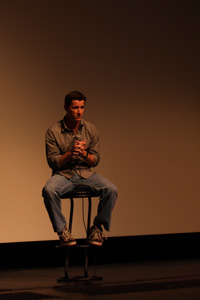
As a result, I was extremely excited for Killen’s appearance at Flow 2010, a television and media conference at the University of Texas at Austin; not only would it give us a chance to learn more about the series, but I could also see whether or not my impression of Killen (pieced together from interviews, tweets and some press tour quotes) would hold in person. During the Q&A after a screening of the series’ pilot, Killen was honest about the show’s failure, open to more complex discussions of the series’ gender representations, and realistic about the way the television industry operates. While the show’s failure identifies much of the cruelty in terms of how the industry evaluates a series’ success, Killen rose above the victim narrative and focused on what he learned from the process, what he wishes he could have achieved, and how he feels about how the process unfolded.

The result was a glimpse into a world of disappointment that, even after learning that we’d be screening the pilot instead of the unfinished third episode, was not close to being disappointing in and of itself.

Continue reading

10 Comments

Filed under Lone Star

Season Premiere: The Good Wife – “Taking Control”

“Taking Control”

September 28th, 2010

I will admit to loving a good ironic title, and I’d argue that “Taking Control” somewhat misrepresents the state of The Good Wife heading into its second season.

I’ve seen a lot of divergent thoughts on the premiere: some seems to think the show is still in fine form, while others felt that it was “off” in some way. I’ll admit to being slightly in the second camp, albeit with a better sense of how, and more importantly why, the show feels this way. While I do think there are a few creative missteps here, I think the general function of the premiere was a good way to enter into the season (if not necessarily conducive to a particularly strong premiere).

Continue reading

3 Comments

Filed under The Good Wife

Cultural Catchup Project: “Dead End” (Angel)

“Dead End”

September 29th, 2010

You can follow along with the Cultural Catchup Project by following me on Twitter (@Memles), by subscribing to the category’s feed, or by bookmarking the Cultural Catchup Project page where I’ll be posting a link to each installment.

I remember way back when I started writing about Angel, and made some comments regarding Wolfram & Hart; as usual, the comments couldn’t help but hint at future developments, noting that there was much to come from this particular organization (a fact which was not really a spoiler, since I was aware the series had some legal elements in its future).

What makes Wolfram & Hart work is that they are simultaneously omnipresent and marginal: while they always seem to have a hand in things, their background role in the majority of threats against Angel keeps them one degree away from pure evil. We know that the firm is certainly capable of evil, and their facilitation of evil activities is certainly something we would consider to be fairly evil, but there is always that sense that the firm as a whole is not truly evil in the sense that we may want them to be. It’s why Angel’s decision to allow Darla and Drusilla to kill the room full of lawyers and their spouses was so problematic: while some of those people, like Holland, deserved to die, the rest seem relatively innocent, and that relativity makes the firm’s position complicated.

It also helps that Lindsey McDonald, central to “Dead End,” has wavered (along with his colleague, Lilah Morgan) as it relates to their connection to the evil at the heart of the company. While Lindsey ultimately chose against leaving the company during those past conflicts, the tension allowed him to seem separate from, perhaps even a victim of, the company’s grasp. It’s a separation which finally comes to its logical conclusion in “Dead End,” although in a way which places Wolfram & Hart into a slightly more direct definition of evil.

Continue reading

20 Comments

Filed under Cultural Catchup Project

Glee – “Britney/Brittany”

“Britney/Brittany”

September 28th, 2010

A week after opening with an unquestionably meta opening, Ryan Murphy did not stray far from that example with “Britney/Brittany”: in the opening scenes, Will expresses how he wants New Directions to know when to show restraint, while Kurt and many other students express their desire to branch out into something more exciting, youthful. It picks up directly where last week’s opening left off, questioning the song choices the series makes, which I’d argue is an interesting question that this season does need to respond to.

Of course, how much you enjoy “Britney/Brittany” depends on both its framework (which has some issues in terms of balancing fantasy and reality) and how Britney Spears’ presence plays out throughout the course of the episode. As someone who admittedly enjoys Spears’ music on the level of cheesy pop fare, I thought choosing Britney was not in and of itself a mistake; however, the show was let down considerably by the way in which her music and its legacy were received by those both within and outside of New Directions.

While musically satisfying, at least for me personally, “Britney/Brittany” suffered from an inelegance which is likely to cause any future themed episodes to raise even more red flags than this hour.

Continue reading

19 Comments

Filed under Glee

Lone Star – “One in Every Family”

“One in Every Family”

September 27th, 2010

“Everything’s always a blur.”

Lying in bed, the newly married Lindsay Allen observes to her husband that her life is sort of like drowning: when he’s away (with his other wife), she feels like she’s drowning, and when he returns it’s like a sudden breath of air.

This scene does little to elevate Lone Star’s gender representations, as effectively Lindsay is arguing that she is lost without her man; however, while I will get to those questions in a moment, I want to focus on the way Lindsay’s description describes Lone Star in and of itself. The show feels sort of like a blur, really: while the show has a fairly leisurely pace, the threat of a reveal remains at every corner, creating just enough instability for an episode like “One in Every Family” to feel meaningful even when it doesn’t have any huge or groundbreaking scenes.

The show continues to paint in fairly broad strokes on some levels, but its second episode quite successfully expands on the nuance within its various worlds: the show still remains fairly centered on James Wolk’s Robert Allen, but the show around him has been effectively given additional depth which would indicate that this show is about more than its premise.

Emphasizing potential, of course, that is unlikely to see the light of the fall season.

Continue reading

2 Comments

Filed under Lone Star