Tag Archives: FOX

Glee Season 1.5: Three Questions Producers Need to Answer

Season 1.5: Three Questions Producers Need to Answer

December 10th, 2009

When we watch a television show as viewers or as critics, we want to believe that our opinions matter. This is not to suggest that we desire to control a particular story, by pushing it in one direction or another, but rather that how people respond to a show is capable of giving the producers some idea of how their show could reach either its widest audience or (for us critics, at least) its fullest comic and dramatic potential.

And yet, for Glee, the voices of fans and critics have seemed to fall upon deaf ears, as some of the common concerns (about the over-produced musical numbers, about the inconsistency between episodes) have remained staples of the show throughout the season. Now, again, this isn’t inherently a problem (it’s their show, they can do with it what they want), but it is important to acknowledge that this was not about ignorance: rather, the show finished filming over a month before the show started in earnest in September. It was produced in a bubble, the writers learning as they went along with only the reviews and reaction towards the pilot to guide them (and, even then, they had produced quite a few episodes before it aired in May).

As a result, when Ryan Murphy, Brad Falchuk and Ian Brennan head back to work in early January to start production on the back nine for the show’s first season (which I’m choosing to dub Season 1.5 as opposed to “Volume 2” or something silly like that), they will have with them the internet’s collective response to the show’s first thirteen episodes. And, for me, the big question now is quite simple: what the heck are they going to do with it?

After the break, I’ll offer my thoughts on where I feel their focus should lie, and why it doesn’t all line up with my own selfish desires for the series going forward.


Continue reading

14 Comments

Filed under Glee

Fall Finale: Glee – “Sectionals”

“Sectionals”

December 9th, 2009

“Winning could make everything good for a while.”

I do not understand the rules of the Sectional Show Choir competition, nor do I know exactly what comes after it in New Directions’ journey. Glee is a show that despite being about what seems like a shockingly bureaucratic existence (with sponsorship disqualifications and everything) wants absolutely nothing to do with that complexity, and as such “Sectionals” boils down to the above: if they win, things will be better.

But what Glee has been doing all season is hiding inherently sombre stories beneath the shiny gloss of over-produced musical numbers. Rachel Berry soars every time she takes the stage, but beneath that surface she has no friends and feels like that’s never going to change. Quinn gets up to sing “Don’t Stop Believin’,” and yet her pregnancy is a source of constant anxiety as she knows how much Finn will be hurt when he, eventually, figures out the truth. And Will Schuester used Glee as a distraction from a marriage in tatters, dancing and mashing up songs when he should have been communicating and patching up his relationship with Terri (and, you know, touching her stomach and discovering her lie earlier).

I’ve accepted, at this point, that Glee’s delayed reaction to some of its early problems (including its somewhat mean-spirited comedy and the aforementioned fake baby storyline) is inherently part of its characters’ journeys – the show is awkward because teenagers are awkward, and it’s inconsistent because high school is inherently impulsive and volatile. And while I am far from suggesting that the show has been perfect this season, I at least feel like the journey it has taken with these characters is consistent with its investigation of what happens when the world of show choir intertwines with a collection of diverse personalities for the sake of both comedy and drama.

As such, “Sectionals” works as a finale precisely because it has no romantic notions about what “Sectionals” is: this is not a simple celebration of musical talent, nor a simple culmination of any one character’s journey. It’s a neon band-aid that makes a wound look a whole lot prettier, capable of healing those wounds but also capable of being ripped off and leaving scars that no neon band-aid will ever be able to fix. It’s an hour of television that highlights life’s futility while celebrating its transcendence, never once suggesting that one will ever cancel out the other.

And it’s a rather fantastic end to what has been a fascinating (if not quite consistently amazing) first thirteen episodes for the show they call Glee.

Continue reading

15 Comments

Filed under Glee

Dollhouse – “The Public Eye” / “The Left Hand”

“The Public Eye” / “The Left Hand”

December 4th, 2009

“Everybody’s got a past – it’s the future [viewers] care about.”

Writing about Dollhouse is like riding a bike – the show has never suffered from a lack of ideas, making even its weaker episodes (once it got ahold of its identity) fascinating to discuss. However, there’s something inherently unsatisfying, in theory, about getting back onto that bicycle when you know that you’re about to run out of road, and in a very short period of time this bike is going to be absolutely worthless to you. So much of what I do here at Cultural Learnings is about contextualizing episodes in the past, present and future of any particular series, and in the world of Dollhouse that future has become a swift cancellation which could come as soon as early next week should the ratings from tonight’s two-hour block of episodes be so disastrous that FOX is willing to risk the wrath of fans as opposed to the wrath of advertisers and replace the show with reruns.

And yet, there is something about where this show finds itself mid-way through its second season that I find far more compelling than I should. I know this show is going to end, and yet there is something about the show’s view of the future that has turned its futility into an asset of sorts. It’s almost as if we’ve already reached the end of the road, but instead of a sheer drop the show is offering a lengthy kill on which we can simply coast down the hill with our hands off the handlebars feeling the wind in our face and taking those last moments to think about what was, what is, and what will (or would) be. It’s almost as if cancellation has freed Dollhouse from certain expectations, and what we get from this point forward is about what we take from the material rather than what the material necessarily says in and of itself.

As such, “The Public Eye” and “The Left Hand” are both really great hours of television not only because they’re well-executed in terms of basic plot and character, but also because through the wonders of a DVD bonus feature we as an audience are perfectly situated to understand the ramifications of what is going on here at levels that go beyond the immediate to a future that we might never be able to see but that we are able to vividly imagine in ways that allow the show to survive beyond the certainty of its fate.

Continue reading

1 Comment

Filed under Dollhouse

Glee – “Mattress”

“Mattress”

December 2nd, 2009

Over the weekend, I was chatting with a friend about Glee, and inevitably the conversation came to Terri Schuester. I find it’s usually a topic that every Glee viewer has in common: whatever they think about any individual episode, no one seems to actually like this character. And while I feel bad for Jessalyn Gilsig, who got stuck playing someone who nearly everyone hates, I think that from its very conception the character was a failure. In an interview with the L.A. Times (where she charmingly notes how a review of an episode which made an elated mention of her absence in said episode on the same site made her want to crawl back into bed), she notes that the character was conceived as a justification for Will’s flirtations with Emma; Will needed a reason to be straying from his marriage, so Terri needed to be someone who audiences didn’t like.

However, what I think Ryan Murphy and the rest of the show’s writers didn’t quite understand was how the show was going to be sold and what kinds of stories would dominate the early going. The show was never going to feel natural being about Will Schuester, to the point that those episodes that did focus heavily on his character (see: “Acafellas”) flopped primarily because the show’s core audience (and most of its mainstream buzz) were there for the less dramatic elements of the series (the music, the one-liners, etc.) or for the younger characters who were connected to the music/jokes but still capable of being expanded dramatically. The show had so many identities that a storyline which might have worked if this was an intense character drama like Mad Men had no chance of ever connecting with audiences, to the point where the character and the storyline were dragging down the rest of the show around it.

What makes “Mattress” work as an hour of television is that the show surrounding that storyline has matured to the point where Ryan Murphy has a handle of who these characters are and how they are able to wake up every morning with a smile on their face. For someone like Rachel, it’s knowing that she’s doing everything in her power to be a star, and for someone like Terri it’s knowing that she is doing everything she can to keep her husband from leaving her. By separating the means from the end, the show is able to take Terri and turn her into a character that is still inherently unlikeable without being so inherently unlikeable that she serves as a blight on its sense of momentum.

It’s not the best hour the show has ever done, but like “Wheels” before it the episode represents a clear sense that Ryan Murphy is back in control of this series just in time for it to head on hiatus.

Continue reading

5 Comments

Filed under Glee

House – “Wilson”

“Wilson”

November 30th, 2009

You might be wondering why I stopped reviewing House after the season premiere. And, well, the answer is quite simple: I stopped watching House after the season premiere.

It wasn’t an intentional decision: a few episodes piled up on the DVR, which proceeded to crash and lose all of its files, and then more episodes piled up alongside some frustrated critics who were growing tired of the show’s ignorance of the rather great premiere, “Broken.” And so my desire to catch up with House was limited, and until tonight I was kind of convinced that I may never return to the show again.

However, on the advice of those same critics, I returned to “Wilson” and discovered what role House will play in my television criticism future. It is a show where the only episodes that truly engage me, truly suck me in, are those which feel uniquely possible within the show’s universe. Alan Sepinwall quite rightly observes in his review of the episode that the focus on Wilson in the episode would never work if not for the inherent juxtaposition of his methods to House’s methods.

It’s an episode that puts someone else in the driver’s seat, and rather than feeling like an overly complicated, soap operatic version of the show’s basic premise (which, based on what I’ve read of the season so far and parts of last season, is effectively what the show has boiled down to) the episode felt like a rumination on character, themes, and the inherent humanity or lack thereof at the show’s core.

The result was a very compelling hour of television, one which is uniquely housed (I made a funny!) within this particular series but will do little to change its overall downward trajectory.

Continue reading

3 Comments

Filed under House

Glee – “Hairography”

“Hairography”

November 25th, 2009

Last week, I had an extensive Twitter conversation with Jace Lacob about Glee, and the argument boiled down to the question of whether or not the show’s characters were one-dimensional. And what was interesting is that Jace and I don’t disagree: the show’s characters are, on occasion, blindly one-dimensional. However, I argued that the show is still in its infancy, and that considering its identity crisis it’s actually doing a decent job of slowly sketching out its characters.

However, I do think that one of the show’s problems is its decision to have characters waver between substantial character development and broad archetypes week by week. While a show like Friday Night Lights, with a similar ensemble cast of characters that often move in and out of the show’s narrative, is dealing with fairly grounded and realistic characters, Glee is slowly humanizing caricatures. And as a result, you have a character like Artie fluctuating from a handicapped student struggling to relate to his classmates to a random background character in a wheelchair, which feels false. Rather than the character development compounding over time, changing the way the show’s dynamics operate, the exact opposite is happening: while individual episodes give Kurt or Quinn or Puck storylines that expand on their identity, outside of the main serialized storyline (Finn and Quinn’s baby) they revert back to their original modes.

It creates a sense that, for a show which is at its best when characters are being developed and explored in a concentrated fashion, the plots of the show itself don’t actually seem to be changing in kind, and the show reverts back to a farcical comedy more often than not. At the heart of “Hairography” is the fairly simple premise that beneath the distractions we create for ourselves is a sense of our true identity, as various characters test out potential distractions only to find that their heart takes them in a different direction.

However, Glee is a show that is all about distractions, and while this individual episode may have peeled everything back to show the supposed true colours of the various characters the show is never going to stop delivering show-stopping musical numbers or interjecting random musical sequences into largely unrelated scenes. The result is an episode that, rather than representing a legitimate step forward for the series, only draws attention to some of its long-term, cumulative limitations: it can tug at the heartstrings and build character when it wants to, but this is never going to start being a show about twelve kids singing on stools.

Especially not with a fake pregnancy storyline hanging over it.

Continue reading

3 Comments

Filed under Glee

FOE4 Musings: FOX’s Glee and the Limitations of Reality Competition Narrative

Glee and the Limitations of Reality Competition Narrative

November 21st, 2009

Following along with this weekend’s Futures of Entertainment 4 Conference at MIT (through the Twitter Hashtag #foe4) has been a really unique experience in many ways, engaging with an academic community I’ve only seen from afar in the past, but there are times when the topics being discussed feel almost too familiar.

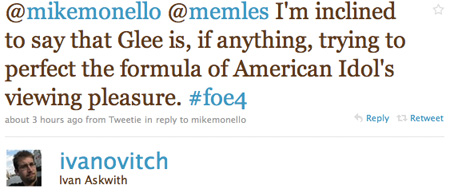
By nature of the number of reviews I write about particular shows, I usually end up attacking them from nearly every conceivable angle, but there’s something about Glee that seems to inspire more angles than seem physically possible. The show has created a lot of controversy with its struggle to find a clear sense of its identity from the narratological point of view, which is the angle we television critics have been considering most carefully, but as discussed both yesterday (in the context of its use of music/iTunes to create transmedia engagement) and today (in its engagement with culture) during the conference its brand strategy has never had the same identity crisis.

I want to pick up on something that Ivan Askwith said during the discussion of the series’ engagement with culture, as he argued the following:

I am going to investigate this further, as it implicitly argues that the series’ narrative struggles are the result of an attempt to engage with a manufactured narrative structure (that will in the Spring be the show’s lead-in), a fact which is both understandable (network synergy and business logic) and complicated by the needs of serialized drama over reality programming from a narrative point of view.

Continue reading

2 Comments

Filed under American Idol, Glee

Glee – “Ballad”

“Ballad”

November 18th, 2009

If you were to go back to the pilot, you would believe that Rachel Berry was the heart and soul of Glee. At that point, she was the person who most believed in Glee club, who saw it as the only place where she wasn’t the subject of ridicule and where she could express herself in the way she most desired.

But since that point, Rachel has become almost heartless. She turned her back on Glee club to join Sandy Ryerson’s musical, and she’s generally judgmental and frustrating before she’s caring or supportive. And yet, because Rachel is the strongest soloist (only Mercedes) on Glee, she’s remained at the centre of storylines and the club itself even while she seems convinced it’s actually holding her back from something better. It’s created a scenario where Rachel isn’t actually likeable, which is somewhat problematic if she’s supposed to be our heroine.

“Ballad” is a continuation of this theme, as a Glee Club exercise has everyone singing emotional ballads that bring out their deepest insecurities (in pretty uniformly effective ways) while Rachel is stuck in a “Hot for Teacher” scenario that never successfully bridges the comic and the dramatic (tears aside). I’m all for the show integrating more comedy than last week’s more emotional episode, and parts of this week’s entry nicely balance the two even with a lot of musical numbers involved, but Rachel’s storyline is effectively emotion-free, something that’s going to grow more and more problematic as we move forward.

Continue reading

6 Comments

Filed under Glee

Glee – “Wheels”

GleeTitle

“Wheels”

November 11th, 2009

There’s a moment in “Wheels” where we fear the worst of Sue Sylvester, testing our ability to see past what we expect her character to do (something offensive and mean-spirited) to what she could potentially do (something transformative). And, in some ways, “Wheels” is very much the same sort of proposition. Ever since I learned ahead of time that “Wheels” was written by Ryan Murphy (as the writers appear to be cycling the scripts between the three of them), I have been fearful of when his worst habits (like his penchant for Terri and the more outlandish storylines) would emerge.

So, I spent most of the episode waiting for the episode to take some sort of turn, to go from being charming and funny and resonant to become outlandish and overbearing. I kept thinking that any scene which felt the least bit emotional would suddenly become undercut by something mean or cruel, and that this was all some sort of Sue Sylvester-like trick.

However, it appears that Murphy has been inspired by his fellow writers, because “Wheels” works in ways that Murphy’s previous episodes simply have not. The episode isn’t perfect, trying to do a few too many things at once, but each and every one of those elements manage to connect at som level. It is an episode that more than any other thus far feels as if it works because of, rather than in spite of, the show’s recurring storylines.

This isn’t to say that everything’s rosy, but it is to say that “Wheels” was certainly a watermark for Murphy’s work on the series, and easily the most starkly dramatic hour yet.

Continue reading

10 Comments

Filed under Glee

Why I Wouldn’t Save Dollhouse from Cancellation

dollhousetitle

Why I Wouldn’t Save Dollhouse from Cancellation

November 11th, 2009

Today, the news came that many expected. Already shelved for November Sweeps in favour of reruns, and with FOX having confirmed that it would be burning off six episodes on Fridays in December, the chances of Dollhouse living to see a third season were always slim. And, to no one’s surprise, the show was officially cancelled today, according to the Hollywood Reporter, thus ending a strange journey for Joss Whedon’s newest series.

And while I will always be a fan of elements of this particular series, and I will miss having it as part of my weekly lineup, I will not be making any effort to try to save the series from its fate. It is not out of a lack of love for the show and what it accomplished, but rather an acknowledgement that it accomplished more than it might have, and that for all that FOX will be getting flack for this decision it was given chances that very few other shows would have received. The show always felt like an experiment, constantly being tinkered with to find the right gear for Whedon’s vision and FOX’s view of the show to become one and the same, and like any good experiment there are some tangible results that can now be put to work by Whedon, the network, and the show’s viewers. Amongst those results:

1) Some great television. Say what you will about some of the show’s weaker episodes, but “Man on the Street,” “Spy in the House of Love,” “Omega,” and “Belonging” were great hours of television independent of the show’s struggles, and some other episodes (like both “Echoes” and “Needs”) managed to take premises that could be either gimmicky or potentially overwrought and showed how this cast and crew could make intelligent, philosophical, funny and sometimes brilliant television. And the unique narrative experiment known as “Epitaph One” will be confounding people for years, further contributing to the show’s legacy of sorts.

2) Being introduced to two really great acting talents. Enver Gjokaj and Dichen Lachman were playing second fiddle to Eliza Dushku in the show’s premise, but they stole nearly every episode they were featured in. On a show that values the ability to be a chameleon, these two managed to slip into the skin of entirely different characters for either extended periods (like Lachman as Priya) or in short scenes (like Gjokaj becoming Reed Diamond’s Dominic) in a way that made them a weekly highlight. While I’m sad they’ll no longer be playing these characters, I know these two will land on their feet, and I’m sure casting directors took notice of their work. The greatest compliment I can pay them is that I learned how to spell their names, which says how often I sang their praises.

Continue reading

5 Comments

Filed under Dollhouse