
Tag Archives: Season 2

Defying Definition: Louie, Finales, and the Pleasure of the Multitudinal

Defying Definition: Louie Season 2

September 10th, 2011

I haven’t written about Louie all season, which makes me one of the only people who hasn’t done so.

Sometimes when this happens I’ll go into the archives and find vast collections of half-written reviews sitting in my “Drafts” section, like all of those failed attempts to discuss How to Make it In America last summer that never got past “Hey, isn’t that theme song awesome?”

However, there are no half-written drafts for Louie, despite the show pretty easily cementing itself as the best comedy of the summer (and probably the second best drama as well), and in tagging this post I discovered I’ve never written a post specifically about Louie. Admittedly, I fell a few weeks behind at least twice over the course of the season, which made the idea of covering it weekly all but impossible (despite the fact that I actually had screeners for the first four episodes). That being said, I do think that this is symptomatic more than it is causal, as I never really felt a particular need to be “caught up.”

While internet chatter created a great deal of temptation, the fact that episodes piled up on my DVR is not a point of disinterest but rather a lack of motivation. Without any sort of serialized element that could be spoiled, and without any continuity that would convince me to catch up on more than one episode on a time, I sort of developed my own pace, stopping and starting wherever I saw fit. Individual episodes proved more engrossing, but immediately turning on the next episode seemed unnecessary. There were logical stopping points, and so I stopped, often for longer than I had initially intended.

However, I was caught up in time for tonight’s season finale, and I do want to write at least a little bit about the show given that the second season has been pretty tremendous. Specifically, I’m interested in the ways in which the show’s lack of “continuity” creates some particularly interesting questions when it comes to a finale. Within television genres, only sitcoms are really exempt from any form of continuity when it comes to finales, and even they often angle towards ongoing storylines or future developments in a finale in this day and age. Considering the finale raises questions about the generic qualities of the series and the formal debate ongoing regarding its structure, which in turn leads into a comparison of my own and a discussion of comparisons in general, which as a whole represents the collective impact of Louie‘s season and finale: there’s a heck of a lot to talk about.
Continue reading

1 Comment

Filed under Louie

Hiding Behind the Brand: How The Killing Threatens the Future of AMC

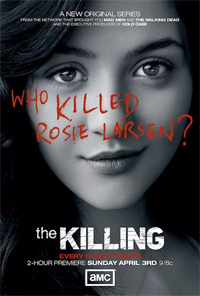
I haven’t seen the first season finale of AMC’s The Killing.


In fact, I haven’t seen the last five episodes of the show’s first season – I fell behind a few weeks ago, struggled to find the motivation to continue, and then traveled away from my DVR before I could get around to catching up.

Accordingly, this is not a piece about the emerging debate regarding the show’s first season finale, which has sharply divided the show’s viewers (and created some extremely strong reactions from some television critics, with Maureen Ryan’s being the most pointed). While it is quite possible that I will some day watch those final five episodes of the season, and that I will have an opinion regarding the show’s finale (which I’ve willfully spoiled for myself) at that time, this piece is not about the finale.

What I’m interested in is the way that this response reflects on larger questions of brand identity that are unquestionably caught up in this response to The Killing. This weekend, I read a piece on AMC’s growing dominance at the Emmy Awards at The Hollywood Reporter in which Sud was quoted quite extensively as she waxed poetic on the freedom of the AMC model. Her first quote was perhaps the one that stuck out most, as she notes that the AMC approach is perhaps best defined by the following: “Always assume that your audience is smarter than you are.”

Given how often I felt The Killing insulted my intelligence as a viewer, this quote struck me as odd. And then I read the rest of her quotes in the article, and discovered the same issue: when she was only spouting a series of platitudes regarding the genius of the AMC brand that we hear from other writers (including a Breaking Bad writer in the same piece), I could take none of them at face value given the fact that The Killing has done little to earn them. In a climate in which The Killing has squandered nearly all of its critical goodwill, Sud’s comments were charmlessly naive, and this was before she made many similar comments in defense of the season finale.

I have nothing against Sud personally, and I think she is entitled to her opinion that her show wasn’t a failure. However, so long as her defense of the show is being framed in the same terms of the AMC brand, the network has a serious problem on their hands. This is a network that feeds off of critical attention, and that has been very protective of its brand identity, but it now finds itself becoming represented by a showrunner who has none of the credentials or the evidence to back up her rhetoric.

It’s a scenario that risks turning AMC into just another brand hiding behind rhetorical statements of superiority, and which should be creating some big questions within the network’s executive structure as they head into an important period for their future development.

Continue reading

34 Comments

Filed under The Killing

A Comic Transition Plan: Season Two of CTV’s Dan for Mayor

Review: Dan for Mayor Season Two

June 5th, 2011

As CTV’s Dan for Mayorone of my Top 10 shows of 2010, if you non-Canadians remember – returns for its second season, things have changed.

It isn’t just that the eponymous Dan has now officially become mayor of the fictional Wessex, Ontario. The first season was built around that campaign, with all of the show’s characters eventually taking some sort of role in its success. Now, with Dan having taken on the office of Mayor, the challenge facing the show’s writers was how to keep their favorite characters around.

Their solution is more functional than elegant, and it raises a number of interesting questions related to seriality in situation comedies. Treating the first season as a prologue of sorts, tonight’s premiere (airing at 7:30 ET on CTV) wastes no time finding ways to re-establish spaces in which these characters can interact on a regular basis. It’s a transparent re-ordering of the series, one that makes the premiere a bit jarring, but it also transitions the show into something simpler, and more sustainable, than what came before.

And, thankfully, it still manages to be plenty charming in the process.

Continue reading

2 Comments

Filed under Dan for Mayor

Summer Premiere: Men of a Certain Age – “The Great Escape”

“The Great Escape”

June 1st, 2011

Given that I already offered a general opinion that “The Great Escape” is a tremendous return for the show’s second season, I don’t expect to say a great deal about the episode itself.

However, I feel that this episode more than any other captures the sort of “coming of age” theme that I highlighted in my pre-air review, creating a set of circumstances in which all of the characters prepare themselves to make an important life change before suddenly realizing that the moment has passed.

It’s oddly one of the most overtly thematic episodes that this subtle show has ever done, but its broad moments are triggered by such subtle observations that it never betrays what makes the series so compelling.

Continue reading

Leave a comment

Filed under Men of a Certain Age

Coming of [a Certain] Age: The Return of TNT’s Men of a Certain Age

The Return of TNT’s Men of a Certain Age

June 1st, 2011

There are usually some questions about when, or why, critics write pre-air reviews for returning series. Personally, I tend to only do so in circumstances where the show is going through drastic changes, where my opinion of the show is going through drastic changes, or when the show simply deserves the recognition in light of its quality (and I’ve seen episodes in advance, of course).

TNT’s Men of a Certain Age, returning tonight at 10/9c, fits into the third category: in fact, considering that this is actually the seventh episode of the second season, it’s hard to argue that there are drastic changes when this is a sort of false premiere as opposed to a fresh start. This is the same show that returned for its second season back in December, and it remains that show through the first three episodes of the back half of the season (which is all I’ve gotten through to this point).

And yet I’m compelled to write down at least a few thoughts given the fact that I feel as though some people still aren’t paying attention as a result of the series’ subject matter. I had actually fallen behind on the first half of the season, and so I just recently sat down to the winter finale, in which Terry, Joe and Owen go and get colonoscopies. On paper, this sounds like something that is very distinct to the eponymous demographic, and you wouldn’t be entirely wrong: after all, the number of 25-year-olds getting colonoscopies is likely pretty slim.

That being said, the idea that the problems that these characters face are strictly “of a certain age” is false: although their experience is certainly more reflective of my parents’ generation than my own, given that I am likely among the youngest viewers the show has, this is as much a “coming of age” story as any show set in high school or university. However, instead of focusing on “coming of age” moments which are ingrained within our experience, mapped out for us from the time we are born, Men of a Certain Age focuses on the fact that middle age doesn’t work the same way: it’s amorphous and, well, anything but certain.

Men of a Certain Age is not a show about the perils of becoming older, it’s a show about the perils of defining yourself at a stage when there’s no clear path ahead of you. As it returns to conclude its second season, the characters are admittedly preoccupied with the notion of turning 50, but it’s not about what they can or can’t do. Instead, it’s about what they should or shouldn’t do, a question that speaks less to being “old” and more to simply being human.

And the result is a pretty terrific drama series.

Continue reading

2 Comments

Filed under Men of a Certain Age

Season Finale: Glee – “New York”

“New York”

May 24th, 2011

“Make one…in your mind.”

As Rachel and Kurt stand on stage at the Gershwin Theater in New Your City, with the land of Oz behind them, Kurt suggests that they take this opportunity to belt out the closing song from Wicked, “For Good.” When Rachel remarks that there isn’t an orchestra, Kurt says the above line, and “New York” begins to fall into place.

Glee’s competition episodes have always felt like they’re sort of off in their own world, a world where show choirs earn standing ovations and where all of the season’s troubles can melt away through the sheer power of song. There was this giddy look on Naya Rivera’s face right before New Directions broke into “Light Up The World” that sells the kind of euphoria that being up on that stage can inspire, and these episodes have been among Glee’s strongest largely because of the emotional pull that the performances can inspire.

Nationals is the largest competition that the show has done so far, but its scale is not demonstrated in the number of songs or the seriousness of the competition. Instead, “New York” turns the euphoria up to 11, transforming the trip to the Big Apple into a glimpse of the dreams that seem so close yet so far away. Up until the moment where New Directions finally makes their way to that stage, this episode is like one long dream sequence, a world where original songs are written and rehearsed in a day, where musical idols are casually encountered, and where Gershwin Theater employees are willing to give two high school kids from Ohio some unsupervised time in a Broadway theater.

And “New York” would have damaged the show irrevocably if it hadn’t shattered that dream as it does. By returning back to the reality of Lima at episode’s end, Brad Falchuk makes it clear that the dreams present in this episode are unattainable, perhaps downright imaginary depending on how far you think the show is willing to stretch its own reality. However, in the spirit of the show and in a decision I don’t entirely hate, he also emphasizes that there’s room for dreams in Lima, Ohio.

At least until a year from now, when the dreams will contend with reality once more.

Continue reading

11 Comments

Filed under Glee

Glee – “Funeral”

“Funeral”

May 17th, 2011

“I’m Lima good. Not New York City good.”

Last season, we didn’t get a “real” penultimate episode: “Funk” was moved into the penultimate spot arbitrarily when FOX wanted to move the Lady Gaga-enhanced “Theatricality,” which created a whole issue in regards to plot continuity.

This time around, “Funeral” was meant as the penultimate episode all along, and I’ve got to be honest: this just doesn’t work. I actually understand the logic here, as Ryan Murphy takes us back to the pilot by staging a new set of auditions and returning us to the hopes and dreams of Will Schuester. I actually really like parts of this, and the idea of Nationals unearthing some of the initial divisions of talent within the Glee club is actually sort of logical – the line above really gets to the heart of the hopelessness that drives the show’s small town aesthetic, and I really like when the show revisits that idea.

But the way Murphy goes about it only highlights how heading in this old direction undercuts all of the other directions that have been built into this season. As a standalone piece, “Funeral” is a fine showcase for Jane Lynch’s ability to depict the emotional turmoil that makes the character the way she is, and a fine musical showcase for a variety of members of the show’s cast. But as an actual penultimate episode as part of the show’s second season, it takes too long to find the story threads it needed to find to feel connected to that which came before, even if it connects nicely into what comes after (which remains an inherent possibility).

Continue reading

13 Comments

Filed under Glee

Glee – “Prom Queen”

“Prom Queen”

May 10th, 2011

Ian Brennan has always been the Glee writer most interested in embracing the series’ meta qualities, but there are two moments in this week’s episode where he goes one step too far. First, Sue’s list of most-hated songs the Glee club has performed were very clearly a bit of self-deprecating commentary rather than something Sue would actually observe – the notion of apologizing to America was particularly strange, greatly exaggerating the reach of “Run Joey Run.”

Now, note that Brennan wrote the episodes in which both “Run Joey Run” and the “Crazy in Love/Hair” remix appeared, so he’s picking away at himself more than the show itself. This was also clear when Jesse discussed the whiplash nature of his relationship with Rachel disintegrating, which was most evident in the Brennan-scripted “Funk.” In both instances, I found the commentary obnoxious, and it pulled me out of the scenes themselves and into the artifice of the series.

Of course, the show does this quite often, but it felt like “Prom Queen” had a particularly steep climb in regards to fully integrating the viewer into its world. This goes both for the episode’s climax, which was the topic of a huge spoiler controversy over Twitter a few weeks back, and the performance of a particular viral video sensation of questionable quality. I am not among those who asks that the Glee universe presents itself as cohesive or realistic, in part because the show is clearly built around their world extending into our own with concerts, downloads, and everything in between, but also because I think this meta quality has a certain charm to it…when used properly, and when used sparingly.

While it is unfortunate that the climax of “Prom Queen” had to be caught up in the online kerfuffle and thus rendered somewhat less effective, I would argue that the episode as a whole transcended Brennan’s obsession with the show itself to deliver a couple of strong moments which felt honest to Prom at McKinley High School.

And yes, that more or less includes “Friday.”

Continue reading

8 Comments

Filed under Glee

Community – “A Fistful of Paintballs”

“A Fistful of Paintballs”

May 5th, 2011

“That was a game. This is paintball.”

“A Fistful of Paintballs” is unquestionably a sequel to “Modern Warfare,” but I’d argue that it’s a fundamentally different episode on some level.

It follows the same basic principle from a story perspective: the school’s descent into paintball-related madness brings out some of the pre-existing relationships between the characters, specifically focused on Britta and Jeff’s consummation of their ongoing sexual tension. However, in terms of the actual methodology of the episode, it was a fairly extensive collection of pop culture references which only occasionally connected with the show’s overall mythology.

Now that the show is ending its second season, “A Fistful of Paintballs” is much more interconnected with ongoing storylines, building much of its structure around the season’s central conflict. While I have had my issues with how Pierce has been portrayed this season, believing that the character’s unpleasantness has not been funny enough to justify its omnipresent nature, this episode is much stronger in its use of the power structures within the latest paintball-based warzone to draw out ongoing character relationships.

With a more straightforward pop culture reference point paired with a more complex serialized component, “A Fistful of Paintballs” is the logical maturation of the “Modern Warfare”-template and a strong first half of what feels like a suitably strong finale.

Continue reading

14 Comments

Filed under Community

Season Finale: Justified – “Bloody Harlan”

“Bloody Harlan”

May 4th, 2011

In what has been a truly spectacular second season, Justified has more or less followed the same pattern as the first season: serialized elements are introduced gradually over the first half of the season before exploding in the final episodes.

What seems different this time around, though, was the nature of that explosion. While both seasons feature conclusions defined by a three-way battle (Miami/Crowders/Raylan in S1, Bennetts/Boyd/Raylan in S2), the second season had given each of those groups an incredible level of detail and history. With the Bennett/Givens feud having been established early on (and most evident in Dickie’s daily reminder of Raylan’s baseball bat handiwork), and with Boyd having risen into a position of power in opposition to the Bennetts, “Bloody Harlan” lives up to its title by giving us the big action climax to these ongoing feuds.

And yet, on some level this still felt like a denouement, or at least a futile attempt at a denouement for a show purposefully designed to avoid such efforts. With so many storylines featuring so many characters with a great deal of agency (and a multitude of motivations), Justified is always reaching the climax of one story or another, but it’s never truly allowed to have that moment to pause and reconsider. There is a brief moment early in “Bloody Harlan” where it feels like Raylan and Winona are going to be able to look to the future, but within minutes another loose end is picked up and another bloody firefight begins to unfold, before being replaced by contemplative scenes almost begging to serve as resolution.

In other words, Justified is a show of false parlays, which this season has focused in on the qualities that will make its constant search for futile resolution one of the finest shows on television.

Continue reading

2 Comments

Filed under Justified


