Tag Archives: Sue Sylvester

Fall Finale: Glee – “Sectionals”

“Sectionals”

December 9th, 2009

“Winning could make everything good for a while.”

I do not understand the rules of the Sectional Show Choir competition, nor do I know exactly what comes after it in New Directions’ journey. Glee is a show that despite being about what seems like a shockingly bureaucratic existence (with sponsorship disqualifications and everything) wants absolutely nothing to do with that complexity, and as such “Sectionals” boils down to the above: if they win, things will be better.

But what Glee has been doing all season is hiding inherently sombre stories beneath the shiny gloss of over-produced musical numbers. Rachel Berry soars every time she takes the stage, but beneath that surface she has no friends and feels like that’s never going to change. Quinn gets up to sing “Don’t Stop Believin’,” and yet her pregnancy is a source of constant anxiety as she knows how much Finn will be hurt when he, eventually, figures out the truth. And Will Schuester used Glee as a distraction from a marriage in tatters, dancing and mashing up songs when he should have been communicating and patching up his relationship with Terri (and, you know, touching her stomach and discovering her lie earlier).

I’ve accepted, at this point, that Glee’s delayed reaction to some of its early problems (including its somewhat mean-spirited comedy and the aforementioned fake baby storyline) is inherently part of its characters’ journeys – the show is awkward because teenagers are awkward, and it’s inconsistent because high school is inherently impulsive and volatile. And while I am far from suggesting that the show has been perfect this season, I at least feel like the journey it has taken with these characters is consistent with its investigation of what happens when the world of show choir intertwines with a collection of diverse personalities for the sake of both comedy and drama.

As such, “Sectionals” works as a finale precisely because it has no romantic notions about what “Sectionals” is: this is not a simple celebration of musical talent, nor a simple culmination of any one character’s journey. It’s a neon band-aid that makes a wound look a whole lot prettier, capable of healing those wounds but also capable of being ripped off and leaving scars that no neon band-aid will ever be able to fix. It’s an hour of television that highlights life’s futility while celebrating its transcendence, never once suggesting that one will ever cancel out the other.

And it’s a rather fantastic end to what has been a fascinating (if not quite consistently amazing) first thirteen episodes for the show they call Glee.

Continue reading

15 Comments

Filed under Glee

Glee – “Mattress”

“Mattress”

December 2nd, 2009

Over the weekend, I was chatting with a friend about Glee, and inevitably the conversation came to Terri Schuester. I find it’s usually a topic that every Glee viewer has in common: whatever they think about any individual episode, no one seems to actually like this character. And while I feel bad for Jessalyn Gilsig, who got stuck playing someone who nearly everyone hates, I think that from its very conception the character was a failure. In an interview with the L.A. Times (where she charmingly notes how a review of an episode which made an elated mention of her absence in said episode on the same site made her want to crawl back into bed), she notes that the character was conceived as a justification for Will’s flirtations with Emma; Will needed a reason to be straying from his marriage, so Terri needed to be someone who audiences didn’t like.

However, what I think Ryan Murphy and the rest of the show’s writers didn’t quite understand was how the show was going to be sold and what kinds of stories would dominate the early going. The show was never going to feel natural being about Will Schuester, to the point that those episodes that did focus heavily on his character (see: “Acafellas”) flopped primarily because the show’s core audience (and most of its mainstream buzz) were there for the less dramatic elements of the series (the music, the one-liners, etc.) or for the younger characters who were connected to the music/jokes but still capable of being expanded dramatically. The show had so many identities that a storyline which might have worked if this was an intense character drama like Mad Men had no chance of ever connecting with audiences, to the point where the character and the storyline were dragging down the rest of the show around it.

What makes “Mattress” work as an hour of television is that the show surrounding that storyline has matured to the point where Ryan Murphy has a handle of who these characters are and how they are able to wake up every morning with a smile on their face. For someone like Rachel, it’s knowing that she’s doing everything in her power to be a star, and for someone like Terri it’s knowing that she is doing everything she can to keep her husband from leaving her. By separating the means from the end, the show is able to take Terri and turn her into a character that is still inherently unlikeable without being so inherently unlikeable that she serves as a blight on its sense of momentum.

It’s not the best hour the show has ever done, but like “Wheels” before it the episode represents a clear sense that Ryan Murphy is back in control of this series just in time for it to head on hiatus.

Continue reading

5 Comments

Filed under Glee

FOE4 Musings: FOX’s Glee and the Limitations of Reality Competition Narrative

Glee and the Limitations of Reality Competition Narrative

November 21st, 2009

Following along with this weekend’s Futures of Entertainment 4 Conference at MIT (through the Twitter Hashtag #foe4) has been a really unique experience in many ways, engaging with an academic community I’ve only seen from afar in the past, but there are times when the topics being discussed feel almost too familiar.

By nature of the number of reviews I write about particular shows, I usually end up attacking them from nearly every conceivable angle, but there’s something about Glee that seems to inspire more angles than seem physically possible. The show has created a lot of controversy with its struggle to find a clear sense of its identity from the narratological point of view, which is the angle we television critics have been considering most carefully, but as discussed both yesterday (in the context of its use of music/iTunes to create transmedia engagement) and today (in its engagement with culture) during the conference its brand strategy has never had the same identity crisis.

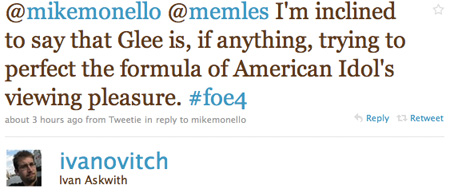
I want to pick up on something that Ivan Askwith said during the discussion of the series’ engagement with culture, as he argued the following:

I am going to investigate this further, as it implicitly argues that the series’ narrative struggles are the result of an attempt to engage with a manufactured narrative structure (that will in the Spring be the show’s lead-in), a fact which is both understandable (network synergy and business logic) and complicated by the needs of serialized drama over reality programming from a narrative point of view.

Continue reading

2 Comments

Filed under American Idol, Glee

Glee – “Wheels”

GleeTitle

“Wheels”

November 11th, 2009

There’s a moment in “Wheels” where we fear the worst of Sue Sylvester, testing our ability to see past what we expect her character to do (something offensive and mean-spirited) to what she could potentially do (something transformative). And, in some ways, “Wheels” is very much the same sort of proposition. Ever since I learned ahead of time that “Wheels” was written by Ryan Murphy (as the writers appear to be cycling the scripts between the three of them), I have been fearful of when his worst habits (like his penchant for Terri and the more outlandish storylines) would emerge.

So, I spent most of the episode waiting for the episode to take some sort of turn, to go from being charming and funny and resonant to become outlandish and overbearing. I kept thinking that any scene which felt the least bit emotional would suddenly become undercut by something mean or cruel, and that this was all some sort of Sue Sylvester-like trick.

However, it appears that Murphy has been inspired by his fellow writers, because “Wheels” works in ways that Murphy’s previous episodes simply have not. The episode isn’t perfect, trying to do a few too many things at once, but each and every one of those elements manage to connect at som level. It is an episode that more than any other thus far feels as if it works because of, rather than in spite of, the show’s recurring storylines.

This isn’t to say that everything’s rosy, but it is to say that “Wheels” was certainly a watermark for Murphy’s work on the series, and easily the most starkly dramatic hour yet.

Continue reading

10 Comments

Filed under Glee

Glee – “Mash-Up”

GleeTitle

“Mash-Up”

October 21st, 2009

Commenting on last week’s episode, Chris Becker noted that Glee has its share of problems, and one of them is (on occasion) actually calling attention to its own problems. By signalling out the minorities within Glee club, the show drew attention to the fact that it has largely ignored issues of diversity, so Sue’s strategy turned out more disturbing than funny. When you have a show that can be hot or cold like Glee can, and that tends to go in as many directions as Glee does, this is almost inevitable, but I would argue there’s a way to avoid it.

Ian Brennan, one of the show’s three creators and who was credited with the Chenoweth-infused “The Rhodes Not Taken,” uses this episode to actually call to our attention some of the show’s problems and actually treats them as problems. Folding them all under the theme of the mash-up, used here not as a drug-infused sideshow but a meditation on the process of bringing two people together in a potentially artificial process, Brennan depicts consequences in a way that the show often avoids, and continues to probe questions of high school popularity while not shying away from the darker side of teenage existence.

It may not be as eventful as “Preggers,” and its musical elements risked over-using Matthew Morrison, but by bringing all of its elements under one key theme that spoke to issues that have been plaguing the series for a while “Mash-Up” is perhaps the most complete episode of the show yet, struggling to balance its various elements only when it had a point to make about the trouble of balancing those elements.

Continue reading

2 Comments

Filed under Glee

Glee – “Throwdown”

GleeTitle

“Takedown”

October 14th, 2009

“An environment of constant irrational terror”

Andy Dehnart (who can be found on Twitter at RealityBlurred) posted a piece of commentary at MSNBC yesterday that, earlier today, exploded into a lively twitter discussion amongst critics. His argument is that the show relies on stereotypes when it could be developing character, and that it needs to eliminate some of its more one-dimensional characters (like Sandy) and provide more depth to its central Glee club members. What’s interesting is that I don’t think there’s anyone who is going to argue with this point, especially if we apply it to Terri and her fake pregnancy. The strangest thing about Glee, from critics’ perspectives, is that most people tend to agree that it has its share of problems, especially when it comes to the adult characters on the show. The difference comes in how people rationalize those criticisms and weigh them with the show’s undeniable charm, and its quick-witted one-liners that most people tend to enjoy.

“Throwdown” is yet another dividing point, an episode that highlights the show’s best character (Jane Lynch’s Sue Sylvester) and as a result features a lot of great one-liners and some solid musical numbers. However, as someone who tends to lean more critically on the show than others, it’s an episode that shows you that Dehnart’s complaints aren’t the show’s only problem. Yes, its adult characters are one-dimensional, but the show’s plotting is just as problematic: storylines seem to happen to characters as opposed to because of characters, and the result is that the Glee club itself is trapped in the middle of wars and plots (the environment of constant irrational terror, in other words) that may be entertaining in the short term but are doing nothing to foster long term development.

Linda Holmes from NPR made the note that it’s impossible for Glee to hit the mark every week, as the mark is tiny and specific. I’d argue that the show is hitting that mark enough to keep me watching, but I’d also argue that it is more consistently missing it where it counts (narrative, character development) than where it’s most popular (the musical numbers, the one-liners). And while that’s a pattern for cult success, it’s not a pattern for dramatic or comic fulfillment.

Continue reading

6 Comments

Filed under Glee

Glee – “Preggers”

GleeTitle

“Preggers”

September 23rd, 2009

“I don’t want to be a Lima Loser the rest of my life”

On Sue’s Corner, Sue Sylvester tells it like it is. She’s bold enough to take a pro-littering stance, brave enough to say “Yes We Cane,” and ballsy enough to ask the homeless how that homelessness thing is working out for them. In Lima, Ohio, Sue Sylvester is a big deal with her two mentions in USA Today and her satellite interviews (that’s lingo, for interviews done by satellite), but without her national championships she is nothing. The studio boss tells her, flat out, that if she doesn’t remain a champion outside of this small little town she is no longer going to be telling the town how Sue sees it.

Because, without her success as the head coach of the Cheerios, Sue is nothing. She and Sandy, her new compatriot, are both teachers who don’t quite know how to deal with teenagers, and if not for her success Sue’s blackmail would be a desperate stab at power rather than a reminder of her existing control. She’s a big fish in a small pond, a fact which remains dependent on her continued success and perhaps one more mention in USA Today.

“Preggers” is an episode about the fact that the teenagers at the core of the show do not yet know what kind of fish they will be, and being stuck in this small town is doing very little to inspire them to greatness. Everyone has a different story, but to some degree your place of residence can just as easily make you (as it does for Sue, whose success breaks expectation and thus deems her a champion worthy of a public opinion segment) as break you. It’s the kind of place where Kurt is too scared to tell his father a truth he probably already knows, and where a sudden pregnancy is defined less by immediate consequences than long term ramifications. If these people are going to avoid being Lima Losers, they’re going to have to find a way to avoid the same kind of pitfalls (and, since this is technically a comedy, pratfalls) which await them.

And while part of Glee’s DNA implies a certain degree of fantasy, football players breaking into a dance sequence without getting a delay of game penalty for example, another part of it knows that life is not a game, and that musical numbers or no musical numbers high school is very, very rule. And, with an episode that seems to embrace this dichotomy rather than exploiting it for sudden shifts of tone designed to shock the viewer, Glee again returns to what made its premise so darn compelling in the first place.

Continue reading

5 Comments

Filed under Glee

Glee – “Acafellas”

GleeTitle

Acafellas

September 16th, 2009

“Acafellas,” by and large, is like an answer to my prayers (or, if not prayers, then at least requests). Last week, I noted that I enjoyed the show as a whole but felt that they were moving too quickly with the main storylines and not giving us any time with the supporting characters. And, by and large, this episode managed to move at a pretty quick pace (the show certainly didn’t become slow) while spending plenty of time with pretty much everyone. The show is a large ensemble, and this episode felt like an effort to both address ongoing storylines (including the main ones covered last week) in small scenes while spending time with entirely new settings and character pairings.

This is not to say that I think the episode was flawless by any means, but I think it’s an example of the show’s particular brand of humour and musical performance proving capable of expanding into other areas outside of the “core” storylines. While I still have some issues with the way the show tends to pace itself with individual storylines, this episode managed to handle a lot of material in a single hour, covering various bases with a fairly high degree of success.

But, be warned that I’ve still got some issues with the way the show likes to rush to the good parts, so to speak.

Continue reading

1 Comment

Filed under Glee

Glee – “Showmance”

GleeTitle

“Showmance”

September 9th, 2009

As a critic, there are two ways one begins to have doubts about a show.

One is the immediate knee jerk response to a particular development: something happens onscreen which calls itself to your attention as if it were someone wearing a T-Shirt which said “Problem” written on it and waving a giant banner that said “Criticize me.”

The other is a more subtle feeling, a sense that something is wrong that’s below the surface of what you’re enjoying and undermining the show as a whole if not any particular moment.

What worries me about Glee is that for all my love of the show and its basic premise, it managed to illicit both of these responses in the span of its second episode, an hour which went from 0-60 and yet never seemed to go anywhere at the same time. What’s fascinating about it is that the things that make the show so charming one moment grinds it to a halt in the next: its fast pace works great in its dialogue, but when its stories start to move at the same pace it all seems like a blur; and while its quippy dialogue feels right in high school, when coming from someone who’s supposed to be a mature adult it sounds entirely wrong and takes a bad storyline and only makes it worse.

This is the kind of show that I don’t want to have to work to like – I enjoy musicals, I know a lot of popular music, and those elements of the show are obviously its hook. However, as long as the show around it feels more like labour than a labour of love, I’m not entirely convinced that I’m ready to commit to becoming a gleek just yet.

Continue reading

4 Comments

Filed under Glee