Tag Archives: TV

Better Without The Bear: How The Cancellation Bear Damages Ratings Culture

CancelBearWantedOver the past year or so, I’ve engaged with what I would call a friendly feud with the Cancellation Bear, the—as far as we know—fictional mascot of ratings site TV By The Numbers. In truth, I have no substantive beef with the Bear or its overlords as individuals, but the Bear and I disagree on a number of issues tied to how ratings are reported and enjoy the occasional repartee. I will admit that it’s a silly thing, filled with wildly exaggerated responses—reflected in this Wanted poster—and certainly among the simpler, more juvenile pleasures one can partake in.

However, over the past year, my feud with @TheCancelBear has been tinged with a degree of legitimate concern for the state of the discourse. Originally, the feud emerged from an ambivalent relationship with the site and its approach to ratings reporting. The site’s role in making ratings data both highly visible and highly accessible makes it a valuable tool for teaching about and researching the television industry, but the Cancellation Bear represents the site’s other role: actively inciting fear and uncertainty among fans of series struggling in the ratings in an effort to both drive traffic and—especially in the past two years—crusade against what they see as “fan excuses” that have no traction compared to their sure-fire prognostications. The former has helped make it possible for a “ratings culture” to exist; the latter has made that “ratings culture” unnecessarily combative and unpleasant.

This ambivalence resulted in a rather epic conversation myself and Tyler Dinucci had with a representative of the site last year. Based on a consideration of Last Resort’s ratings, the conversation wasn’t really about the fate of Last Resort (and I’m not just saying that because I was on the side of optimism and the series was canceled after 13 episodes). The conversation was actually about how TV By The Numbers frames its analysis of ratings not simply as good on its own merits, but rather uses the Cancellation Bear as a front behind which it can insult “desperate fans” who would choose to look on the bright side.

More troll-like than ursine, the Cancellation Bear is the site’s Id, framing the site’s largely measured—and unquestionably educated—predictions through the contempt the site’s creators seem to have for many of their readers and fellow reporters/journalists; it’s a frame that risks turning TV By The Numbers into a disruptive force within ratings culture, more interested in loudly performing its distinction than participating in a meaningful discourse central to TV’s future.

Continue reading

20 Comments

Filed under Ratings

Why The Homeland Twist Works [For Me] [Mostly] [Okay, Barely]

HomelandTitle

“Game On”

October 20th, 2013

Last year, The New Yorker’s Emily Nussbaum had a theory about Homeland. She argued that Sgt. Nicholas Brody’s panicked communications with Abu Nazir as Carrie Mathison was held hostage were all an act, and that he was in on the plan from the beginning.

It was an interesting theory, one she gave me credit for partially debunking by noting that Abu Nazir and Brody continue speaking in the same manner once Carrie is no longer listening to their conversation. For me, that was the sign that the theory couldn’t work: while an interesting idea, I did not believe Homeland was a series that would so actively mislead the viewer with information that—in hindsight—would contradict the intended truth of the situation.

If you saw last night’s episode of Homeland, and have been following some of the subsequent conversation, the above may sound familiar. Indeed, this season’s central storyline almost feels inspired by Nussbaum’s theory, as though the writers took it as a challenge as to whether the series could sustain a twist that in retrospect contradicts many of the storylines and character actions displayed in earlier episodes and maintain its reputation.

The response to “Game On” suggests that they can’t, but that doesn’t necessarily mean I’m no longer on board.

Continue reading

2 Comments

Filed under Homeland

Homeland – “Tower of David”

HomelandTitle

“Tower of David”

October 13th, 2013

It’s been a few months since I watched the first two episodes of Homeland‘s third season. They were made available to press ahead of the show’s panel at the Television Critics Association press tour, which was logical—in that it allowed those in attendance to ask informed questions rather than random guesswork—but also daring. It was daring because in the two episodes screened for critics, Nicholas Brody did not appear for even a brief sequence, and yet Damian Lewis was seated on the panel at the Beverly Hilton.

I tweeted in advance of that panel that I was interested to see how the room responded to this (among other facts about Homeland‘s third season, specifically the increased focus on Morgan Saylor’s Dana), but Showtime was quick to offer clarification: a trailer revealed early footage of Brody’s first appearance in “Tower of David,” and the panel confirmed he would return in the very next episode beyond the ones we had seen. Part of me had expected them to treat Brody’s return as a surprise, leaving his fate open-ended, but from the beginning Brody was something the series was very open about, creating a certain suspense to see how the show planned on reintegrating the character into the narrative.

“Tower of David” works as a structural exercise in character development, drawing a parallel between Brody and Carrie’s respective prisons. However, it fails to acknowledge and mitigate the issues that plagued the two characters’ development last season, leaving an episode that works up until the point you look into the past rather than the present/future.

Continue reading

1 Comment

Filed under Homeland

Interview: Hell On Wheels Showrunner John Wirth

JohnWirthWhen veteran writer/producer John Wirth took over as showrunner on AMC’s Hell on Wheels, it was a somewhat strangely public process. John Shiban, the showrunner for the show’s first two seasons, backed out unexpectedly after the series was renewed, leading AMC to make the series’ pickup contingent on finding a new showrunner. With series creators Joe and Tony Gayton departing as well, Wirth stepped into a series with established characters, existing storylines, and more or less complete creative freedom to take the show in whatever direction he desired.

That direction has made the show a strange sort of success story for AMC, shuffled off to the prestige-less refuge of Saturday nights where it’s been quietly outperforming expectations (see Kate Aurthur’s report at Buzzfeed for more). It concludes its third season tonight at 9/8c on AMC with the expectation that it has earned a fourth season, and having successfully transitioned from a slightly underperforming prestige AMC drama to a successful translation of their film western audience into original programming on a normally dead night.

At July’s TCA Press Tour before the season premiered, I had a chance to talk to Wirth about his perspective on showrunning, how he came to be involved with Hell on Wheels, his planned use of social media (which I’ll be reflecting on soon elsewhere), and how—despite the strange circumstances—Hell On Wheels marks a meaningful period in his career as a showrunner-for-hire.

This is far from your first time serving as showrunner on a series; in fact, the Internet suggests you were part of a “Showrunner Training Program” at some point? How do you train someone to be a showrunner?

JW: I put together a committee of writer-producer-showrunner types. We did a small book called A Television Writers’ Handbook. And it was the first time in the history of the Writers’ Guild that anybody had codified what it is to work on a TV show and what the various positions are and what’s expected of you when you’re in those positions. And we had a big chapter on showrunners, and how to behave as a showrunner, and so forth.

Out of that, Jeff Melvoin—who I had asked to be a part of that committee—had the idea: is this something we could teach? And I didn’t believe that it was, and he believed that it was. He said “I’m going to try to put together this program, will you work on it with me? “And I said sure, but I don’t want to be in charge—this little book we did took five years, and I thought it would take a couple months.

We put together the Showrunner Training Program, which has been enormously successful. I still don’t believe you can teach someone to be a showrunner, but you can expose them to the things they’re going to experience when they are showrunners. That’s really the goal of that program, to let people know what it is they’re going to be experiencing when they get that job.

What’s that job like?

The job itself is ridiculous. You’re the hardest working man or woman in show business – the hours are incredible, you have to be a writer/producer and manager, you have to manage up down and sideways, you have to be a priest, you have to be a magician, you have to be a wife – it’s nutty.

So why you do you think AMC came to you to fill that job on Hell on Wheels?

JW: I think they got to the Ws in their rolodex and were like “Damnit!” Who’s after this guy? We’d better like him. Continue reading

2 Comments

Filed under Interviews

Series Finale: Breaking Bad – “Felina”

BreakingBadTitle“Felina”

September 29th, 2013

A series finale is different from any other episode of a television show; the biggest test for a series finale is whether or not it feels different from any other episode of that television show.

Breaking Bad has been an often messy show, driven by complex moral agency and characters who seem simultaneously the architect and the victim of chaos. It was a series that continued to grow in scale but largely followed the same principles of tight characterization and almost claustrophobic connections with those characters. In the show’s third season, it delineated between “half measures” and “full measures,” and the series was ultimately a narrative driven by the former: while some were explosive and others were tragic, there was never a moment when one could say that Breaking Bad had solved or even dramatically mitigated its central conflict.

It was this quality that gave the series its momentum, and enabled it to grow an audience of devotees from a series that many people—myself included—had not given much of a chance in its early seasons. It was also this quality that by the very nature of a series finale was forced to change in “Felina,” a clean end to a messy show that very purposefully limits its capacity to embody the series it brings to a conclusion.

Continue reading

27 Comments

Filed under Breaking Bad

The Race to Address Race in Orange is the New Black

SuzanneOITNB

Today I wrapped six weeks of writing about Orange Is The New Black, two episodes at a time, at The A.V. Club. It means I’ve written a lot of words about the show, and lived in its development more than most people, and it’s created some frustration as I’ve read a series of trend pieces that function as an interrogation of its progressive statements regarding diversity in television.

To be clear, this is rarely frustration with the overarching arguments being deployed. The core of pieces at The Nation, the Daily Beast, and Roxane Gay’s piece at Salon—the best of the three—in recent days have been seeking to complicate readings of the series’ diversity as a dramatic step forward. In many reviews, the diversity of the series’ cast has been considered praise-worthy, and Gay nicely captures the sentiment that has similarly driven other authors to resist this critical consensus:

“I’m tired of settling for better instead of truly great. I’m tired of feeling like I should be grateful when popular culture deigns to acknowledge the experiences of people who are not white, middle class or wealthy, and heterosexual.”

It’s an important argument, but it’s one that I’m seeing deployed with Orange Is The New Black not because the series is wholly representative of this problem but rather because it is a text with a degree of cultural relevance in our current pop culture moment that undoubtedly connects with this problem. The Daily Beast’s Allison Samuels didn’t even watch Orange Is The New Black before lumping it in with other pop culture examples. The Nation’s Aura Bogado only watched six episodes before quitting on the show’s first season. My reaction to these articles is not a rejection of the basic principles on which the authors stand, but rather a rejection of their relevance to this particular series as it evolved over the course of its first season.

Continue reading

7 Comments

Filed under Orange is the New Black

Recap by Default: Why Terminology Matters To How We Write About Writing About TV

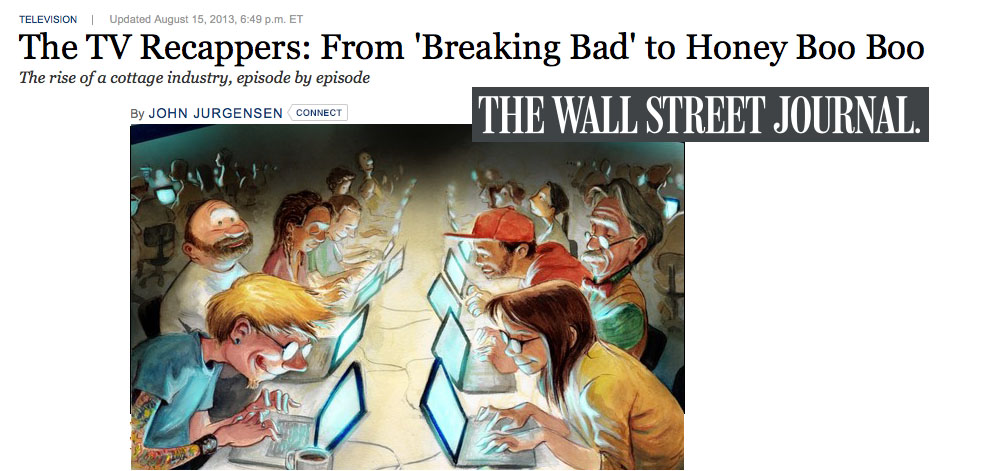
WSJImage

In the wake of Brett Martin’s Difficult Men, which itself comes in the wake of Alan Sepinwall’s The Revolution Was Televised, there has been new scrutiny placed on the culture of television criticism. In Ken Tucker and Phillip Maciak’s reviews of Difficult Men—Maciak also covers Sepinwall’s book—they each delve into the culture of “TV recaps” as a rejoinder between the shows being canonized by the authors and the culture with which those shows are being analyzed. It’s an acknowledgement that how we write about television matters, which extends Jaime Weinman’s argument that we are in a “golden age of taking TV seriously.”

In Tucker and Maciak’s reviews we see an interesting crosstalk, where Maciak ably dissects Tucker’s broad dismissal of what Martin refers to as “the strange and telling practice of ‘recapping.'” Tucker picks up Martin’s dismissal and runs with it, expounding on “the challenge of creating diverse aesthetic principles that rise above the Internet’s limited range of extracritical responses, which typically run the gamut from this-is-awesome! blog posts to fitfully edited twelve-thousand-word essays about this or that show’s elaborate ‘mythology.'” While citing a number of—great—critics who are indeed capable of “rising above” the apparent limitations of the form, Tucker largely paints recap culture as the venue for “the adoring gaze of online fanboys and fangirls.”

Maciak picks away at Tucker’s case, not so much disagreeing with his call for more serious television criticism as he is claiming that “the culture of online television commentary has expanded, rather than degraded, our critical culture.” With more space than Tucker to explore the nuances of the current landscape of television criticism, Maciak finds a larger sample of diverse writing about television that ranges in terms of genre, focus, and audience. Rightfully picking away at Tucker’s emphasis on asking “proper artistic questions,” Maciak makes a strong case for how the culture of instant responses to television has proliferated not as a dichotomy of fanboys and obsessives but rather as a spectrum of incredible breadth and depth (even if sometimes in a shorter form than the critics Tucker cites from other media).

It’s a rich conversation, one that reflects some of my own thoughts on the rise of episodic television criticism from a number of years ago. However, it’s also a conversation that bears the mark of our culture’s mass acceptance of “recap” as an acceptable term for this diverse range of ways of writing about television. If Tucker were speaking about the actual practice of night-of “recapping” which manifests as a basic plot rundown with minimal commentary, I agree with his argument; when he extends to the suggestion that most episodic criticism fits under this umbrella term, his argument is reductive. Maciak, meanwhile, goes so far as to acknowledge Matt Zoller Seitz’s use of “overnight review,” but ultimately accepts “recap” as an acceptable term for describing all types of episodic criticism while arguing for the critical capacity of that form.

I have long stood as the standard bearer of drawing a distinction between recaps and reviews, to the point where it’s kind of a joke. I made the distinction initially because I was seeing the work of critics I admired being forcibly labeled as recaps based on the belief from websites that the term was better optimized for search engines. However, over time my concern has grown to pieces like Tucker’s and Maciak’s which beyond the goal of SEO optimization accept the term’s ubiquity (if critically, in Maciak’s case), which was my real concern when considering the web practices of sites like AOL—now Huffington Post—or HitFix. I was the crazy person signaling an alarm bell over something that—while certainly still a first world problem if ever there was one—has had a negative impact on a larger public understanding of television criticism.

While I’d argue Tucker and Maciak’s pieces together represent a productive and ultimately constructive conversation (even if Tucker’s brushstrokes are too broad), today’s Wall Street Journal trend piece from John Jurgensen—entitled “The TV Recappers: From Breaking Bad to Honey Boo Boo”—is more problematic in its claim to be capturing the broader culture of writing about television. While rightfully tracking the lineage of episodic television criticism from its TWoP origins (although oddly addressing neither the fact those recaps are posted days after an episode airs nor the way the site has evolved in a contemporary moment), the article accepts “Recap” and “Recapper” as blanket terms to describe every single form of writing that emerged in what Jurgensen terms a “cottage industry.”

Continue reading

5 Comments

Filed under Television Criticism

Mad Men – “In Care Of” and the Narrative Engine of Place in Season 6

madmen2

“In Care Of” and the Narrative Engine of Place in Season 6

June 24th, 2013

“This is where everything is.”

Mad Men began with a spatial divide. In the series’ pilot, we are introduced to Don Draper in Manhattan but only get the full picture when we follow him onto the train to the suburbs, and to the family life he leaves behind every day he travels into the city. The show was invested in exploring the distinct ebbs and flows of those two spaces, and on Don’s ability to travel between them. While we would come to learn that Don had been living a double life for most of adulthood, initially we watched a man live two lives separated by the train ride between them.

The show evolved beyond its urban/suburban divide, adding enough complexity to both Don’s family life and Sterling Cooper as a setting that it would seem reductive to boil the show down to this dichotomy. And yet although Don was no longer traveling to the suburbs since separating from Betty, the spatial divide stuck around thanks to characters like Pete, who began the season in his city apartment that would become his primary residence after he proved less agile in his duplicity than Don was. And as Betty explored the life of young runaways or as Peggy let Abe talk her into living in a nascent neighborhood, New York City was no longer confined to the offices of Sterling Cooper, gaining diversity and perspective as the turmoil of 1968 played out over the course of the season.

Mad Men’s sixth season was far from the first time the show has become invested in the meaning of space and place, but “In Care Of” highlights how central the idea of “going somewhere else” has been to this season in particular. For a season that began in the escape of Hawaii, and jetted to Los Angeles and Detroit and to upstate New York in a very tiny plane, it ends with multiple characters imagining what life would be like away from New York. In the process, we can imagine a final season spread across the country, even if we can also picture a season that remains tethered to the Manhattan Mad Men has over time embedded into the fabric of its storytelling.

Continue reading

5 Comments

Filed under Mad Men

Season Finale: Game of Thrones – “Mhysa”

GameOfThronesTitle2

“Mhysa”

June 9th, 2013

“Here only the family name matters.”

As Varys explains this fact to Shae, he’s being pragmatic: he’s trying to help someone whose very existence at King’s Landing threatens her own life and the life of the man she loves. Varys acknowledges that she has made Tyrion better. Varys acknowledges that hers is a true love. And yet Varys also gives her a collection of diamonds, telling her to sail to Pentos and start a new life for herself so that her love can do something good for Westeros without the threat of a single-named woman hanging over him.

It’s dark advice, advice that Shae refuses to take. Despite the fact that we just saw both Robb Stark and Talisa die for following true love over pragmatism, and despite the fact that Jon Snow just took three arrows from the woman he loves, Shae proves what many other characters have learned as well: there is still power in love even when all signs would suggest that trusting in such power will be your undoing.

“Mhysa” is about this love, which may seem strange in light of the fact that last week ended on such a foreboding sendoff for Robb and Catelyn Stark. And yet Game of Thrones needed a new motivation beyond ascending to the throne, a sense of purpose that could evolve beyond the War of the Five Kings and the deaths of Robert Baratheon and Ned Stark which set it off. What “Mhysa” seeks to accomplish is reframe the actions of its characters not as part of a larger power struggle, but rather as actions designed to protect their families or to protect the realm. This is not to say that we are to support the Lannisters’ cruelty or to endorse Melisandre’s sorcery, but rather that we can shift our understanding of their actions away from a part in a larger plot and instead toward what motivated them to take those steps in the first place.

It’s an enriching move that works to build a strong foundation for future seasons, although one that has some issues retroactively making some of the season’s storylines resonate in the way intended. “Mhysa” concludes a third season that was only retroactively revealed—for non-readers, at least—to be the season where Game of Thrones could no longer be simplified to a battle between the Starks of Winterfell and the Lannisters of Casterly Rock, one that did its job without necessarily connecting in the process.

Continue reading

27 Comments

Filed under Game of Thrones

Game of Thrones – “The Rains of Castamere”

GameOfThronesTitle2

“The Rains of Castamere”

June 2nd, 2013

“The closer you get, the worse the fear gets.”

Every season of Game of Thrones has built to a big event in the season’s ninth episode. As a result, the end of each season has continually created a conflict between those who have read the books and those who haven’t: the pattern means that both parties know the season is building to something major, but only those who have read the books know what that is. This wouldn’t be as much of a problem if those people didn’t really, really want to talk about it.

In the first season, I would say fans mostly tried to keep quiet about Ned Stark’s death. The first season hinged on Ned’s story, and the initial shock of his beheading gave the show its big hook that could make casual viewers into fans and help sustain the show moving forward. In the second season, the Battle of Blackwater Bay was a fairly spoiler-free form of anticipation, as there’s nothing to really spoil: no one major dies, Stannis’ attack on King’s Landing is never kept a secret, and the episode was more about execution than surprise (and well-executed it was).

The third season was always going to be the problem. The “Red Wedding” has been on the tips of readers’ tongues since they read the books, considered by most to be the definitive moment in the series. It’s the moment that makes Ned’s death look like just a drop in the bucket, and the clearest evidence of George R.R. Martin’s wanton disregard for his own characters and their happiness. From the time the show first sprung into existence, this has been the moment that book readers were waiting for, and by the time it arrived in the third season there was no longer any concern about letting viewers engage with the series on their own terms out of fear for its future. This season has all been a buildup to this moment, to the point where the phrase “Red Wedding” was something that even those who tried to avoid spoilers were probably familiar with because readers could not contain themselves.

“The Rains of Castamere” arrives with intense expectation, and like many other book readers I sat through the episode with a slightly higher heart rate. As much as I think the fans went too far in proliferating the use of “Red Wedding” and hyping this particular episode as noteworthy, thus providing non-readers enough information to potentially spoil the episode’s conclusion, I can understand why they were excited, and felt that excitement in the moments leading up to the episode and throughout. This is as intense an hour of television that Game of Thrones will produce over the course of its run, and I’d argue it’s a particularly well-executed adaptation that makes some smart choices to salt the wounds left behind by this most storied of literary–and now televisual—weddings.

Continue reading

24 Comments

Filed under Game of Thrones