A Whole New World: World-Building in Avatar and Scrubs

A Whole New World: World-Building in Avatar and Scrubs

December 20th, 2009

It’s very rare around these parts that I actively engage in any sort of cinematic analysis, but apparently it’s a yearly tradition as twelve months ago I was waxing poetic on the virtues of Danny Boyle’s Slumdog Millionaire and its connection to reality television narrative. And after seeing James Cameron’s Avatar last night, I feel I need to spend at least some amount of time discussing what was a truly fantastic cinematic experience (even if I also end up discussing its connection with television).

I could spend a long time talking about the film’s visual prowess, but as noted on both Twitter and Facebook (which means that, if you’re a Myles McNutt aficionado, you think me mighty repetitive) this was the first movie I saw wearing my new corrective lenses, which meant that it was so stunningly sharp that I think I would have found any movie mind-blowing from a visual perspective.

However, I want to focus on what those visuals are meant to achieve, in particular the film’s efforts to create a “world.” Cameron’s Pandora is full of life in a way that sustains this film, filling in the gaps of the somewhat reductive and straightforward plot by making us anxious less for what will happen next and more for what unseen part of this planet we’re going to see for the first time in the near future.

And it has me thinking about those television series which rely on the same sense of world-building, specifically ABC’s Scrubs, and in particular how Cameron’s film draws attention to the advantages and disadvantages of the audience (or, in the case of the film, its characters) dropping in and out of that world on a regular basis.

[Spoilers for Avatar will be minimal, more particular moments than any sort of plot or character things, but if you want to go in blind turn back now.]

Continue reading

2 Comments

Filed under Avatar, Scrubs

The Best of 2009: Episodes of the Year

Episodes of the Year

December 20th, 2009

[This is the second of three lists recognizing the best of 2009 in Television: Performers of the Year has been posted, and Series of the Year will be posted tomorrow morning. These other lists will recognize parts of some of the shows missing from this particular list.]

When you review individual episodes all year, you might presume that it’s easy to be able to then categorize those episodes for the sake of an end of year Top 10.

You would be right…and wrong.

See, on the one hand, I have a pretty good memory of individual episodes that really made an impact, ones which stood out from the pack and connected with me. However, on the other hand, comparing an episode of Lost to an episode of 30 Rock doesn’t feel particularly natural, and more importantly you can’t actually create a list like this in a bubble. You have to consider which shows are making it onto other lists, and whether the sum of their parts are perhaps more worthy of recognition than a single episode. And you also need to consider whether a single performance was more likely the cause of an episode’s greatness as opposed to its collective influence. Throw in concerns about nostalgia or proximity clouding your judgment, and you have just as large a challenge whether or not you write episode reviews for the heck of it.

As such, my Top 10 Episodes of the Year are not, perhaps, the best episodes that aired this past year, but rather those which either really connected with me, or felt incredibly important to their individual shows’ success, or those which are on the list so that I’m not so embarrassed as to have those shows represented on none of the lists I put together. It’s not an exact science, but it eventually created a list (which is ordered by air date, in case that isn’t clear) of ten television episodes that really stuck with me this year.

Continue reading

21 Comments

Filed under Best of 2009

The Best of 2009: Performers of the Year

Performers of the Year

December 19th, 2009

I am not capable of working magic, so I shall not attempt to rank every single amazing television performance of the past year and boil them down to only ten selections. It’s an impossible task that the Emmys are incapable of doing correctly even when they have numerous categories in which to highlight particular nominees, so who am I to try to cover all of my bases with just ten names?

The purpose of this list, rather than trying to represent every great performance, is to highlight those that had an impact on me, and to some degree to highlight those which might not be represented elsewhere on the list in terms of particular episodes or the series themselves (and since I limited it to one performer per show, in some instances I refused to make a decision and chose to represent them elsewhere). In some cases, this means singling out the one part of an ensemble that I enjoyed, and in others it means singling out obvious candidates because there may not have been room for their shows on other lists (although I could just be messing with your heads, who knows?).

Now, in selecting this list, I had two basic rules:

  • If they won an Emmy or some other major award, chances are I didn’t include them.
  • If I didn’t see it (e.g. Breaking Bad), I can’t award them for it.

The second rule is there for an obvious reason, but the first is a bit more complex. I know that someone like Toni Colette gave a great performance in United States of Tara this year, no doubt, but I also know that she already got an Emmy for it – I don’t really need to tell you she gave a great performance, and I am more likely to give her spot to someone who hasn’t won an Emmy, or who should have won an Emmy, or who might some day win an Emmy. This isn’t to say I’m avoiding all buzzworthy individuals, but rather to suggest that I tried to avoid the usual suspects (so, no Tina Fey and Alec Baldwin, for example).

So, without further ado, let’s discuss the Top 10 Performers of the Year (in alphabetical order, by the way).

Continue reading

7 Comments

Filed under Best of 2009

Television, the Aughts & I – Part Six – “Reinventing How We See the Wheel”

“Reinventing How We See the Wheel”

December 18th, 2009

[This is Part Six in a six-part series chronicling the television shows which most influenced my relationship with television over the past decade – for more information and an index of all currently posted items, click here.]

I started Cultural Learnings in January 2007 for two main reasons. The first was that my brother Ryan had a blog, and thus its proximity to my life made it seem like a cool thing to do. The second was that I was in a “Politics of Mass Media” course and the idea of using a blog as a way of brownnosing extra credit appealed to me. So, in the early days (which, for the sake of my pride, have largely been purged), there were posts about a myriad of subjects, as whatever struck my fancy made its way under the collective banner of Cultural Learnings.

As noted throughout these pieces, a number of factors influenced the switch to a television blog, whether it was the return of Battlestar Galactica and Lost from their respective hiatuses or the false optimism engendered by Heroes’ first season. And in 2007, I wrote a piece that suggested (quite accurately, at the time) that the fan campaign surrounding Jericho was what made Cultural Learnings what it was in its first year. It made me realize that what I wrote had an audience, and that said audience could be enormously passionate about things in ways that I simply was not. It was what convinced me of the value of writing about television online in a blog format, and my experience in that community (despite my lack of affection for the show itself) was an important part of this decade.

However, if there were a single show that defined television criticism in this decade for me and quite a few others, it would have to be According to Jim

…wait, scratch that. Yes, I have to make a joke to distract you here, as I’m about to provide more praise for David Simon and Ed Burns’ The Wire, an epic tale of urban decay and personal tragedy that broke the hearts and captured the minds of critics and a relatively small number of viewers. It’s a show that will be near the top of almost every critical Top 10 list, and a show that until last summer I had never had the pleasure of watching. And that, if you look back in the archives, I’ve written about far less often than you might think, which isn’t entirely going to change here.

Rather than being the show that I’ve written the most content about, or the show that had the greatest emotional impact upon watching it, The Wire defines the past decade of television for me because it’s the show that has most made me want to be a television critic, to be able to not only analyze it more carefully but also spread the word and facilitate further discussion using the power of this blog. While I could probably get away with calling it the best television series of all time, my blind spots require me to simply say that no piece of television has had a larger impact on how I live my life than The Wire, both in terms of my choice to write television criticism and my aversion to hardware stores.

And I’m not sure there will be another show like it in the decade ahead.

Continue reading

4 Comments

Filed under Television The Aughts & I

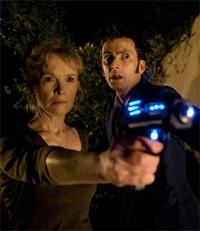
Review: Doctor Who: Waters of Mars (December 19th, Space/BBC America)

Doctor Who? My question exactly.

This is not to suggest I don’t know the basic premise of Doctor Who: he’s an omniscient figure who travels through time/space solving exotic problems with the help of assistants (wait, I think it’s companions). However, I’m fairly certain there’s a deeper mythology here than “he’s mortal enemies with those ugly robot dudes that I think are called Daleks,” which means that going into Doctor Who: Waters of Mars (which according to the press kit is the second of the four final “movies” that David Tennant is doing before running off to star in an NBC pilot) my knowledge of this universe is a cribbed together collection of tidbits gleamed from pop cultural exposure and a couple of random episode viewings during the Eccleston period.

But, as was the case earlier this year when Russell T. Davies created an enormously compelling, stand alone piece of entertainment with Torchwood: Children of Earth, Doctor Who: Waters of Mars (which airs tomorrow night, December 19th, at 9pm ET on SPACE in Canada and on BBC America in the U.S.) is capable of engaging just about any audience. While it doesn’t have Children of Earth’s real world commentary on government corruption or anything so complicated, it tells a tightly driven story that at its core speaks to the inherent dilemma of being a man who is capable of changing time but only to a certain extent, and the plight of humans out to save the planet but finding themselves at the precipice of placing that planet in even further danger.

The result is a very compelling piece of television in its own right, but one that feels like a turning point for this character as he David Tennant prepares to say goodbye to what is very clearly a career-making role.

Continue reading

15 Comments

Filed under Doctor Who

Friday Night Lights – “In the Bag”

“In the Bag”

December 16th, 2009

In the show’s third season, the show said goodbye to two characters who, for the most part, were unconnected to the remaining characters. Yes, everyone had a relationship with Smash and Jason Street, especially the audience, but there was the sense that their relationship was coming to an end. Smash and Jason Street were ready to leave Dillon, and the show’s characters were ready to see them leave and achieve their dreams. As much as people respected these individuals, they were moving onto bigger and better things.

However, last week’s character exit left behind people who were emotionally connected to them beyond respect, people who don’t entirely know how to function without them. And accordingly, “In the Bag” becomes a discussion of those intense connections, as people try to deal with parts of their lives on which they are dependent and those parts where other people are dependent on them.

Continue reading

1 Comment

Filed under Friday Night Lights

Equal Treatment: SAG delivers Disappointing TV Nominations

The other day, I tore into the Golden Globes for being star fetishists, arguing that their choices reflect a clear lack of interest in actually honouring the best in television (when Entourage is your default, there is something very wrong). However, I think sometimes we pick on the Golden Globes so much that we forget that other award shows which actually have some shred of credibility are just as capable of proving disappointing.

And so I feel I need to provide equal treatment, and criticize the Screen Actors’ Guild for a bizarre set of nominations (click the link to read if you want to know all of the context for the below rant) which seem to indicate that they’re not actually watching television at the moment. While the rut SAG has fallen into is less egregious than that of the Hollywood Foreign Press Association, its relative credibility makes its shame a definite disappointment during this end of year awards season.

Continue reading

1 Comment

Filed under Award Shows

Television, the Aughts & I – Part Five – “Late to the Comedies”

“Late to the Comedies”

December 17th, 2009

[This is Part Five in a six-part series chronicling the television shows which most influenced my relationship with television over the past decade – for more information and an index of all currently posted items, click here.]

Flipping through the three channels I got using my rabbit ear antennas in my dorm room late one night (okay, early one morning), I stumbled across a very snowy episode of television. In it, a group of office employees organize an “Office Olympics,” which ends up both funny and quite sweet, and I wanted to know more about this single-camera comedy.

Following internet chatter, I heard of a cult-favourite show that my only memory of was my confusion at its victories at the Emmy awards.  Fan response was overwhelmingly positive to the point where my very credibility as a television viewer was in jeopardy if I didn’t join in for its upcoming third season.

Although no one I knew actually watched the show, I heard word of a multi-camera comedy with some recognizable faces that was slowly building a cult following of its own with what it called a “Robin Sparkles,” and since I was wrapped up in a “Save this Show” campaign for a different show at the time I figured I should see if another bubble show might be worth getting behind.

A decade ago, my only recourse in these situations was to find out when the various shows (which, for the unawares, are The Office (US), Arrested Development and How I Met Your Mother, respectively) aired and just pick up wherever they happen to be, hopeful that some day reruns could fill in the gaps.

However, we live in an age where I was able to catch up with twenty episodes of The Office to be up to date a mere week later, and where I marathoned two seasons of Arrested Development to be able to join the Bluth family in progress, and where I spent the summer before HIMYM’s third season learning what a Slap Bet was and watching Barney Stinson own the Price is Right. As a result, I became a vocal supporter of all of these shows, getting in on all of their jokes, despite having been late to the party with every single one of them.

And I’ll admit right now that I probably broke a law or two doing it.

Continue reading

11 Comments

Filed under Television The Aughts & I

Being “Wrong” in Lost, The Big Bang Theory and So You Think You Can Dance

Being “Wrong”

December 17th, 2009

In an interview with GQ this week (where they were joined by J.J. Abrams and the rest of the Bad Robot crew), Lost co-executive producers Damon Lindelof and Carlton Cuse spoke candidly about their anxieties going into Lost’s sixth and final season (if not so candidly about what that season will involve, as per their spoiler policy leading into the much-anticipated swan song for the series). And in the span of that conversation, Lindelof shared their concern regarding what message viewers will take from the upcoming season:

“But in a lot of ways, the storytelling this year is just us telling people that they were wrong. They’ve built up theories for five years. When a show like this gets to a certain point and then it’s “Oh, man, we were cancelled,” people get to bring their theories with them to the grave. With us, it’s basically like, “No—you’re wrong.” And some people may have been right. Who knows?”

Questions, after all, beg answers, and only those of us with extraordinary will power have managed to avoid hatching an elaborate theory (or two, or twelve) about the island or guessing at where certain characters will end up by series’ end. But what happens when the show has built up five seasons worth of fan-generated answers, only to systematically disprove 99.9% of them over the course of the sixth season? Their job has, as a result, expanded to not only providing answers that satisfy plot or character, but also answers which are so satisfying that they also convince the audience that being “wrong” is not something to be ashamed of.

Because people don’t like being wrong, as a general rule, and they can often respond negatively (likely with “No, you’re wrong!”) when a show seems to be dead set on devaluing their theory, or ignoring a relationship they “ship,” or eliminating a contestant they cheer for. And reading that GQ interview, and witnessing the a Big Bang Theory fan community over the past months, and finding myself responding to tonight’s So You Think You Can Dance finale as if it were “wrong,” I’ve realized that we shouldn’t vilify being wrong; in fact, it’s probably one of the most powerful emotional connections we have to television.

[Spoilers for the So You Think You Can Dance Season 6 finale, and extended ruminations on the question of “wrong,” after the break]

Continue reading

1 Comment

Filed under Lost, So You Think You Can Dance

Television, the Aughts & I – Part Four – “Reality Doesn’t Bite”

“Reality Doesn’t Bite”

December 16th, 2009

[This is Part Four of a six-part series chronicling the shows which most influenced my relationship with television over the past decade – for more information and an index of all currently posted items, click here.]

In Part One, I suggested that I had no real vivid memories of television before 2001, and while this is effectively true I do have a memory about reality television that predates that time. I was watching Entertainment Tonight (I swear, at one point this was a perfectly logical thing to do), and they had a short news blurb about how a Scandinavian reality show concept was coming to television amidst controversy. The show was, in fact, Survivor, and when they talked about the premise (people stranded on a pacific island left to fight it out for a million dollars) I thought it was one of the stupidest things I had ever heard.

And then I watched 19 seasons of it.

What I quickly discovered was that I love what we’ve now come to call the Reality Competition genre, shows which capture the thrill of, you know, competition with the added dose of, well, reality. To use other words is convenient to help justify watching the shows, equating them to a social experiment or a chance to live vicariously through others, but there is something about seeing people you come to know and care about compete against one another for a cash prize that continues to see me tuning in week in and week out.

Now, when analyzing the decade as a whole it may seem strange – more than strange, it’s probably a bit misrepresentative – to limit the limitless reality genre to only its competition format, but for me the competition format has been the far more important and positive television force. While there is, in fact, something borderline exploitative about some elements of the reality genre, competitive reality is the unique mix of casting and a cleverly designed structure, shows which utilize various narrative tools (especially editing) in order to welcome viewers into experiences that are not their own in a way that empowers us to, in a limited form, psychoanalyze our social interactions, race around the world, or care about something about which we know extremely little.

And while it isn’t in fact for everyone, it’s definitely something that has been an important part of my television experience over the past decade.

Continue reading

6 Comments

Filed under Television The Aughts & I