
 “White to Play”
October 1st, 2009
At the opening of “White to Play,” we open on a shot of children lying on the playground out cold. We have reason to believe, of course, that this is a flashback to the blackout, until we see Charlie, Mark and Olivia’s daughter, standing. The show wants us to believe that Olivia is unique, or that perhaps she had some other sort of vision, but it turns out that it was the kids playing a game. They were playing “Blackout,” where everyone pretends they were out cold and then wakes up and tells everyone what they saw.
While the initial feeling is that this is a particularly ominous opening, there’s a problem: instead of appearing dichotomous to the show itself, it seems a fitting metaphor. In its second episode, FlashForward largely treats the viewers like children, repeating themes over and over again and actually managing to flash back to a flashback of a flashforward in the process. The investigative process feels like random happenstance, sprinkled with odd comic tangents and explosions in place of plot development, and the show struggles to recapture anything even approaching the tone that made its pilot stand out from the crowd.
There are a lot of interesting questions at play with this premise, and on occasion the show quite intriguingly interacts with some of them, but when it’s not thinking big its conversations turn into microcosms of overall themes, never allowing characters to act human in the process.
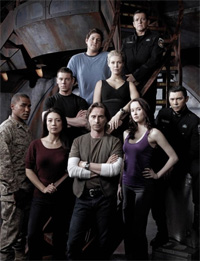 My experience with the Stargate franchise is somewhat limited: I’m fairly certain I’ve seen the movie, likely stumbled upon SG-1 at some point, and saw quite a few random episodes of Atlantis while home during holidays. It is a series that, for me, has always failed to keep my interest largely because of the repetitiveness of its procedural construct, especially with Atlantis. While there were some interesting ideas on that show, and even some interesting performances, I found that the universe being constructed wasn’t interesting enough for me to come back week after week for very similar storylines that would either end quickly or, at the most, develop into a 2 or 3 episode arc.








 Cultural Learnings