Tag Archives: Review

How I Met Your Mother – “Last Words”

“Last Words”

January 17th, 2011

Response to “Bad News,” HIMYM’s last original episode, was decidedly mixed. What struck me most was the way the episode-ending reveal that Marshall’s father had passed away became so problematic despite the fact that this is the kind of show which should be capable of handling such delicate matters. I’ll certainly agree with those who felt that there was some potential incongruity between the playful nature of the countdown and the eventual reveal, requiring a sudden gear shift which made the episode considerably divisive.

However, while the series is no so heavily serialized that we need reserve judgment on an individual episode until seeing how it carries over into the next, I would say that “Last Words” is in a position to sort of payoff the buildup offered in “Bad News.” The result, I feel, is an infallible merging of the comic and dramatic elements mashed together two weeks ago – with more time to establish the balance, Bays and Thomas emphasize the way in which well-drawn, longstanding characters offer great potential to take even a fairly rote storyline to a truly emotional place through some sharp writing and some stellar performances.

And that’s the sort of self-actualization the show was missing last season.

Continue reading

7 Comments

Filed under How I Met Your Mother

Ricky the Rabble-Rouser: The 2011 Golden Globe Awards

Normally, watching the Golden Globes is a fairly solitary experience for me.

Sure, my parents or a few floormates would often be in the room as I liveblogged, livetweeted, or took notes during previous years, but the focus was on putting together short-form snark and long-form analysis of the night’s events. It was just me and the internet, as I awaited the (relative) flood of page views which come with writing about any event of this notoriety.

This year was somewhat different – I attended a lovely Golden Globes viewing party held at some colleagues’ home here in Madison, where the collective snark of my Twitter feed was replaced by the collective snark of a bunch of media studies grad students. We enjoyed some fine food, some fine wine, and I took advantage of being the only obsessive follower of award season prognosticators in order to win the prediction pool. While I have much love for the online community which has formed around this blog, and around my work in general, I will admit that there was something nice about being (largely) disconnected from the online snark in favor of a more interpersonal form of social interaction (which is perhaps fitting considering The Social Network’s dominance of the evening’s proceedings).

However, as a result, I didn’t quite have the time to prepare the lengthy analysis I might normally have written, and which I normally write much of during the show to facilitate its completion. Instead, I put together a more concise and focused piece on the evening’s reflection of ongoing questions surrounding the Golden Globes’ legitimacy over at Antenna. It’s a question that I’ve had on my mind for a while now, and something I wrote about at length for a term paper on the Emmy Awards last semester, but some of Ricky Gervais’ jokes at the expense of the Hollywood Foreign Press Association offered a nice entry into how precisely an awards show that nominates The Tourist, Burlesque and Piper Perabo can hold any sort of legitimacy within the industry.

The Gilded Globes: Legitimacy Amidst Controversy [Antenna]

Every year, the Golden Globes give us a large collection of reasons to dismiss them entirely. The Tourist and Burlesque are perhaps the two most prominent examples on the film side this year, and Piper Perabo’s Lead Actress in a Drama Series nomination for USA Network’s Covert Affairs offers a similar bit of lunacy on the television side. While these may lead us to dismiss the awards as a sort of farcical celebration of celebrity excess, the fact remains that the Golden Globes hold considerable power within the industry.

However, since the piece features very little of my opinion surrounding the night’s winners and this is likely why you’re here, some brief thoughts on Gervais and the awards themselves after the jump.

Continue reading

7 Comments

Filed under Award Shows

Friday Night Lights – “Gut Check”

“Gut Check”

January 12th, 2011

Thanks to a particularly busy schedule and some difficulties getting access to the episodes in question, Friday Night Lights’ fifth season has been mostly absent from Cultural Learnings. And yet, this is about to change, both because of greater access and because there is a growing sense of urgency.

Not really within the show itself: while there is certainly plenty of tension on the series right now, it continues to follow the slow burn mentality it always has. And yet my relationship with the series has taken on a certain tension, as it is becoming more and more clear that this is a show which is about to come to its end. I could have waited until the NBC airings to cover the show, but this is going to be the real ending: this is when critics will write their posts on the series’ legacy, this will be when the fans will respond to the fond (or, who knows, potentially tragic) farewells, and this is when I want to say goodbye.

And so I’ll likely be checking in with the series weekly from now until the finale – for now, a few brief thoughts on the season as a whole and a more detailed review of “Gut Check” after the jump.

Continue reading

4 Comments

Filed under Friday Night Lights

Review: Lights Out – “Pilot” and Beyond

“Pilot” and Beyond

January 12th, 2011

The central contradiction in FX’s newest drama series, Light Out, is not uncommon in serial dramas. It is a show about the tension created during times of great stress, when individuals are forced to choose between the path which is “right” and that which allows them to keep their marriage, or pay off their debts, or survive another day. And yet, while the show wants us to empathize with Patrick “Lights” Leary and his decision to take the path of least resistance (and least blows to the head) and the forces threatening to pull him back in, the show is actually more like his younger brother. The show doesn’t really have the same sense of tension, the same pull in different directions: it knows what needs to be done, and lays a clear path which lacks much of the ambiguities which plague its central figure.

I don’t call this a “contradiction” to suggest that it undermines the series tremendously – Lights Out is a fine series, one which grows over the course of its first five episodes and eventually finds moments which do more than echo great drama series of the past decade. Those echoes are not without value, and with generally strong performances and some solid action the show does not come across as a blatant copy so much as a prestige pastiche (a pastige, if you prefer), but there always remains the sense that the show is following a decipherable logic. Characters fit into fairly small boxes, boxes we understand better than we would in an ideal situation, and the conclusions they come to are logical more in terms of pre-existing tropes than in terms of human behavior.

And yet, as I think the “Pilot” demonstrated quite nicely, there is value in treading over familiar ground so long as it still provides a certain thrill. While it may not always transcend its genre trappings, and has some down moments throughout its first five episodes, Lights Out is the kind of show that breeds appreciation if not necessarily fandom. I didn’t feel as if I needed to watch one more episode, but once I turned it on I didn’t start looking at the clock to see when it might be over. It doesn’t exactly pull you in but it doesn’t push you away either, and while that distance creates some of the resistance to the series you may see above, it also creates room to let the show sort of settle; it’s room that I’m hoping the series uses to its advantage in the remainder of its first season, as there’s plenty of potential to work with here.

[Spoilers for the Pilot, and some vague comments on subsequent episodes, to follow]

Continue reading

1 Comment

Filed under Lights Out

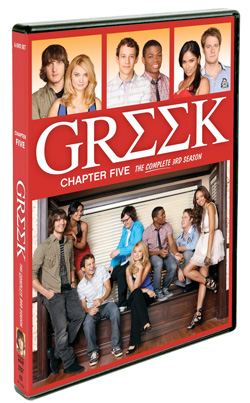
Review: Greek: Chapter Five – The Complete Third Season

Listening to the audio commentary on Greek‘s third season finale, I was struck by the mention of a “Save Greek” campaign – not because it brought back nostalgic memories of a barrage of red cups flooding ABC Family’s offices, but rather because I didn’t know such a thing existed.

Greek is one of those shows which operates outside of critical consciousness: there were no critics lining up to ensure that the series got a short ten-episode fourth season in order to conclude its storylines, and what fan behavior there was never seemed to bleed into even popular journalism. Instead, the campaign was apparently much like the show itself: inconspicuous, subtle, but ultimately effective. Without the ratings success of The Secret Life of the American Teenager, or the scandal-driven storylines of Pretty Little Liars, Greek has pretty much been left to its own devices, and the result has been a compelling if not necessarily earth-shattering comic drama series.

Admittedly, I don’t write about the show a great deal – it just isn’t something that suits weekly critical analysis, although I did recently get the opportunity to review the fourth season premiere at The A.V. Club. However, I was extremely excited earlier this year when it was revealed that Shout! Factory would be taking over the DVD production for Greek (as well as the beloved, and sadly missed, Huge): the company has a sterling reputation when it comes to creating polished sets worthy of their respective series, and while this is normally in relation to beloved classics or cult favorites (Freaks and Geeks, Undeclared, Sports Night, The Larry Sanders Show, My So-Called Life, etc.) they are in this case bringing the same sense of care to an ongoing series.

The result is hardly groundbreaking: this is not a complex show which would necessitate a detailed DVD package, and where one might normally find retrospectives or numerous deleted scenes you’ll instead find small snippets of behind-the-scenes footage and packages which seem aimed squarely at the show’s rabid fanbase rather than the television connoisseur. And yet I am acutely aware that I am not, in fact, the target audience for Greek: Chapter Five – The Complete Third Season (which releases today, January 11th, in North America at your retailer of choice). This is for the fans who sent in those red cups, the people who watch the show from an angle where Casey/Cappie are a portmanteau-worthy coupling rather than an ultimate detriment to the series’ success.

This set, dubbed Chapter Five for reasons I’ll discuss after the break, should please those long-term fans – it is also a good value, though, for those who have yet to discover the series’ charms.

Continue reading

2 Comments

Filed under Greek

Doctor Who – “A Christmas Carol”

“A Christmas Carol”

December 25th, 2010

My “first” experience with Doctor Who, at least more than off-handed glimpses of the Eccleston era, was “Waters of Mars.” I received the screener, watched the episode, and sort of decided that I should see more of what the series had to offer. My next step was, not shockingly, “The Next Doctor,” the first of the four Tennant Specials of which “Waters of Mars” was part.

It was my first, and to date “only,” experience with the Doctor Who Christmas Special, an interesting example of television form. They’re a sort of palate cleanser, a way to transfer smoothly from one series to the next: there’s no major plot developments, no huge shifts in character relationships, serving instead as a reminder of how much you like the series and how much you are anticipating its return later in 2011.

And yet, while “The Next Doctor” was definitely a Christmas episode, it was very much affected by the Tenth Doctor’s soul searching, a sort of existential crisis which made that Christmas special a transition into a very particular journey of identity and meaning in the specials which followed. By comparison, “A Christmas Carol” is unconcerned with all of it: writing his first such special, Steven Moffat uses Christmas as a source of whimsy and magic, heartbreak and memory, and a wonderful bit of storytelling from which it seems the season to follow will draw momentum if not necessarily inspiration.

Although I wouldn’t mind if it took some of that too, considering how much I enjoyed this return to Who-Ville.

Continue reading

12 Comments

Filed under Doctor Who

Community – “Abed’s Uncontrollable Christmas”

“Abed’s Uncontrollable Christmas”

December 9th, 2010

As if Community weren’t meta enough, my immediate response to “Abed’s Uncontrollable Christmas” was a desire to sit Dan Harmon down in a study room and journey into his mind in search of the meaning of Community.

I say this not because the episode undermined or threatened pre-existing notions of the series, but after the episode I wasn’t sure if what I’d seen was the very embodiment of the series’ general approach to comedy or something completely unique. Because it looked decidedly unique, I first leaned towards the latter category, but then it was put into context with the sense of generic parody that Daniel T. Walters wrote about this week, and even Abed’s general trend of seeing the world through pop culture that friend of the blog Cory Barker wrote about on his publicly-available term paper.

The episode was lovingly crafted, comically inspired, and willing to delve into some darker emotional territory, but I ended up feeling that this ended up in a liminal space between what Community wants to be and what I often fear it will become. It was sort of like I was Ebenezer Scrooge, and the episode manifested as ghosts of Community Past, Present and Future all at once.

And I don’t know whether to be extremely excited or mildly concerned.

Continue reading

5 Comments

Filed under Community

Glee – “A Very Glee Christmas”

“A Very Glee Christmas”

December 7th, 2010

Generally speaking, the most difficult question for Glee to answer is “Why?” So many of its stories seem to have no connection with ongoing events that if you keep asking why precisely it’s happening, and so you sort of have to just sit back and enjoy the ride.

But “A Very Glee Christmas” offers an answer to this question at every turn: every time I imagine someone questioning the various hurried and forced story developments in the episode, the show screams back “BECAUSE IT’S CHRISTMAS.”

It’s a pretty good excuse, honestly: while sometimes the show risks losing its heart amidst the broadness of Sue’s cartoon villainy, and it sometimes struggles with how theme episodes deal with ongoing storylines, Christmas gives them something cheerful and magical to bring it all together. We expect Christmas to overwhelm all other emotions, as holidays are all about coming together regardless of our differences and celebrating peace on Earth.

And for a show that is always most comfortable, in my eyes, when it merges its sense of celebration with a sense of sadness, “A Very Glee Christmas” at times hits the sweet spot: it uses the broad comedy to fuel the sadness, but follows through on the consequences with an investigation of the limitations of Christmas rather than simply a celebration of the holiday. The result is an episode which seemed charmingly celebratory and yet still felt like it could indulge in “Sue the Grinch” when it so desired.

And it’s pretty emotionally honest until it ends up with nowhere to go but sap, positing Christmas as collective rather than connective and losing its momentum and its charm in the process.

Bah humbug.

Continue reading

22 Comments

Filed under Glee

How I Met Your Mother – “The Mermaid Theory”

“The Mermaid Theory”

December 6th, 2010

“The Mermaid Theory” is interesting in two ways. And since they’re not particularly substantial ways, I’m just going to cut the introduction off here and we can get into the meat of it.

Continue reading

5 Comments

Filed under How I Met Your Mother

Season Finale: Terriers – “Hail Mary”

“Hail Mary”

December 1st, 2010

In plotting the first season of Terriers, Shawn Ryan and Ted Griffin made two key decisions which shaped the series into one of the year’s finest.

The first was their willingness to resist creating a season-long arc: after the first four or five episodes seemed to be towards some larger conspiracy, the show risked frustrating viewers by pulling up before things became too complicated. In an age where hyper-serialization is highly valued, the decision seemed strange until we saw the result. The residual energy from the near-miss mythology lingered in the subsequent standalones, as unfinished business meant a constant threat of its return – when it did return in “Asunder,” there were more pieces to the puzzle, and the re-entry was surprisingly elegant.

The second was that, throughout the various ups and downs, the show never concretely positioned its heroes within any definitive morality. While we could argue that Hank and Britt are inherently good men, their willingness to do petty, despicable, and reckless things has been refreshing. Hank’s jealousy has never been romanticized, and Britt’s violent outbursts have never been pitched as heroic; while we understand why they do the things they do, we are never asked to agree with them, and the result is two characters who we can relate to even when we don’t want to. They’re characters we like even in their darkest moments, but characters that we don’t necessarily forgive after the fact. They are characters that feel real, and thus characters that we become connected with.

“Hail Mary,” coming off of the rollercoast that was “Quid Pro Quo,” is hopelessly hopeful. Following the earlier pattern, it concludes stories without actually concluding them, leaving threads of story that can be picked up at a later date. It provides a sense of future that it must subsequently tear away, reunions that are either years or weeks too late. While you could technically argue that this is a happy ending, a sort of scrappy P.I. Casablanca, in truth the ending is as the season was: an exercise in dynamic delay, a true marvel of narrative form.

And a show that simply cannot be allowed to ride off into the sunset.

Continue reading

8 Comments

Filed under Terriers