Tag Archives: Review

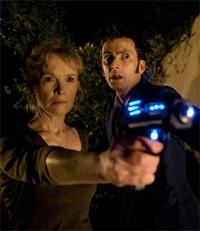
Review – Doctor Who: The End of Time, The End of Tennant

The End of Time, The End of Tennant

January 2nd, 2010

Watching Doctor Who: The End of Time, for me personally, is a bit of a strange exercise for two reason (one exclusive to me, the other general).

First, I don’t watch the show on a regular basis, so while watching a few of the recent specials (Specifically the quite enjoyable “The Next Doctor” and the thrilling “The Waters of Mars”) has given me some sense of what’s going on – the Doctor (David Tennant) without a companion on a self-destructive journey to confront his impending death (I think?) – I’m still left out of the loop in terms of both the show’s larger mythology and the intricacies of Tennant’s run on the series.

However, even considering my ignorance to the broader mythology at play, the two-part event (which airs in its entirety tonight at 8pm on SPACE in Canada, with the second part (Part One aired in Boxing Day) airing on BBC America) is unique in its clear purpose: the death of the Doctor, and the departure of David Tennant from the series to make way for newcomer Matt Smith. And while you could argue that Law & Order or CSI, with their revolving door casting policy, offer something similar (in terms of transitioning from one actor to another), Doctor Who is unique in the fact that Smith will effectively be playing a new character…except that he won’t.

The single greatest accomplishment of The End of Time, which is at times a mixed bag in terms of its effectiveness, is that despite my lack of knowledge of the show’s history, and despite the lack of suspense surrounding an inevitable conclusion that has been known for over a year, I was emotionally affected by Russell T. Davies saying goodbye to the Doctor, and the Doctor saying goodbye to the people he cares about. Built on a foundation of David Tennant’s fantastic performance, the movie overcomes a bit of a muddled first part (which is tied up in a lot of exposition) in order to deliver a conclusion which demonstrates the combination of whimsy and pathos that has made the show, with its low budget special effects and its quirky sense of humour, so enduring.

And it feels like just the right kind of note on which to head into the reign of the new Doctor, which based on what I’ve seen in these specials is something that I might be willing to spend some time with in the years to come.

[Spoilers for both parts of the Miniseries after the break, where we’ll discuss the special in more detail]


Continue reading

5 Comments

Filed under Doctor Who

Crossroads: Cinematic Convergence and Up in the Air

Crossroads: Cinematic Convergence and Up in the Air

December 29th, 2009

One of the joys of fictional narratives is that writers have free rein to start their story at any point in their characters’ lives. Unless we’re literally following a character from the time of their birth to the time of their death, there are parts of their stories that are simply not going to be told; instead, writers will select a particular time to pick up a character’s story that feels the most cinematic, or pressing, or engaging.

Television is at a distinct advantage in this area when compared with film, in that it is able to pick up multiple moments over the course of multiple seasons. Mad Men has made a business of using time shifts in order to find Don Draper amidst particular historical periods, while a show like Weeds fastforwarded its heroine’s pregnancy in an effort to streamline its position in the narrative. This is plausible, even desirable, because the lengthy runs of television shows allow them to create their own past, present and future – the narrative becomes longer and the moments become more plentiful and the characters’ lives become augmented by their lives as it relates to our experience (measured in seasons as opposed to years).

But with cinema, at least with those films which aren’t part of a broader franchise or serving as a sequel, there is an expectation that things will largely standalone. You will meet a set of characters at a particular point in their lives, and you will follow those characters for as long the writer intends for you to do so. And that’s sort of what I find fascinating about Jason Reitman’s Up in the Air, a film where we meet a variety of characters at a definitely cinematic point in their lives. It is a film where we meet those at a crossroads in their lives, and one which is far less interested in how they got to this point than it is interested in what they’re going to do now that they’re here.

And in terms of finding a strong narrative of self-realization and life choices, Reitman has picked the right moment: it has also, however, led to some very strong negative reactions to the film from those who were expected a more indepth investigation into any one of the story’s various elements.

Continue reading

3 Comments

Filed under Up in the Air

Better Off Ted – “Battle of the Bulbs”

“Battle of the Bulbs”

December 22nd, 2009

How far can a show get on wordplay alone?

It’s a question that Better Off Ted seems to really want to answer, because there have been points early in the second season where there hasn’t been any glue to hold the one-liners together. Even the show’s corporate satire has been weaker than usual, as the Veridian Dynamics commercials have entirely disappeared and left behind a solid show with funny character and witty writing but not, unfortunately, the same comic sensation we fell in love with earlier this year.

And “Battle of the Bulbs” doesn’t fundamentally change this trajectory, although it works harder than past episodes at tapping into the show’s strong points while also managing to feel more cohesive. However, there is still something missing here, something that shows that Victor Fresco’s attempts to push the show outward from its first season bubble has largely proved an inconsistent experiment that relies heavily on the characters involved.

Continue reading

Leave a comment

Filed under Better Off Ted

Scrubs – “Our Mysteries”

“Our Mysteries”

December 22nd, 2009

As Scrubs continues into its ninth season, one can’t help but feel as if the greatest mystery is why said season needs to exist.

It’s not that “Our Mysteries” or any other episode of the season thus far is terrible, but rather that what we’re seeing lacks any sort of emotional punch beyond a desperate play at some sort of nostalgia. And unfortunately, that was already the focus of the show’s creative resurgence in its eighth season, which I found myself absent-mindedly revisiting over the weekend. There, the show used a new crop of interns in order to raise questions of maturity and “moving on” in the characters we knew and loved, which was a good strategy for transitioning a character like J.D. from buffoon to father/husband.

However, the problem with the ninth season thus far is that it seems to want to go beyond that, to actually build these med students into characters, and yet the only parts of their stories which are really connected on an emotional level (Scrubs’ strong suit) have more to do with the returning characters than Lucy, Cole, or Drew.

And what that is, precisely, is still a mystery to me.

Continue reading

3 Comments

Filed under Scrubs

Review: Doctor Who: Waters of Mars (December 19th, Space/BBC America)

Doctor Who? My question exactly.

This is not to suggest I don’t know the basic premise of Doctor Who: he’s an omniscient figure who travels through time/space solving exotic problems with the help of assistants (wait, I think it’s companions). However, I’m fairly certain there’s a deeper mythology here than “he’s mortal enemies with those ugly robot dudes that I think are called Daleks,” which means that going into Doctor Who: Waters of Mars (which according to the press kit is the second of the four final “movies” that David Tennant is doing before running off to star in an NBC pilot) my knowledge of this universe is a cribbed together collection of tidbits gleamed from pop cultural exposure and a couple of random episode viewings during the Eccleston period.

But, as was the case earlier this year when Russell T. Davies created an enormously compelling, stand alone piece of entertainment with Torchwood: Children of Earth, Doctor Who: Waters of Mars (which airs tomorrow night, December 19th, at 9pm ET on SPACE in Canada and on BBC America in the U.S.) is capable of engaging just about any audience. While it doesn’t have Children of Earth’s real world commentary on government corruption or anything so complicated, it tells a tightly driven story that at its core speaks to the inherent dilemma of being a man who is capable of changing time but only to a certain extent, and the plight of humans out to save the planet but finding themselves at the precipice of placing that planet in even further danger.

The result is a very compelling piece of television in its own right, but one that feels like a turning point for this character as he David Tennant prepares to say goodbye to what is very clearly a career-making role.

Continue reading

15 Comments

Filed under Doctor Who

Fall Finale: Glee – “Sectionals”

“Sectionals”

December 9th, 2009

“Winning could make everything good for a while.”

I do not understand the rules of the Sectional Show Choir competition, nor do I know exactly what comes after it in New Directions’ journey. Glee is a show that despite being about what seems like a shockingly bureaucratic existence (with sponsorship disqualifications and everything) wants absolutely nothing to do with that complexity, and as such “Sectionals” boils down to the above: if they win, things will be better.

But what Glee has been doing all season is hiding inherently sombre stories beneath the shiny gloss of over-produced musical numbers. Rachel Berry soars every time she takes the stage, but beneath that surface she has no friends and feels like that’s never going to change. Quinn gets up to sing “Don’t Stop Believin’,” and yet her pregnancy is a source of constant anxiety as she knows how much Finn will be hurt when he, eventually, figures out the truth. And Will Schuester used Glee as a distraction from a marriage in tatters, dancing and mashing up songs when he should have been communicating and patching up his relationship with Terri (and, you know, touching her stomach and discovering her lie earlier).

I’ve accepted, at this point, that Glee’s delayed reaction to some of its early problems (including its somewhat mean-spirited comedy and the aforementioned fake baby storyline) is inherently part of its characters’ journeys – the show is awkward because teenagers are awkward, and it’s inconsistent because high school is inherently impulsive and volatile. And while I am far from suggesting that the show has been perfect this season, I at least feel like the journey it has taken with these characters is consistent with its investigation of what happens when the world of show choir intertwines with a collection of diverse personalities for the sake of both comedy and drama.

As such, “Sectionals” works as a finale precisely because it has no romantic notions about what “Sectionals” is: this is not a simple celebration of musical talent, nor a simple culmination of any one character’s journey. It’s a neon band-aid that makes a wound look a whole lot prettier, capable of healing those wounds but also capable of being ripped off and leaving scars that no neon band-aid will ever be able to fix. It’s an hour of television that highlights life’s futility while celebrating its transcendence, never once suggesting that one will ever cancel out the other.

And it’s a rather fantastic end to what has been a fascinating (if not quite consistently amazing) first thirteen episodes for the show they call Glee.

Continue reading

15 Comments

Filed under Glee

Season Finale: Being Erica – “The Importance of Being Erica”

“The Importance of Being Erica”

December 8th, 2009

Going into its second season, Being Erica was a show about one person. But, with a slight expansion of its universe, the show had the potential to become about people beyond Erica, for her journey to become less about her own problems and more life’s problems. The show’s therapy conceit, driving characters to revisit their past in order to offer perspective on their lives, isn’t something that is isolated to one character, and in some ways Erica revisiting her greatest regret (her brother’s death) meant that the show would need to find its emotional core elsewhere. Erin Karpluk will always be very charming, and the show’s structure is a nice procedural element to drive the show forward, but Erica no longer had a “purpose” all season, and at times it felt as if the season was actively ignoring the expansion of its universe (which I found really intriguing) in favour of telling stories that, well, didn’t matter.

The season’s solution to this problem was to introduce Kai, a futuristic barista with a deep secret, and to spend two episodes delving into Dr. Tom. And while the latter resulted in a real tonal shift for the show that worked to its advantage, Kai didn’t work in the beginning like the show wants to believe it did at the end. Sebastian Pigott is a decent actor and a solid singer, able to pull off the role in a way that makes us invested in Kai’s journey, but the show was never consistent on what that journey meant. The show never let us see Kai’s journey through a perspective other than Erica’s, never allowed us to relate to him in a way that makes his story stand separate from his relationship with Erica. And yet, until the end, Erica never felt logically connected to Kai beyond their shared therapy strategies, and the story just never clicked in the way it could have.

“The Importance of Being Erica” is a strong finale that wants to pretend that the show figured all of this out, and that the season worked in a way that led to Erica’s emotional and career realizations. That’s stretching too far, but it’s another sign that even in its occasional problems there is a very good show that occasionally comes to the surface here (and that, if the show learned its lessons, could dominate in the third season).

Continue reading

16 Comments

Filed under Being Erica

Dexter – “Hello, Dexter Morgan”

“Hello, Dexter Morgan”

December 6th, 2009

“Who are any of us, really?”

There’s a requisite scene or two in “Hello, Dexter Morgan” where Dexter stands in front of a four-part mirror discussing his fragmented self or sits in his storage container chatting with his conscience in the form of his dead father. In these scenes, the show taps into something within Dexter Morgan that serves as the very basis for this character study, and I consider myself legitimately interested.

Except that, in this the show’s fourth season, those scenes have been completely ineffective, to the point where I consider them a parody of what the show once was. Lines like the above used to have some legitimate weight in this show’s universe, but the theme has been dragged through the muck so many times that it has lost all meaning. Michael C. Hall has never stopped capturing the inner torment of Dexter Morgan, but the show is so insistent on surrounding that with absolute chaos in an effort to “excite” the audience that moments of contemplation feel like exposition as opposed to inquisition.

What makes “Hello, Dexter Morgan” work as an hour of television is that in a collection of scenes it manages to capture at least one character in an new light, finding Jennifer Carpenter doing some of her stronger work on the show to date. If you were to isolate her scenes, you’d have a bang-up Emmy tape – unfortunately, you’d also have a non-representative statement of where the show is truly headed right now.

Continue reading

1 Comment

Filed under Dexter

Who Won The Amazing Race Season 15, and Did They Deserve It?

“Amazing Grace, How Sweet the Sound!”

December 6th, 2009

For three seasons, I have asked this question, and for three seasons I always wonder why I asked it in the first place.

You see, I like to think myself objective about The Amazing Race, more capable than most of separating my personal feelings for each individual team from my analysis of each individual leg. This isn’t to suggest that I don’t have teams I like more than others, but ever since I started writing television criticism I like to keep my distance to manage disappointment (like last year’s early exit from Mike and Mel and this year’s tragic end for Justin and Zev) and be able to avoid sounding too bitter if something goes wrong.

However, the reason I asked this question in the first place (and why I continue to ask it despite my supposed objectivity) is that the final leg of The Amazing Race always raises this question whether we’re trying to detach ourselves or not. The very nature of the race is that we’ve seen these teams at their highest and lowest, and the editors have done everything in their power to make their inevitable finish in this race as meaningful as possible.

For Meghan and Cheyne, that finish would symbolize the strength of their relationship as evidenced by their teamwork throughout the race (the frontrunners). For Brian and Ericka, the win would symbolize the strength of their relationship and more importantly their ability to bounce back from near defeat (the underdogs). And for Sam and Dan, after intense focus on “dishonest acts” in recent weeks, the win would demonstrate that doing everything it takes to win the Race is both opportunistic and highly effective (the villains).

And for at least some viewers, each of these teams would represent a “deserving” victory of The Amazing Race’s 15th journey around the globe – for me, I’d say that any one of them would have deserved it, but I think it’s tough to argue that the “right” team didn’t win.

So, time to found out: who won The Amazing Race?

Continue reading

2 Comments

Filed under The Amazing Race

Dollhouse – “The Public Eye” / “The Left Hand”

“The Public Eye” / “The Left Hand”

December 4th, 2009

“Everybody’s got a past – it’s the future [viewers] care about.”

Writing about Dollhouse is like riding a bike – the show has never suffered from a lack of ideas, making even its weaker episodes (once it got ahold of its identity) fascinating to discuss. However, there’s something inherently unsatisfying, in theory, about getting back onto that bicycle when you know that you’re about to run out of road, and in a very short period of time this bike is going to be absolutely worthless to you. So much of what I do here at Cultural Learnings is about contextualizing episodes in the past, present and future of any particular series, and in the world of Dollhouse that future has become a swift cancellation which could come as soon as early next week should the ratings from tonight’s two-hour block of episodes be so disastrous that FOX is willing to risk the wrath of fans as opposed to the wrath of advertisers and replace the show with reruns.

And yet, there is something about where this show finds itself mid-way through its second season that I find far more compelling than I should. I know this show is going to end, and yet there is something about the show’s view of the future that has turned its futility into an asset of sorts. It’s almost as if we’ve already reached the end of the road, but instead of a sheer drop the show is offering a lengthy kill on which we can simply coast down the hill with our hands off the handlebars feeling the wind in our face and taking those last moments to think about what was, what is, and what will (or would) be. It’s almost as if cancellation has freed Dollhouse from certain expectations, and what we get from this point forward is about what we take from the material rather than what the material necessarily says in and of itself.

As such, “The Public Eye” and “The Left Hand” are both really great hours of television not only because they’re well-executed in terms of basic plot and character, but also because through the wonders of a DVD bonus feature we as an audience are perfectly situated to understand the ramifications of what is going on here at levels that go beyond the immediate to a future that we might never be able to see but that we are able to vividly imagine in ways that allow the show to survive beyond the certainty of its fate.

Continue reading

1 Comment

Filed under Dollhouse