Category Archives: Game of Thrones

Game of Thrones – “The Ghosts of Harrenhal”

“The Ghosts of Harrenhal”

April 29th, 2012

“I still can’t believe that you’re real.”

Perhaps it’s my relatively unromantic disposition, but I’ve never really considered love in the context of Game of Thrones. It’s obviously part of Martin’s books, but it’s so often quashed, or forbidden, or broken, that it’s hard to identify it as one of the key themes (or even as a theme in some instances). However, as I noted in last week’s review, the introduction of Robb’s love interest reminded us that romance and desire are not entirely foreign concepts within the framework of this story.

However, as “The Ghosts of Harrenhal” observes (and as we’ll see continue into next week’s episode as well), that love is rarely consummated. Sam speaks of Gilly in hypotheticals, in love with a memory more than a real person, while Jorah’s love for Dany (captured in the quote above) makes both of them uncomfortable, an unspoken reality they dare not bring to the surface lest it shatter their existing relationship. In other words, their love remains unromantic out of fear of what romantic love would look like, relying instead on the love you have for a brother or a sister or for your King. It’s this love that ultimately threads through “The Ghosts of Harrenhal,” and the season at large, and it’s a love that may be equally tenuous depending on its object.

Continue reading

12 Comments

Filed under Game of Thrones

Game of Thrones – “Garden of Bones”

“Garden of Bones”

April 22nd, 2012

“Too much pain will spoil the pleasure.”

One of my general criticisms for “Garden of Bones,” which is Vanessa Taylor’s first script credit on Game of Thrones after joining as a co-executive producer this season, it’s that choosing a pull quote was a bit too difficult. It was an episode filled with lines that felt like they were aiming too much towards broader thematic ideas, pulling me out of the moment and placing me into the head of the writer.

It doesn’t mean that the episode isn’t filled with a lot of great sequences, or that those lines aren’t evocative of key themes that are valuable to the series’ future. However, there’s something about the episode’s exposition that calls attention to itself: a rarely seen character emerges with new confidence early on so that his comeuppance later has relevance, a single character out of a larger group is awkwardly signaled out by his full name for no reason other than informing the viewer who he is, and another name is conveniently used in a conversation just as another character needs to learn it.

It’s not enough, as noted, to entirely derail the larger function of “Garden of Bones,” but there does come a point where an episode that begins with a Westerossi Meet Cute begins to flow less naturally, a point that this episode reached as the exposition burden of the early parts of the season seems to come to a head.

Continue reading

30 Comments

Filed under Game of Thrones

Game of Thrones – “What Is Dead May Never Die”

“What Is Dead May Never Die”

April 15th, 2012

“They are the knights of summer, and winter is coming.”

This central idea has been at the heart of Game of Thrones from the very beginning: the children we’ve come to know, and the younger characters who jostle for power, do not know the true struggles of both the actual winter (starvation, struggle) and the metaphorical winter (war, bloodshed) that await them in the future.

Unfortunately, almost all of these characters have been faced with this reality sooner than they anticipated, pushing characters like Sansa and Arya Stark, Theon Greyjoy, and Renly Baratheon into positions where they must reconcile their fears and insecurities with a path they might not have chosen if not for the circumstances. Their struggles, however, must remain largely personal: while Theon Greyjoy might struggle to decide between his two families, for example, he has no one on the Iron Islands to talk to but a single flame and a piece of parchment. When he chooses to burn what he’s written, he makes his decision by isolating himself and accepting that this is his burden to bear as his father’s son.

“What Is Dead May Never Die” is about exploring these kinds of relationships, and exploring really is the right word: although partnerships both begin and end in the episode, other scenes are more about the complicated politics of those partnerships as winter approaches. While the show is still at the point where plot remains on the backburner, the pieces moving into place no longer seem motivated by the whims of the script; characters are taking greater agency in this environment, and the result is a strong thematic piece which lays some important groundwork for characters both new and old.

Continue reading

15 Comments

Filed under Game of Thrones

Game of Thrones – “The Night Lands” and Sexposition

“The Night Lands” and Sexposition

April 8th, 2012

People who coin new terms are very rarely trying to coin new terms. When I used the term “sexposition” to describe a particular kind of scene in Game of Thrones, I wasn’t staking a claim to a corner of the cultural lexicon so much as I was trying to be clever. In fact, for a while – and still, really – I refused to believe it was possible to “invent” such a simple portmanteau – all I did was add an “s” at the end of the day. However, the word has caught on, leading to a bizarre couple of weeks in which Esquire magazine and The Guardian were contacting me on the subject, I was listening to Nikolaj Coster-Waldau and writer Bryan Cogman talking about it on the DVD commentaries, and now it even has a Wikipedia page not to be confused with “sex position.”

What I realized in chatting with these journalists, though, is that we (as a larger Game of Thrones-viewing community) had never come to a clear understanding of what sexposition even was. The first thing the Esquire journalist did was run a definition by me, and I realized that I didn’t really have any corrections because I had never actually thought much about it. While I had a number of scenes connected to the term in my mind, expanding it beyond Game of Thrones would require a more rigorous set of criteria, something that became clear when Michael Hann at the Guardian began talking about sexposition in the context of Showtime’s Homeland.

While Hann’s article captured the overall issue quite well, asking broader questions that speak to why the word is useful in considering the implications of this particular narrative device, I was confused by the evocation of Homeland, a show I would not associate with the term (which is a larger conversation that would require spoilers, so if you really want me to expand on that let me know). Also, in following fan discussion around Game of Thrones, I’ve seen sexposition become more of a catch-all term for the overuse of sex and nudity in general, something that obscures the specific implications of the neologism.

“The Night Lands” features what I’d consider the season’s first explicit use of sexposition as a narrative strategy, but it also features other sequences that feature similar amounts of nudity but which I would not associate with the term. Before delving a bit more into the rest of the episode, which features some of my favorite moments in the early parts of the second season, I want to tease out this distinction in an effort to consider what this sex is accomplishing, and what we make of the show effectively doubling down on the practice.

Continue reading

43 Comments

Filed under Game of Thrones

Season Premiere: Game of Thrones – “The North Remembers”

“The North Remembers”

April 1st, 2012

“For the night is dark and full of terrors.”

Game of Thrones is a very different show now than it was when the first season began last April. “Winter is Coming,” the series premiere, was an introduction to the world of Westeros, the characters who inhabit it, and the basic principles of honor which would be torn asunder over the course of the next ten episodes. It was a hint at the dangers that lurked beyond the wall, a glimpse of the paths being forged for those south of it, and a beginning of what would become a much larger, and on some level never-ending, journey.

By comparison, “The North Remembers” tells a very different story. Those dangers are now more real, those paths well trodden, and that journey more expansive than that first episode could have established. Where there was one king there are now four, each staking a claim on power that might well lie in the hands of those who wear no crown and yet play their games behind the scenes, and there are more Kings and Queens waiting in the wings for their opportunity to strike in the future.

However, the strategies of these two episodes are nearly identical, each tasked with providing a bird’s eye – or, rather, comet’s eye – view of the narrative map of the series as it stands at this very moment. While “Winter is Coming” was introducing characters for the first time, “The North Remembers” is fittingly enough about restoring the audience’s memory. Using similar strategies to the series premiere, the episode drops in on the various story threads we left back in June, a helpful reminder for those who haven’t revisited the first season on DVD or HBO Go.

Continue reading

12 Comments

Filed under Game of Thrones

A Westerossi Balancing Act: Game of Thrones Season Two [Review]

Review: Game of Thrones Season Two

March 29th, 2012

What do people really want to know about HBO’s Game of Thrones as it enters its second season?

When the first season premiered, writing a pre-air review was an easy process. Fans wanted to know how well George R.R. Martin’s A Song of Ice and Fire had been adapted for the screen by David Benioff and D.B. Weiss, and non-fans wanted to know if the result still qualified as a television show worth their time. These questions were conveniently interlinked, in that the show’s success as an adaptation (faithful but not slavish, episodic without losing broader narrative complexity) was very much part of its appeal to non-readers.

However, I found myself somewhat stumped as I sat down to write about the first four episodes of the second season. The challenge is that we’ve already answered those broader questions, and to my mind the answer hasn’t changed – the show is still a compelling and worthy adaptation of Martin’s series, and that still results in some tremendous television. I have some specific comments about nuances in the adaptation, and some opinions about how certain stories are being depicted, but I don’t feel as though I have anything new to add to the growing chorus of people praising the show upon its return as a preface to my post-air reviews which will go up over the next four weeks (and which will delve into those nuances and opinions in more detail).

Looking to solve my writer’s block, I opened up the conversation to my followers on Twitter and the users at NeoGAF (where a lively community has been built around the show), asking them whether they had any lingering questions they had which they didn’t feel had been covered by the mass of reviews to date. While I want to address a few directly, the larger takeaway was that readers and non-readers might have more in common as the show goes forward than I had presumed, a notion I’d like to explore further.

Continue reading

8 Comments

Filed under Game of Thrones

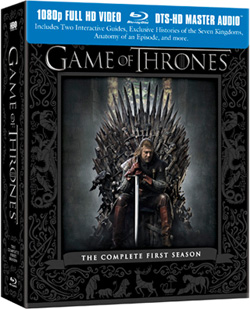
A Gloss of Thrones: Game of Thrones – The Complete First Season [Blu-ray Review]

It is now widely accepted that the way we watch television is a variable – if you’re reading this, chances are that I don’t have to regale you with the myriad ways we can now watch the programming we’ve historically viewed live in primetime, and so I can keep my big “DVRs, Streaming, and Bears, Oh My!” song and dance in my pocket for the time being.

However, I would argue that Game of Thrones represents a specifically complicated television text in this regard. Like all shows, there are questions of how it played on a week-to-week basis compared to how it would play as a marathon, questions that partly inspired the tremendous discourse around television narrative spurred on by Ryan McGee’s essay at The A.V. Club. However, in addition, the variables of consumption around the show are equally divided by the nature of its source material, with perhaps the clearest binary between “reader” and “non-reader” in television history. The result, I would argue, is a complex, diverse audience base who watches the show from different perspectives which make it difficult to generalize regarding what attracts them to a DVD or Blu-ray box set.

However, with Game of Thrones‘ Complete First Season (which I reviewed on Blu-ray), I really think HBO has succeeded in creating a set that has more than a little something for everyone, worth the price of admission for both readers and non-readers alike (along with those who are watching for the first time, for whom this set is a tremendous introduction). The production values are exceptional, the features are fairly plentiful, and the set fits comfortably into the quality aesthetics that both the show itself and the earlier paratexts achieved last year.

And yet, while I can easily recommend this set based on its own merits, there’s still some part of me who was left wanting, if not something more, than perhaps something different.

Continue reading

4 Comments

Filed under Game of Thrones

Season Finale: Game of Thrones – “Fire and Blood”

“Fire and Blood”

June 19th, 2011

“There you will see what life is worth when all the rest is gone.”

Earlier this week, I rewatched last week’s penultimate episode, “Baelor,” with my brother who was seeing it for the first time. Generally, I’ve been watching Game of Thrones alone, and any interaction with other viewers has been done online (or, if done in person, was done with people who I had previously interacted with online). For the first time, I was sitting in the same room as another viewer as we watched the show, and the experience made clear what I had known from the beginning but had never seen quite so clearly visible: Game of Thrones is a show that every single viewer likely considers differently.

It is not just that we can separate between readers and non-readers, although that is certainly the most obvious distinction to be made. Rather, we need to also consider questions of genre, gender, sexual content, race, and other qualities which have been called into question over the course of the season: regardless of whether I individually had concerns with the show’s use of fantasy, or its sexposition, or the Othering of the Dothraki, the fact is that those concerns existed, and have created a divisive response even among those who generally like the show.

In a piece earlier this week, friend of the blog Cory Barker wrote about his ambivalence towards the series, and kept trying to find reasons for it within the text. While his process was enlightening, he couldn’t find the silver bullet: there was no one part of the show that was creating a lack of an emotional connection. How we view the series can be defined by issues like genre which are inherent to the text itself, or issues like viewing patterns which are entirely extratextual but can define one’s experience with the text. My brother, for example, watched the season on a staggered schedule of short marathons, while my parents watched it on a weekly basis; as a result, they remembered different things, retaining different parts of the show that were highlighted by their personal experience with the text.

I raise all of these points because after a season of open interpretation, at least for those who hadn’t read the books, there is something almost prescriptive about “Fire and Blood.” While “Baelor” delivered a fatal twist, and suggested a certain degree of carnage to come in the weeks ahead, “Fire and Blood” steps back to serve as a more traditional denouement, laying out the various threads which will be followed into a second season. Rightly treating the fate of Ned Stark as the season’s climax, it seeks to explore the scenario that Mirri Maz Duur lays out to Dany early in the episode: what is the worth of each of these characters and these storylines in light of recent events? It’s a moment where the show actually has to step forward and proclaim its identity in order to convince the skeptics that this is a show worth watching, and to convince the believers that their faith has not been misplaced as the show transitions into the next stage of its narrative.

“Fire and Blood” doesn’t beat around the bush: it shows its hand from its bloody opening to its fiery conclusion, laying out a pretty detailed framework for what the second season of the show will look like. However, it never feels like an artificial framework, and that sense of interpretation never disappears even as the storyline becomes less open-ended. Serving as a fitting bookend to what I personally feel was a very strong first season, “Fire and Blood” reinforces central themes and delivers on what matters most: reminding us why these characters are following the path they’re on, and informing us why we want to follow that path next season.

Continue reading

30 Comments

Filed under Game of Thrones

Game of Thrones – “Baelor”

“Baelor”

June 12th, 2011

“I learned how to die a long time ago.”

It has been a bit of an adventure tiptoeing around the events of “Baelor” over the past eight weeks.

It’s been a bit of a game, honestly – from the moment the show was announced, people who had read the books were well aware that this episode was going to come as a shock to many viewers. This was the moment when the show was going to be fully transformed from a story about action to a story about consequences, and the point at which the series would serve notice to new viewers that this is truly a no holds barred narrative.

On some level, I don’t know if I have anything significant to add to this discussion: as someone who read the books, I knew every beat this episode was going to play out, and can really only speak to execution as opposed to conception. The real interest for me is in how those without knowledge of the books respond to this particular development, and how it alters their conception of the series. While I don’t want to speak for them, I am willing to say that “Baelor” was very elegant in its formation, rightly framing the episode as a sort of memorial to that which we lose at episode’s end.

And now, if you’ll excuse me, I’ll save my other thoughts for after the break so that I can finally talk about this without fear of spoiling anyone.

Continue reading

30 Comments

Filed under Game of Thrones

Game of Thrones – “The Pointy End”

“The Pointy End”

June 5th, 2011

“Written by George R.R. Martin”

The credits for Game of Thrones has always read “Created by David Benioff and D.B. Weiss,” but the question of authorship has always been considerably more complicated. The fact is that this is very clearly George R.R. Martin’s world, and George R.R. Martin’s characters, and even George R.R. Martin’s story – while we can certainly argue that Benioff and Weiss have taken certain liberties, adding scenes and shifting character allegiances, it has not utterly transformed Martin’s vision. And yet, at the same time, we can’t say that this is Martin’s show, as he was ancillary to the myriad of decisions which move beyond the initial creation to the execution and design. A Song of Ice and Fire may be his story, but Game of Thrones is not his television show, and there’s an odd shared ownership of Westeros that has been evident throughout the season.

I say evident, mind you, and not problematic. The scenes that have been added have been strong, and the decisions made have been mostly logical if not necessarily ideal in every instance (or for every fan). However, here you have an instance where the person doing the adaptation is Martin himself, given a chance to return to key moments and characters and tell the same story all over again. And yet, he’s now working within someone else’s show even when he’s working within his own story, an intriguing scenario that I thought going in might make for an intriguing case study.

However, there’s honestly nothing to really see here: while this is a very strong outing, and maintains the momentum from last week’s episode quite brilliantly even as it hits the fast forward button on the narrative action (and thus risks missing key pieces of the puzzle), I don’t think we see some sort of crisis of authorship. Martin’s return coincides with the period where exposition goes out the window, and where major story events are starting to take shape. It is a period where characters are making decisions instead of pondering them, and where key themes are beginning to filter throughout the storylines at a rapid pace, and so any authorship is swallowed up by the sheer presence of the realm and those outside its borders who threaten it.

In other words, it’s just as Martin intended it, and thus as Benioff and Weiss intended it as well.

Continue reading

16 Comments

Filed under Game of Thrones