Hope Springs Intermittently: Stories of the 2011 Emmy Nominations

Stories of the 2011 Emmy Nominations

July 14th, 2011

My favorite thing about Emmy nomination morning is the sense of hope.

It lingers in the air before the 5:35am PT announcement – last night, as both coasts drifted off to sleep, people on Twitter were posting lists of contenders that they were crossing their fingers for, still believing that shows like Fringe or Community had a shot of breaking into their respective categories. This is not a slight on either show, or on their fans who choose to believe. As always, some part of me wishes that I didn’t know enough about the Emmy nomination process to logic away any chance of sentimental favorites garnering a nomination.

My least favorite thing about Emmy nomination morning is the moment the bubble bursts. When the nominations are actually announced, it’s this constant rollercoaster: one nominees brings excitement while another brings disappointment. The bubble hasn’t burst yet, at that point, as there are often enough shifts in momentum that no one emotion wins out, leaving us struggling to figure out just how we feel.

The moment it bursts is when you open the PDF and see all the nominations laid out before you, and when the math starts adding up. Twitter has quickened this process: you don’t need to wait until critics and reporters break down the nominations, as everyone is tweeting the sobering details by the time 8:45am rolls around. Excitement in one area turns to disappointment in another, with one favorite’s surprise nomination becoming deflated when you realize that other favorites were entirely shut out.

As always, I was one of those people sorting through the list of nominations, and the bubble did burst at a certain point. It was the point when I remembered that surprise nominees are often unlikely to be surprise winners, and that for every category with a surprising amount of freshness there’s another that reeks of complacency and laziness. These are not new narratives, of course, but they’re narratives that overpower any sense of hope that could possibly remain after a morning of sobering reality, and that temper any enthusiasm that might nonetheless remain.

Although we cannot say that there is no enthusiasm to be found. While there are no real dominant narratives at this year’s Emmys, I do want to focus on a number of stories that I consider important based on the nominations, some of which involve excitement and others which involve that defeatist Emmy spirit we cynics hold so dear. One deals with how a network fights to remain relevant after giving up its Emmy bait, while another deals with the failings of an oft-derided set of categories. The others, meanwhile, look at the difference between being nominated and being competitive, as well as why it might be that an entire set of categories can’t help but feel like a disappointment.
Continue reading

10 Comments

Filed under Emmy Awards

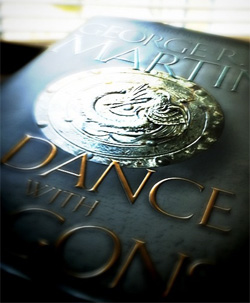
Cultural Reading: George R.R. Martin’s A Dance with Dragons

The last book I purchased on the day of its release was Harry Potter and the Deathly Hallows, fitting given Friday’s release of the final installment of the film adaptations of that series.


I remember going to my local grocery store early in the morning and picking up a copy, and then returning home to do nothing but read for the remainder of the day. I finished that book in just eight hours of reading, writing a live blog and a full review by the time the day was done.

That did not happen with George R.R. Martin’s A Dance with Dragons. Yes, I went out to get the book early in the morning, and I returned home and spent most of the day reading. However, this is not a book that can be consumed properly in a single day (at least for me), and it’s also something that I feel less comfortable evaluating as I read along. A few people have tweeted asking me for my opinion, but this particular book sort of confounds our traditional evaluation methods for literature.

This is mainly because the book is functioning as a chronological sequel to one book and a narrative sequel to another: despite coming after A Feast for Crows, it is picking up from A Storm of Swords. While I reread the end of A Storm of Swords to refresh myself on where we last left these narratives, there are nonetheless parts of A Dance with Dragons that pick up on story threads that were vaguely referenced in A Feast for Crows, which draws attention to the parallel narratives unfolding.

I don’t raise these as flaws so much as complications, especially to trying to offer initial impressions. While I am certainly enjoying the book, I sort of hesitate to make any broader statements given the myriad of variables within the current narrative structure. However, since many of you have asked for some thoughts on the novel and because shutting off my critical instincts for an entire 1100-page tome is nigh impossible, I plan on dropping in with some daily thoughts on my progress. Nothing evaluative, and nothing too complicated, but just a dialogue.

One ground rule, though: do not, under any circumstance, discuss or even gesture towards things I have not yet read. I’m going to include the page number that I am on, and I don’t want any details or even vague references to future events. I don’t even want “Oh, just you wait” style comments. I realize this could limit discussion, but I want to try to remain spoiler-free for the book, and I currently know extremely little about where the story is heading (or, rather, I know only what the book has led me to believe).

[Note: Spoilers for A Dance with Dragons, up to page 306, after the jump.]

Continue reading

21 Comments

Filed under A Song of Ice and Fire

A Final Forecast: Five Stories to Watch in the 2011 Emmy Nominations

5 Stories to Watch in the 2011 Emmy Nominations

July 12th, 2011

After numerous failed attempts at writing about why I was struggling to write about the Emmy Awards, which will go down as a meta fail of epic proportions, I’ve decided just to write about the Emmy Awards now that we’re only two days away from the nominations.

These are the five stories that I’m most interested in heading into the awards, the situations that have the most potential to surprise, infuriate, or otherwise stir emotion within my person. They are not predictions so much as they are a forecast, one that I sort of hope will get to my ambivalence towards this year’s awards in the process (although that might send me back into the spiral that I’ve found myself in for the past few weeks all over again).

1. Playing the Game of Thrones

While I think that Game of Thrones is worthy of Emmy consideration, I don’t know if I’m actively rooting for it over other competitors: while it has some strong acting contenders, and will definitely compete in the craft categories, I think there is tough competition in the drama field in terms of both acting and in terms of series.

Continue reading

5 Comments

Filed under Emmy Awards

What Does TNT Know, Again?: On The Fate of Men of a Certain Age

On The Fate of TNT’s Men of a Certain Age

July 11th, 2011

It hasn’t exactly been a secret that critics are fans of TNT’s Men of a Certain Age, but the simultaneous posting of two independent articles from prominent critics (HitFix’s Alan Sepinwall and AOL’s Maureen Ryan) defending the series against a potential cancellation has certainly cemented the show as this year’s critics’ cause.

For the record, I’m with both Alan and Mo regarding the show: the back half of the second season was maybe its strongest stretch to date, taking each character on a distinct journey that always felt controlled more by the ebbs and flows of life than by the machinations of plot development. The finale, in particular, was narratively complex while staying true to the characters and their relationships. It was about Joe’s relationship with his children, Owen’s relationship with his father, and Terry’s relationship with his past, as much as it was about golf, car dealerships, and career paths. It was a hopeful finale, perhaps, but it was not one that offered any sort of ending. In fact, I don’t know if this is a show that can truly have an ending given its focus on lives being lived.

Of course, Alan and Mo’s posts exist because the show is low-rated, and TNT is not a network known for its low-rated shows. In fact, given that Alan and Mo have covered the show’s strengths so well already, I’m actually more interested in the TNT side of this equation. A network that has staked its reputation on “We Know Drama,” TNT has found great success with quasi-serial procedurals like The Closer and Rizzoli & Isles (which both return tonight), and recently greenlit a second season for its sci-fi drama Falling Skies.

When people appeal to a network to save a show, there needs to be some sort of justification. For Chuck it was product placement and a willingness to make budget concessions, while for Friday Night Lights it was an off-network distribution deal with DirecTV. Other networks, meanwhile, are in such dire shape that they can’t afford to cancel shows with a heartbeat (NBC, I am looking at you). With TNT, though, you have a stable and consistently-performing network that seems immune to the vast majority of “Save our Show” logics, except for the one that critics help manage.

And the one that remains loosely defined for TNT.

Continue reading

7 Comments

Filed under Men of a Certain Age

Season Premiere: Torchwood: Miracle Day – “The New World”

“The New World”

July 8th, 2011

It’s a familiar story by now: like a large number of other critics, Torchwood was pretty far off my radar until Children of Earth (which I reviewed here), the show’s third series/season that took the critical world by storm. In fact, I saw Children of Earth before I started watching Doctor Who, so it also stood as my first engagement with Russell T. Davies and the somewhat spirited debate that surrounds his televisual output.

Miracle Day, the subtitle for the show’s fourth series/season (although I guess season might be more apt given that it is aired in the U.S. ahead of its U.K. premiere), comes with a great deal more baggage. While I believe Children of Earth would stand on its own merit, I do think that the element of surprise was part of its appeal two years ago. Not many shows suddenly make a dramatic leap in quality in their third season, and the unique miniseries structure (five parts airing over five days) made for a real sense of “Event” programming that stood out in the crowd. It wasn’t just that Children of Earth was good, it was that it seemed perfectly designed to make a real statement, a statement that creates definite expectations for Miracle Day.

In truth, those expectations are sort of unfair for two reasons. The first is that the show is returning to a weekly format, and a ten-episode format, which means that the pacing of the show will be dramatically different – this isn’t going to come out of the gates with the same swagger, which will likely dampen its impact. The second, meanwhile, is just a matter of hype: thanks to the increased attention created by Starz’s involvement in the production and critical appreciation of Children of Earth, this project has been on the North American cultural radar. Going into tonight’s premiere, I pretty much knew everything that was going to happen, meaning that “edge of your seat” was transformed into a much more passive viewing experience.

This is not to say that “The New World” isn’t good television, or that the show is heading in a weak direction, but there’s just nothing here to really make us sit up and take notice – instead, we’re meant to sit back and enjoy the ride, which does reveal some of the procedural mechanisms that get Miracle Day off and running…or, more accurately, jogging. However, at the same time, there are some questions related to the production of the miniseries that are somewhat intriguing in their deployment here, which is what I want to discuss in relation to tonight’s premiere.

Continue reading

11 Comments

Filed under Torchwood

Notes on an Unintentional Cultural Hiatus

It is natural for people who write about television to write less during the summer: the number of shows on the air dwindles, meaning that the overall sense of activity within the industry is less conducive to the kinds of near-daily analysis that I might otherwise be engaged with.

Or, rather, this is what I tell myself as I return to the blog after an unintended two-week hiatus. In truth, a number of things have happened since that point which I could have written about, and the very point of the Cultural Catchup Project was to help fill in the gaps during these warmer months. However, a combination of a trip home to Canada and the recent holiday weekend have created enough distractions that writing about television just hasn’t seemed like a priority…or, rather, it hasn’t seemed like a priority here.

When I started writing for The A.V. Club, I knew that it would mean writing slightly less here: because I was writing about The Office on a weekly basis, and because those reviews were time-sensitive, it did mean that I wrote about shows like Community and Parks and Recreation less often than I might have otherwise. This time around, meanwhile, it’s resulted in a situation where I’ve felt fairly busy in terms of writing even when the blog sits largely dormant.

On top of a few drop-ins (including a review of the premiere of ABC’s Expedition Impossible and ABC/Global’s Rookie Blue), I’m covering two ongoing series for The A.V. Club.

The first was something entirely new, which has actually been a major reason for a lack of blogging: while BBC America’s U.K. import The Inbetweeners only had twelve total episodes in its first two series, catching up on them felt somewhat necessary given that I’m covering the third series for the site. I’ll admit that I’ve found Series Three a bit uneven, and parts of the show remain a bit broader than I would like, but the first two series have a real charm to them which has made it an enjoyable experience. Mind you, it is somewhat odd to be covering a series (or season) that the majority of commenters have seen in its entirety through YouTube and illegal downloads (since it aired in the U.K. last fall), but that’s sort of given it a TV Club Classic vibe that I’m not entirely opposed to.

The Inbetweeners | TV Club | The A.V. Club

The second, meanwhile, picks up on something I wrote last fall. I’m among those who felt the sixth season of Weeds marked a creative turnaround for the beleaguered Showtime series, and said as much in my review of the finale. While the jury remains out on the seventh season, the show has returned to The A.V. Club lineup after a year-long absence, and I’m quite pleased with the response from readers. There are very few sites covering the show week-to-week, and while the show may be inconsistent I don’t think it has stopped being interesting since the reboot back in Season Four. I’ll be tracking the season’s ups and downs, however they might fall, in the weeks ahead.

Weeds | TV Club | The A.V. Club

Of course, things are not going to stay quiet at Cultural Learnings forever: the Cultural Catchup Project will return early next week, Breaking Bad reviews will return on the 17th, I will at least offer some preliminary thoughts on Torchwood: Miracle Day (and may review it consistently if there is both demand and personal interest), and the Emmy nominations are now only eight days away. However, if there’s anything that’s happened in the last two weeks that you want me to comment briefly on, feel free to leave a comment/question below and we’ll see if we can’t get a conversation started.

6 Comments

Filed under Cultural Learnings, The Inbetweeners, Weeds

Review: FX’s Wilfred is Weird (in More Ways Than One)

I am very curious to see how people respond to FX’s Wilfred, which debuts tonight at 10/9c on FX.
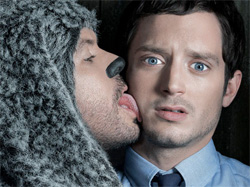
On the one hand, I’m interested in how divisive the show’s premise will be: this is a decidedly weird premise, and the show doesn’t spend any time trying to explain or justify it in tonight’s premiere. “Happiness” begins with Elijah Wood’s Ryan imagining his neighbor’s dog Wilfred as a bipedal, pot-smoking dude in a dog suit – creator/producer Jason Gann, to be specific – and simply moves on from there.

However, on the other hand, I’m wondering what those expecting something truly bizarre are going to think when they discover that Wilfred isn’t as weird as its premise might indicate. Now, don’t get me wrong: this is still a weird show, and all three episodes sent to critics feature moments which play on the premise quite directly. And yet, at the same time, all three episodes boil down to some pretty general themes, and this is at its core the story of a depressed man exploring his identity with the help of a friend. That the friend is imaginary, and that he is actually a dog, is not really the point of it all, which was kind of surprising given that “Guy in a Dog Suit” was pretty much all I knew about the show going in.

While I find Wilfred to be occasionally amusing, and certainly think that the premise holds narrative potential, what I’ve seen so far ends up coasting on the premise without really exploring it to any large degree. Individual setpieces may signal where the show may succeed in the future, and Wood and Gann may be strong anchors around which to build a larger comic world, but this is a surprisingly small show given its larger-than-life premise.

And while that may benefit that show in the end, it has resulted in a bit of a slow start that might engender a mixed reaction.

Continue reading

8 Comments

Filed under Wilfred

Hiding Behind the Brand: How The Killing Threatens the Future of AMC

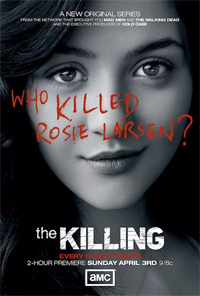
I haven’t seen the first season finale of AMC’s The Killing.

In fact, I haven’t seen the last five episodes of the show’s first season – I fell behind a few weeks ago, struggled to find the motivation to continue, and then traveled away from my DVR before I could get around to catching up.

Accordingly, this is not a piece about the emerging debate regarding the show’s first season finale, which has sharply divided the show’s viewers (and created some extremely strong reactions from some television critics, with Maureen Ryan’s being the most pointed). While it is quite possible that I will some day watch those final five episodes of the season, and that I will have an opinion regarding the show’s finale (which I’ve willfully spoiled for myself) at that time, this piece is not about the finale.

What I’m interested in is the way that this response reflects on larger questions of brand identity that are unquestionably caught up in this response to The Killing. This weekend, I read a piece on AMC’s growing dominance at the Emmy Awards at The Hollywood Reporter in which Sud was quoted quite extensively as she waxed poetic on the freedom of the AMC model. Her first quote was perhaps the one that stuck out most, as she notes that the AMC approach is perhaps best defined by the following: “Always assume that your audience is smarter than you are.”

Given how often I felt The Killing insulted my intelligence as a viewer, this quote struck me as odd. And then I read the rest of her quotes in the article, and discovered the same issue: when she was only spouting a series of platitudes regarding the genius of the AMC brand that we hear from other writers (including a Breaking Bad writer in the same piece), I could take none of them at face value given the fact that The Killing has done little to earn them. In a climate in which The Killing has squandered nearly all of its critical goodwill, Sud’s comments were charmlessly naive, and this was before she made many similar comments in defense of the season finale.

I have nothing against Sud personally, and I think she is entitled to her opinion that her show wasn’t a failure. However, so long as her defense of the show is being framed in the same terms of the AMC brand, the network has a serious problem on their hands. This is a network that feeds off of critical attention, and that has been very protective of its brand identity, but it now finds itself becoming represented by a showrunner who has none of the credentials or the evidence to back up her rhetoric.

It’s a scenario that risks turning AMC into just another brand hiding behind rhetorical statements of superiority, and which should be creating some big questions within the network’s executive structure as they head into an important period for their future development.

Continue reading

34 Comments

Filed under The Killing

Season Finale: Game of Thrones – “Fire and Blood”

“Fire and Blood”

June 19th, 2011

“There you will see what life is worth when all the rest is gone.”

Earlier this week, I rewatched last week’s penultimate episode, “Baelor,” with my brother who was seeing it for the first time. Generally, I’ve been watching Game of Thrones alone, and any interaction with other viewers has been done online (or, if done in person, was done with people who I had previously interacted with online). For the first time, I was sitting in the same room as another viewer as we watched the show, and the experience made clear what I had known from the beginning but had never seen quite so clearly visible: Game of Thrones is a show that every single viewer likely considers differently.

It is not just that we can separate between readers and non-readers, although that is certainly the most obvious distinction to be made. Rather, we need to also consider questions of genre, gender, sexual content, race, and other qualities which have been called into question over the course of the season: regardless of whether I individually had concerns with the show’s use of fantasy, or its sexposition, or the Othering of the Dothraki, the fact is that those concerns existed, and have created a divisive response even among those who generally like the show.

In a piece earlier this week, friend of the blog Cory Barker wrote about his ambivalence towards the series, and kept trying to find reasons for it within the text. While his process was enlightening, he couldn’t find the silver bullet: there was no one part of the show that was creating a lack of an emotional connection. How we view the series can be defined by issues like genre which are inherent to the text itself, or issues like viewing patterns which are entirely extratextual but can define one’s experience with the text. My brother, for example, watched the season on a staggered schedule of short marathons, while my parents watched it on a weekly basis; as a result, they remembered different things, retaining different parts of the show that were highlighted by their personal experience with the text.

I raise all of these points because after a season of open interpretation, at least for those who hadn’t read the books, there is something almost prescriptive about “Fire and Blood.” While “Baelor” delivered a fatal twist, and suggested a certain degree of carnage to come in the weeks ahead, “Fire and Blood” steps back to serve as a more traditional denouement, laying out the various threads which will be followed into a second season. Rightly treating the fate of Ned Stark as the season’s climax, it seeks to explore the scenario that Mirri Maz Duur lays out to Dany early in the episode: what is the worth of each of these characters and these storylines in light of recent events? It’s a moment where the show actually has to step forward and proclaim its identity in order to convince the skeptics that this is a show worth watching, and to convince the believers that their faith has not been misplaced as the show transitions into the next stage of its narrative.

“Fire and Blood” doesn’t beat around the bush: it shows its hand from its bloody opening to its fiery conclusion, laying out a pretty detailed framework for what the second season of the show will look like. However, it never feels like an artificial framework, and that sense of interpretation never disappears even as the storyline becomes less open-ended. Serving as a fitting bookend to what I personally feel was a very strong first season, “Fire and Blood” reinforces central themes and delivers on what matters most: reminding us why these characters are following the path they’re on, and informing us why we want to follow that path next season.

Continue reading

30 Comments

Filed under Game of Thrones

Cultural Catchup Project: “Flooded” (Buffy the Vampire Slayer)

“Flooded”

June 13th, 2011

You can follow along with the Cultural Catchup Project by following me on Twitter (@Memles), by subscribing to the category’s feed, or by bookmarking the Cultural Catchup Project page where I’ll be posting a link to each installment.

Thus far, Buffy the Vampire Slayer’s sixth season has been strikingly “realistic.” It sort of reminds me of the fourth season, in that Buffy spent the first set of episodes battling “real world” forces as much as demonic ones. There, the traditional college experience was framed through the eyes of the Slayer, while here Buffy’s resurrection from heaven is almost being framed as the transition into the adult realities of parenting, home ownership, and everything in between. Whereas Buffy’s role has more often than not been framed in terms of general responsibility, a task that she has always been able to live up to, the show is reframing that role in the context of financial responsibility.

While “After Life” very much focused on the ways in which reality itself has become a burden for Buffy in light of her ordeal, “Flooded” makes reality a bit less philosophical and a bit more…well, real. We could argue the same for the season itself, actually, given how the episode uses a fairly typical Monster-of-the-Week and a number of private conversations to set a pretty clear foundation for the season that follows. It’s too early to pass judgment on The Trio, and on the direction the season seems to be heading in, but the best thing I can say about “Flooded” is that it never gave me pause. Burdened by exposition, the episode nonetheless found a fair deal of poignancy in what could be considered a mundane premise, and created a great deal of interest (and a moderate amount of excitement) for what is to come.

Continue reading

36 Comments

Filed under Cultural Catchup Project