Tag Archives: Narrative

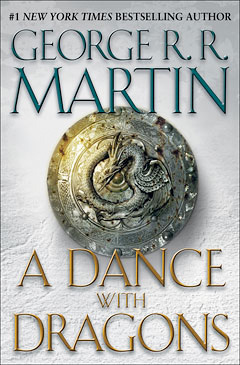
Cultural Reading: George R.R. Martin’s A Dance with Dragons [Review, w/ Spoilers]

There are a number of ways in which George R.R. Martin’s A Dance with Dragons has been defined by its circumstances rather than the text itself.

It became almost a book of prophecy, initially intended to arrive soon after the last book (A Feast for Crows) but then entering into an endless series of delays. It was promised but never delivered, all the more problematic given that it was meant to hold the answers we had been waiting for. It was positioned as the second half of a larger whole, a continuation of a novel now over a decade old, and on some level an apology for a novel that some felt moved too far astray from the story they wanted to see.

The book’s challenge, in true fact, has nothing to do with these circumstances; in fact, the book’s greatest challenge is making it seem as if these circumstances do not even exist. More than ever before, Martin’s task is to get us lost in the world of Westeros and the lands beyond the Narrow Sea, to make us forget that we haven’t visited them for what based on some commentary has been an eternity. While the novel’s intertextual links to the book’s predecessors will remain, a reminder of what expectations have been placed before the text, it would be unfortunate if this book felt like an “answer” in any fashion. It instead needs to feel like its own statement, a statement not in response to criticism but in defiance to expectation.

I’d argue that Martin has managed this task. Although the novel’s odd position results in some issues with balance, strong thematic ties bind these stories together and fall into familiar rhythms that only gather more momentum as the book hurdles along. It is satisfying in every way I wanted it to be, and dissatisfying in every way that Martin intended it to be, ending on a note of utter disarray that nonetheless makes the novel (and its predecessor) feel whole.

I wrote all of this before diving into the discussion of the novel online, discussion that then made me incredibly self-conscious about the above. Now, it isn’t that I started to doubt my opinion: my reaction to the book has not changed upon reading these comments, and in some ways I feel more confident now then I did a week ago (when I liveblogged my reading experience). However, I have become wary of writing a larger review when it appears inevitable that I will be positioned as an apologist for having no large-scale problems with the narrative that Martin has put forward. I have my complaints, some of which I’ve seen bandied about, but the central complaints I’m reading about the novel are things that never really occurred to me.

It reminds me of when both Battlestar Galactica and Lost had their divisive series finales, both of which I enjoyed even while I had my quibbles with each. I’d be discussing the Lost finale with someone who hated it, who felt it shit on everything they loved about the show, and I’d sit there explaining why I felt absolutely none of those emotions and was satisfied. After having numerous such discussions, it became clear that we simply viewed the story differently, were watching for different things and for different reasons.

So when it came time to sit down and truly tackle A Dance with Dragons, it started with a question I didn’t want to be asking: could it be that I have been reading A Song of Ice and Fire wrong all this time?

[NOTE: There will be NO HOLDS BARRED spoilers for the entire novel. Admittedly, I’m vague about some details and probably won’t ruin every twist and turn, but I’m still forbidding anyone intending on reading A Dance with Dragons from reading.]

Continue reading

55 Comments

Filed under A Song of Ice and Fire

Cultural Reading: Suzanne Collins’ Hunger Games Trilogy

I think Twitter was the main reason I chose to read Suzanne Collins’ Hunger Games trilogy.

No, it wasn’t because my followers on Twitter suggested I read the books, or that a person I follow recommended them at large. Instead, I was becoming completely unglued at every sight of the never-ending casting announcements for the upcoming film adaptation of the first book in the series, The Hunger Games, coming in the Spring. More than any other film in recent memory, it seemed as though every single role was a piece of news, and I became too curious to resist diving into the series.

A few weeks later, I emerged with an understanding for the books’ appeal and a large pile of critical thoughts that I’m itching to discuss with other folks who have read the books. Although I rarely dive into literature around these parts (although this will likely not be the first time this summer that I do so), I figured that this is as good a place as any to consider what makes the series distinct, what makes the series an ultimate disappointment, and why I’m extremely curious to see how they plan to adapt this story given some of its particular qualities.

Spoilers for the entire Hunger Games Trilogy follow.

Continue reading

17 Comments

Filed under Cultural Reading

Game of Thrones – “The Pointy End”

“The Pointy End”

June 5th, 2011

“Written by George R.R. Martin”

The credits for Game of Thrones has always read “Created by David Benioff and D.B. Weiss,” but the question of authorship has always been considerably more complicated. The fact is that this is very clearly George R.R. Martin’s world, and George R.R. Martin’s characters, and even George R.R. Martin’s story – while we can certainly argue that Benioff and Weiss have taken certain liberties, adding scenes and shifting character allegiances, it has not utterly transformed Martin’s vision. And yet, at the same time, we can’t say that this is Martin’s show, as he was ancillary to the myriad of decisions which move beyond the initial creation to the execution and design. A Song of Ice and Fire may be his story, but Game of Thrones is not his television show, and there’s an odd shared ownership of Westeros that has been evident throughout the season.

I say evident, mind you, and not problematic. The scenes that have been added have been strong, and the decisions made have been mostly logical if not necessarily ideal in every instance (or for every fan). However, here you have an instance where the person doing the adaptation is Martin himself, given a chance to return to key moments and characters and tell the same story all over again. And yet, he’s now working within someone else’s show even when he’s working within his own story, an intriguing scenario that I thought going in might make for an intriguing case study.

However, there’s honestly nothing to really see here: while this is a very strong outing, and maintains the momentum from last week’s episode quite brilliantly even as it hits the fast forward button on the narrative action (and thus risks missing key pieces of the puzzle), I don’t think we see some sort of crisis of authorship. Martin’s return coincides with the period where exposition goes out the window, and where major story events are starting to take shape. It is a period where characters are making decisions instead of pondering them, and where key themes are beginning to filter throughout the storylines at a rapid pace, and so any authorship is swallowed up by the sheer presence of the realm and those outside its borders who threaten it.

In other words, it’s just as Martin intended it, and thus as Benioff and Weiss intended it as well.

Continue reading

16 Comments

Filed under Game of Thrones

A Televisual Love Letter: Reveling in HBO’s Game of Thrones

A Televisual Love Letter: HBO’s Game of Thrones

April 3rd, 2011

When I sat down to watch the first six episodes of HBO’s Game of Thrones – which HBO subscribers can preview tonight at 9/8c when the first fifteen minutes of the pilot air before the third part of Mildred Pierce (and arrive streaming online shortly after) – I knew that I would be viewing them from a particular perspective.

As someone who has read the first four books in George R.R. Martin’s A Song of Ice and Fire series – the fifth comes out in July – on multiple occasions, I knew my way around this story. I would not count myself among those who have an encyclopedic knowledge of Westeros, and I’ll readily admit that the density of the books means I often misplace particular story events within my memory, but the fact remains that I am very familiar with the world Martin created and the characters that inhabit it.

Accordingly, I expected my view of the series to be influenced by this perspective: I would know more about these characters than the show would expect me to know, able to fill in details and see foreshadowing that some viewers would not even know was foreshadowing. I would be more excited about seeing things come to life than I would be about seeing things happen, surprised not so much by the events transpiring but by the decisions made in giving those events physical form. However, I also presumed that I would ultimately remain the stoic critic figure, my familiarity with the series presenting less as a “fandom” and more as an extra layer that would contribute to my experience.

So imagine my surprise when my experience became defined by this familiarity, my fairly casual “fandom” transformed into a giddy reverie by the time the credits rolled on the show’s pilot. Game of Thrones is not precisely Martin’s books come to life fully formed, but I would argue that this is a love letter to A Song of Ice and Fire and those who hold it most dear. It does not just stumble its way into bits of foreshadowing: it fully embraces the scale of this narrative from the word go and begins to craft a tale worthy of the source material. It does so not just through strong performances and evocative production design, but also through tapping into the very qualities that made the source material so compelling on a structural level: this is not just an instance of plot and character being spun into a new medium, but rather David Benioff and D.B. Weiss drawing inspiration from a man who knew how to build something.

The result is a rare adaptation which compounds, rather than challenges, our appreciation for the franchise in question. Game of Thrones may not yet be the finest show on television, but it is well on its way to being one of the most rewarding television experiences I’ve ever had, and certainly shows the potential to be found in continuing to explore Martin’s – and now Benioff and Weiss’ – Westeros for many seasons to come.

Continue reading

21 Comments

Filed under Game of Thrones

Fringe – “Bloodline”

“Bloodline”

March 25th, 2011

The greatest test of a critic’s demeanor towards a particular program is how they respond to its renewal.

When Fringe was picked up on Thursday, there were two primary responses among critics. The first was excitement: many had written off Fringe after it was banished to Fridays by a network with a reputation for injustices related to science fiction programming, and so an early renewal (rather than a tense upfront decision) was a revelation.

If I’m being honest, though, my response was more on the side of cynical. My first thought was what would need to change to justify the renewal, and what kind of story/casting changes might be necessary in order to facilitate this renewal. I think part of this is just my inner pragmatist, wanting to be realistic about the obvious compromises that will need to be made as Fringe shifts from a show Fox wants at a 2.0 to a show Fox will renew at a 1.5. However, I can’t lie and suggest that my cynicism is not partially the result of some trepidation regarding the show’s more recent story developments.

“Bloodline” seems an ideal episode to air directly after the renewal, given that this is the kind of episode that the show might no longer be able to do. While I think it might be premature to suggest that a cash-strapped fourth season will result in the end of Over There’s role within the series’ overarching storyline, I think it is fairly safe to claim that spending a quarter of the season in an entirely different world populated by different characters may be lost.

And I hope they don’t think that plot can make up for the loss of atmosphere.

Continue reading

5 Comments

Filed under Fringe

Back to the (Reality) Future: “Unfinished Business” and “Redemption Island”

Back to the (Reality) Future: The Amazing Race and Survivor

February 20th, 2011

Watching the Survivor: Redemption Island premiere, I listened to Jeff Probst with a certain degree of skepticism. His argument was that Rob and Russell both had their own form of unfinished business, having played the game multiple times without ever having won. However, really, their presence is not about their story – they are there because Survivor needed a hook, and pitting two of its most infamous players against one another. While I think Russell probably believes that he is there to prove something, I think that Rob is just there to have fun, which for me makes him much more enjoyable to watch.

The fact is that seeing reality contestants try to “prove” something holds very little value for me. I appreciate a good reality storyline, and I think that every great reality show needs a great narrative or three in order to sustain itself. What is always difficult about all-star driven seasons, like both Redemption Island and The Amazing Race: Unfinished Business, is the way in which the narrative is defined for us: in the latter case, the teams are all introduced based on the reason they lost, and the season becomes more about them moving past that initial defeat than anything else.

I know my Amazing Race history, and so I remember almost all of these teams (like many others, Amanda and Kris were too short-lived and too generic to make an impression, but I did remember them eventually). There are also many stories here that I am inherently attached to: Zev and Justin’s early exit thanks to a lost passport and Mel and Mike’s charming father/son dynamic were two narratives that ended too early, and that I was excited to see more of. On the other hand, the idea of seeing more of Margie and Luke is somewhat terrifying, given the fairly odious behavior which characterized their more tense moments back in Season 14.

The difference between Redemption Island and Unfinished Business is simple: while the former has the ability to create new narratives early on, both based on the minimal all-star presence and the structure of the game, the latter is not built for the same type of instant narrative. This does not make it a failure, as the opening episode is filled with spectacle designed to highlight the switch to filming in HD, but it does mean that the season’s real value won’t be certain until we get a bit deeper into the race and see if any new narratives might be able to emerge.

Although there is evidence to suggest that the show is well aware that you can’t coast your way to the finals with just Unfinished Business.

Continue reading

1 Comment

Filed under Survivor, The Amazing Race

How I Met Your Mother – “The Mermaid Theory”

“The Mermaid Theory”

December 6th, 2010

“The Mermaid Theory” is interesting in two ways. And since they’re not particularly substantial ways, I’m just going to cut the introduction off here and we can get into the meat of it.

Continue reading

5 Comments

Filed under How I Met Your Mother

Series Premiere: Lone Star – “Pilot”

“Pilot”

September 20th, 2010

“If you want to make something last, you need to make it with your own two hands.”

David Bordwell, a prominent film scholar, wrote earlier this month about his personal experience with television as medium, in particular why he doesn’t write about it despite the so-called golden age of serialized television. While his piece briefly speaks to his (somewhat tongue-in-cheek) lack of interest in modern texts, it focuses primarily on his childhood experience with television, which leads him to this depiction of television viewership:

“Having been lured by intriguing people more or less like us, you keep watching. Once you’re committed, however, there is trouble on the horizon. There are two possible outcomes. The series keeps up its quality and maintains your loyalty and offers you years of enjoyment. Then it is canceled. This is outrageous. You have lost some friends. Alternatively, the series declines in quality, and this makes you unhappy. You may drift away. Either way, your devotion has been spit upon.”

I raise this point because it creates the image of television as an investment, which leads me to FOX’s Lone Star. A show about a con artist who convinces others to invest in a lie, the series itself raises an important question in relation to Bordwell’s notion of devotion: is Lone Star a con?

It’s the question that everyone has sort of been struggling with: the pilot is a polished, intelligent episode of television, featuring a strong lead performance by James Wolk and a strong supporting cast, but there remains this sense that it is all smoke and mirrors. It isn’t necessarily that we think the writers and producers are incapable of making a great series, but rather the concern is that the premise just isn’t expansive enough to sustain itself over multiple seasons (or an entire network season, for that matter), leaving room for future heartbreak when it (as Bordwell predicts) fails to live up to our lofty expectations.

But, as someone who enjoys the ups and downs of television and wouldn’t have it any other way, I don’t think that this uncertainty should keep us from enjoying it. Lone Star is not, in fact, a con: the pilot doesn’t hide anything beneath the surface, resisting the sense of mystery and uncertainty that plagues other series of this nature. While the premise may not have the longevity of your basic crime procedural, this is a well-made premise pilot that rarely blinks in presenting a clear scenario to its audience.

Yes, it could all come tumbling down in a few episodes – based on this pilot, however, I (unlike Bordwell) will take that risk.

Continue reading

2 Comments

Filed under Lone Star

Worked Over: Jaclyn Santos’ Online Reclamation of her Work of Art Narrative

Worked Over: Jaclyn Santos’ Online Reclamation of her Work of Art Narrative

August 7th, 2010

In profiling Work of Art contestant Miles Mendenhall, I highlighted how his behavioural multiplicity both serviced and undermined traditional reality show narratives and editing practices; however, at the end of the day, the fact is that even those who find fault in Miles’ behaviour have few issues with his art. The series may have portrayed him as a jerk, but the series never went so far to blur the lines between his actions and his artistic expression.

However, I think artist Jaclyn Santos has a fair case for the fact that the editors were not quite so kind, although it is fairly clear how and why this happened. For better or for worse, Santos’ use of her own image created a direct connection between her behaviour and her artwork, and while this led to some of her most successful pieces it was also a key element in the producers’ efforts to paint her into a box throughout the editing process. If Miles carefully controlled his behaviour to appeal to the basic structure of reality television, Jaclyn purposefully positioned her work as both intensely personal and as a direct subversion of the male gaze, which gave the editors plenty of opportunities to paint her into a corner.

However, Jaclyn’s true subversion has taken place after the competition came to a close: frustrated with how she was being portrayed, her personal blog has evolved from an opportunity to celebrate her appearance on the series to an effort to reclaim her personal reputation and her artistic point of view from what she sees as Bravo’s manipulative editing. Investigating that blog offers a glimpse of something we rarely see: a reality contestant confronting their depiction head on, in the process heightening the series’ clear – and likely unintended – willingness to unearth the contradictions and conflicts inherent in reality television as a whole.

While I’m sympathetic to her frustrations, I think that her post-show efforts to set the record straight has transformed her experience from lemons to lemonade, and furthered the series’ reputation as the most frustrating yet fascinating reality series in recent memory.

Continue reading

8 Comments

Filed under Work of Art: The Next Great Artist

Point of View: Bravo’s Work of Art a (Fascinating) Piece of Work

Point of View: Bravo’s Work of Art a (Fascinating) Piece of Work

July 7th, 2010

In the second episode of Bravo’s newest reality series Work of Art: The Next Great Artist, a contestant created a sculpture which derided reality television, a sculpture which led to him being sent home.

Mind you, he wasn’t sent home just because he had little love for the form of television in which he was taking part: the sculpture was lifeless and uninteresting, and relied on an inside baseball art joke that not even the contestants/judges (yet alone the home audience) understood. But the fact remains that he wasn’t here to play a game of any sort, unwilling to engage in any sort of drama and, more importantly, not in a position where he would be willing to step outside of his comfort zone in order to compete in what most would consider a competition. Another contestant, eliminated the following week, went home because she refused to take a challenge seriously because it was a commercial “job,” and she doesn’t make art to appease clients; she, too, ended up making something of limited value (and hadn’t done much interesting previous to that piece), but the fact remains that it was her refusal to “play along” which separated her from other failures.

Reality Competition series require participation, not only in terms of creating strong personalities (and the conflict which arises from them) but also in terms of creating compelling narratives for viewers to follow. What I find so fascinating about Work of Art is that it is both a tremendous success and an absolute failure, a series which is flawed by traditional reality competition standards and yet offers ancillary, and unique, opportunities for viewer connection which the show’s structure isn’t built to really capture. While many contestants aren’t participating in the reality series they’ve been cast on, they are participating in a larger quest for creative fulfillment, and at moments the show successfully invites us into their own little worlds and gives us a legitimately fascinating glimpse into their creative process which overshadows the tired machinations of the Magical Elves.

And allows us to find our own point of view on the competition at hand, even if Bravo isn’t willing to fully embrace this sort of potential.

Continue reading

6 Comments

Filed under Work of Art: The Next Great Artist




