Game of Thrones – “Baelor”

“Baelor”

June 12th, 2011

“I learned how to die a long time ago.”

It has been a bit of an adventure tiptoeing around the events of “Baelor” over the past eight weeks.

It’s been a bit of a game, honestly – from the moment the show was announced, people who had read the books were well aware that this episode was going to come as a shock to many viewers. This was the moment when the show was going to be fully transformed from a story about action to a story about consequences, and the point at which the series would serve notice to new viewers that this is truly a no holds barred narrative.

On some level, I don’t know if I have anything significant to add to this discussion: as someone who read the books, I knew every beat this episode was going to play out, and can really only speak to execution as opposed to conception. The real interest for me is in how those without knowledge of the books respond to this particular development, and how it alters their conception of the series. While I don’t want to speak for them, I am willing to say that “Baelor” was very elegant in its formation, rightly framing the episode as a sort of memorial to that which we lose at episode’s end.

And now, if you’ll excuse me, I’ll save my other thoughts for after the break so that I can finally talk about this without fear of spoiling anyone.


Continue reading

30 Comments

Filed under Game of Thrones

Midseason Finale: Doctor Who – “A Good Man Goes to War”

“A Good Man Goes to War”

June 11th, 2011

My choice not to review “The Rebel Flesh” and “The Almost People” is partly due to the awkwardness created by BBC America making the idiotic decision to take a one-week hiatus over Memorial Day Weekend, but I’ve also got to be honest: I didn’t think they were very good.

I saw a Twitter conversation go by, I think involving Jeremy Mongeau, and it really captured what I think the problem was. He made the argument, if memory serves me correctly, that serialization has actually damaged the show through the first half of the sixth series: everything has been so caught up in laying groundwork for future events or setting up the seasonal arc that it doesn’t really have time to breathe (or, if you’re “The Curse of the Black Spot,” was kind of just too dull to stand out).

Even if we argue that the serial elements have remained intriguing (which I would), and even if “The Doctor’s Wife” was a really compelling standalone that spoke to overarching themes in a strong fashion (which it was), “The Rebel Flesh” and “The Almost People” were like a narrative fetchquest. The Doctor needed to learn more about the flesh, and therefore traveled to where it first originated in order to better understand it, and a story had to be created around that particular event. It just seemed like Matthew Graham’s script never quite managed to make the characters compelling enough, implying a sense of depth instead of actually showing it to us.

Did the two-parter lay some important groundwork for explaining the Doctor’s “death” back in the premiere? Absolutely. And did it quite effectively transition into the reveal that Amy has been flesh since the beginning of the season? Yes. But it becomes a two-hour exhibit in exposition when “A Good Man Goes to War” begins, a too-long detour in a season that seemed to lose its momentum. Mind you, Steven Moffat regains that momentum in about three minutes and forty seconds, give or take a minute or two, and “A Good Man Goes to War” is a stellar effort that benefits from having some truly substantial exposition to relay.

It also tells a compelling story to go along with it, one that we can be certain will resonate both in the fall and beyond.

Continue reading

11 Comments

Filed under Doctor Who

Cultural Catchup Project: The Disc Stands Alone (Angel)

The Disc Stands Alone

June 10th, 2011

You can follow along with the Cultural Catchup Project by following me on Twitter (@Memles), by subscribing to the category’s feed, or by bookmarking the Cultural Catchup Project page where I’ll be posting a link to each installment.

I’ve been falling behind a bit on my Angel catchup, although it isn’t without reason. After finishing the first disc of Season 3, I found myself confronting three very different episodes that were slightly more distinctive than I might have expected. Some offer standalone stories which gesture towards future developments, some look to focus on our supporting characters and their journey to this point, and some offer a more general thematic consideration as facilitated through a carefully designed monster of the week.

There just wasn’t any sort of hook for me to focus on which would unite “That Vision Thing,” “That Old Gang of Mine,” and “Carpe Noctem,” and the recent heatwave zapped away my energy to dive any further into the series to try to find that thread.

And so, while I would like to offer something more, here’s a fairly basis episode-by-episode rundown of the remainder of Disc 1.

Continue reading

12 Comments

Filed under Cultural Catchup Project

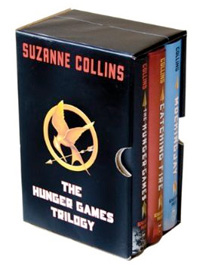
Cultural Reading: Suzanne Collins’ Hunger Games Trilogy

I think Twitter was the main reason I chose to read Suzanne Collins’ Hunger Games trilogy.

No, it wasn’t because my followers on Twitter suggested I read the books, or that a person I follow recommended them at large. Instead, I was becoming completely unglued at every sight of the never-ending casting announcements for the upcoming film adaptation of the first book in the series, The Hunger Games, coming in the Spring. More than any other film in recent memory, it seemed as though every single role was a piece of news, and I became too curious to resist diving into the series.

A few weeks later, I emerged with an understanding for the books’ appeal and a large pile of critical thoughts that I’m itching to discuss with other folks who have read the books. Although I rarely dive into literature around these parts (although this will likely not be the first time this summer that I do so), I figured that this is as good a place as any to consider what makes the series distinct, what makes the series an ultimate disappointment, and why I’m extremely curious to see how they plan to adapt this story given some of its particular qualities.

Spoilers for the entire Hunger Games Trilogy follow.

Continue reading

17 Comments

Filed under Cultural Reading

Pandering to the Demo: The Critics’ Choice Television Awards

I’ve known about the existence of the Broadcast Television Journalists Association for a while now, and it’s always struck me as a bit odd. Seemingly an alternative to the Television Critics’ Association, although some of the members actually hold membership in both organizations, the BTJA “has been formed as a collective voice to represent the professional interests of those who regularly cover television for TV viewers, radio listeners and online audiences as well.”


This sounds all well and good, but it seems pretty obvious to me that someone like TV Line’s Michael Ausiello doesn’t have any issues getting access to either stars or content, and the same goes for members representing TV Guide, AOL, or Access Hollywood. For these people, the second part of the BTJA’s mandate seems like the true raison d’etre: “BTJA will also present the Critics’ Choice Television Awards to honor the finest achievements on networks and channels big and small.”

The nominees for the first annual Critics’ Choice Television Awards were released this morning, and my Twitter stream lit up with excitement over nominations for shows criminally overlooked by the Emmys in previous years. I saw tweets from excited bloggers, excited fans, excited executives, and even excited nominees. And yet, when I went to actually look at the nominees, my response was more apprehension than excitement.

Now, my issue is not so much with who/what was nominated, but rather how those people/shows were nominated. Essentially, I consider the Critics’ Choice Television Awards to be a large-scale extension of “Dream Emmy Ballot” pieces, an outlet through which an individual or group can increase their own profile by pandering to fans of particular programs by including them and pointing out that the Emmys will never do the same. This is not an effort to create a more transparent or accurate nomination process, nor does it place any pressure on the Academy to revamp the Emmy Awards process: all it does is use the lure of awards glory to gain our attention.

And while it’s nice to see someone pandering to my demo for a change, that doesn’t mean that we should be partying in the streets.

Continue reading

2 Comments

Filed under Award Shows

Game of Thrones – “The Pointy End”

“The Pointy End”

June 5th, 2011

“Written by George R.R. Martin”

The credits for Game of Thrones has always read “Created by David Benioff and D.B. Weiss,” but the question of authorship has always been considerably more complicated. The fact is that this is very clearly George R.R. Martin’s world, and George R.R. Martin’s characters, and even George R.R. Martin’s story – while we can certainly argue that Benioff and Weiss have taken certain liberties, adding scenes and shifting character allegiances, it has not utterly transformed Martin’s vision. And yet, at the same time, we can’t say that this is Martin’s show, as he was ancillary to the myriad of decisions which move beyond the initial creation to the execution and design. A Song of Ice and Fire may be his story, but Game of Thrones is not his television show, and there’s an odd shared ownership of Westeros that has been evident throughout the season.

I say evident, mind you, and not problematic. The scenes that have been added have been strong, and the decisions made have been mostly logical if not necessarily ideal in every instance (or for every fan). However, here you have an instance where the person doing the adaptation is Martin himself, given a chance to return to key moments and characters and tell the same story all over again. And yet, he’s now working within someone else’s show even when he’s working within his own story, an intriguing scenario that I thought going in might make for an intriguing case study.

However, there’s honestly nothing to really see here: while this is a very strong outing, and maintains the momentum from last week’s episode quite brilliantly even as it hits the fast forward button on the narrative action (and thus risks missing key pieces of the puzzle), I don’t think we see some sort of crisis of authorship. Martin’s return coincides with the period where exposition goes out the window, and where major story events are starting to take shape. It is a period where characters are making decisions instead of pondering them, and where key themes are beginning to filter throughout the storylines at a rapid pace, and so any authorship is swallowed up by the sheer presence of the realm and those outside its borders who threaten it.

In other words, it’s just as Martin intended it, and thus as Benioff and Weiss intended it as well.

Continue reading

16 Comments

Filed under Game of Thrones

A Comic Transition Plan: Season Two of CTV’s Dan for Mayor

Review: Dan for Mayor Season Two

June 5th, 2011

As CTV’s Dan for Mayorone of my Top 10 shows of 2010, if you non-Canadians remember – returns for its second season, things have changed.

It isn’t just that the eponymous Dan has now officially become mayor of the fictional Wessex, Ontario. The first season was built around that campaign, with all of the show’s characters eventually taking some sort of role in its success. Now, with Dan having taken on the office of Mayor, the challenge facing the show’s writers was how to keep their favorite characters around.

Their solution is more functional than elegant, and it raises a number of interesting questions related to seriality in situation comedies. Treating the first season as a prologue of sorts, tonight’s premiere (airing at 7:30 ET on CTV) wastes no time finding ways to re-establish spaces in which these characters can interact on a regular basis. It’s a transparent re-ordering of the series, one that makes the premiere a bit jarring, but it also transitions the show into something simpler, and more sustainable, than what came before.

And, thankfully, it still manages to be plenty charming in the process.

Continue reading

2 Comments

Filed under Dan for Mayor

Summer Premiere: Men of a Certain Age – “The Great Escape”

“The Great Escape”

June 1st, 2011

Given that I already offered a general opinion that “The Great Escape” is a tremendous return for the show’s second season, I don’t expect to say a great deal about the episode itself.

However, I feel that this episode more than any other captures the sort of “coming of age” theme that I highlighted in my pre-air review, creating a set of circumstances in which all of the characters prepare themselves to make an important life change before suddenly realizing that the moment has passed.

It’s oddly one of the most overtly thematic episodes that this subtle show has ever done, but its broad moments are triggered by such subtle observations that it never betrays what makes the series so compelling.

Continue reading

Leave a comment

Filed under Men of a Certain Age

Coming of [a Certain] Age: The Return of TNT’s Men of a Certain Age

The Return of TNT’s Men of a Certain Age

June 1st, 2011

There are usually some questions about when, or why, critics write pre-air reviews for returning series. Personally, I tend to only do so in circumstances where the show is going through drastic changes, where my opinion of the show is going through drastic changes, or when the show simply deserves the recognition in light of its quality (and I’ve seen episodes in advance, of course).

TNT’s Men of a Certain Age, returning tonight at 10/9c, fits into the third category: in fact, considering that this is actually the seventh episode of the second season, it’s hard to argue that there are drastic changes when this is a sort of false premiere as opposed to a fresh start. This is the same show that returned for its second season back in December, and it remains that show through the first three episodes of the back half of the season (which is all I’ve gotten through to this point).

And yet I’m compelled to write down at least a few thoughts given the fact that I feel as though some people still aren’t paying attention as a result of the series’ subject matter. I had actually fallen behind on the first half of the season, and so I just recently sat down to the winter finale, in which Terry, Joe and Owen go and get colonoscopies. On paper, this sounds like something that is very distinct to the eponymous demographic, and you wouldn’t be entirely wrong: after all, the number of 25-year-olds getting colonoscopies is likely pretty slim.

That being said, the idea that the problems that these characters face are strictly “of a certain age” is false: although their experience is certainly more reflective of my parents’ generation than my own, given that I am likely among the youngest viewers the show has, this is as much a “coming of age” story as any show set in high school or university. However, instead of focusing on “coming of age” moments which are ingrained within our experience, mapped out for us from the time we are born, Men of a Certain Age focuses on the fact that middle age doesn’t work the same way: it’s amorphous and, well, anything but certain.

Men of a Certain Age is not a show about the perils of becoming older, it’s a show about the perils of defining yourself at a stage when there’s no clear path ahead of you. As it returns to conclude its second season, the characters are admittedly preoccupied with the notion of turning 50, but it’s not about what they can or can’t do. Instead, it’s about what they should or shouldn’t do, a question that speaks less to being “old” and more to simply being human.

And the result is a pretty terrific drama series.

Continue reading

2 Comments

Filed under Men of a Certain Age

Game of Thrones – “You Win or You Die”

“You Win or You Die”

May 29th, 2011

“It’s the family name that lives on. It’s all that lives on.”

[You can also hear additional thoughts on this episode in a special edition of the Talking TV with Ryan and Ryan podcast that I participated in.]

[Also, for more on “Sexposition,” check out my review of Season 2, Episode 2, “The Night Lands”]

There has been a lot of conversation surrounding the question of exposition with Game of Thrones, understandable given the high volume of material that has been revealed through conversations in an effort to capture the complexity of George R.R. Martin’s world.

“You Win or You Die” is not particularly exposition heavy, although there is one example that I will break down in greater detail, but the function of exposition is to provide a sense of history and context and I would argue that this episode is very interested in this idea. Some have argued that flashbacks might be considered another way to provide insight into history, and that it would beat the somewhat sloppy exposition that has to this point been deployed, but I would ask this: is the point of exposition to inform or remind the audience of particular information, or is it designed to inform the audience that the particular information in question is, in fact, important enough to be discussed in this context?

The answer, as always, is that it is meant to function as both, but I think those decrying the very existence of exposition in its current form should consider the latter more carefully. The role of history within this world is an important theme that is highlighted in “You Win or You Die,” as various threads comes to a point where the past is either given new meaning or forgotten entirely.

Or, rather, forgotten in some circles and remembered in others.

Continue reading

209 Comments

Filed under Game of Thrones