Tag Archives: Analysis

Cultural Catchup Project: The Disc Stands Alone (Angel)

The Disc Stands Alone

June 10th, 2011

You can follow along with the Cultural Catchup Project by following me on Twitter (@Memles), by subscribing to the category’s feed, or by bookmarking the Cultural Catchup Project page where I’ll be posting a link to each installment.

I’ve been falling behind a bit on my Angel catchup, although it isn’t without reason. After finishing the first disc of Season 3, I found myself confronting three very different episodes that were slightly more distinctive than I might have expected. Some offer standalone stories which gesture towards future developments, some look to focus on our supporting characters and their journey to this point, and some offer a more general thematic consideration as facilitated through a carefully designed monster of the week.

There just wasn’t any sort of hook for me to focus on which would unite “That Vision Thing,” “That Old Gang of Mine,” and “Carpe Noctem,” and the recent heatwave zapped away my energy to dive any further into the series to try to find that thread.

And so, while I would like to offer something more, here’s a fairly basis episode-by-episode rundown of the remainder of Disc 1.

Continue reading

12 Comments

Filed under Cultural Catchup Project

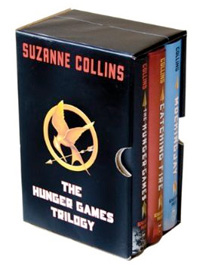
Cultural Reading: Suzanne Collins’ Hunger Games Trilogy

I think Twitter was the main reason I chose to read Suzanne Collins’ Hunger Games trilogy.

No, it wasn’t because my followers on Twitter suggested I read the books, or that a person I follow recommended them at large. Instead, I was becoming completely unglued at every sight of the never-ending casting announcements for the upcoming film adaptation of the first book in the series, The Hunger Games, coming in the Spring. More than any other film in recent memory, it seemed as though every single role was a piece of news, and I became too curious to resist diving into the series.

A few weeks later, I emerged with an understanding for the books’ appeal and a large pile of critical thoughts that I’m itching to discuss with other folks who have read the books. Although I rarely dive into literature around these parts (although this will likely not be the first time this summer that I do so), I figured that this is as good a place as any to consider what makes the series distinct, what makes the series an ultimate disappointment, and why I’m extremely curious to see how they plan to adapt this story given some of its particular qualities.

Spoilers for the entire Hunger Games Trilogy follow.

Continue reading

17 Comments

Filed under Cultural Reading

Game of Thrones – “The Pointy End”

“The Pointy End”

June 5th, 2011

“Written by George R.R. Martin”

The credits for Game of Thrones has always read “Created by David Benioff and D.B. Weiss,” but the question of authorship has always been considerably more complicated. The fact is that this is very clearly George R.R. Martin’s world, and George R.R. Martin’s characters, and even George R.R. Martin’s story – while we can certainly argue that Benioff and Weiss have taken certain liberties, adding scenes and shifting character allegiances, it has not utterly transformed Martin’s vision. And yet, at the same time, we can’t say that this is Martin’s show, as he was ancillary to the myriad of decisions which move beyond the initial creation to the execution and design. A Song of Ice and Fire may be his story, but Game of Thrones is not his television show, and there’s an odd shared ownership of Westeros that has been evident throughout the season.

I say evident, mind you, and not problematic. The scenes that have been added have been strong, and the decisions made have been mostly logical if not necessarily ideal in every instance (or for every fan). However, here you have an instance where the person doing the adaptation is Martin himself, given a chance to return to key moments and characters and tell the same story all over again. And yet, he’s now working within someone else’s show even when he’s working within his own story, an intriguing scenario that I thought going in might make for an intriguing case study.

However, there’s honestly nothing to really see here: while this is a very strong outing, and maintains the momentum from last week’s episode quite brilliantly even as it hits the fast forward button on the narrative action (and thus risks missing key pieces of the puzzle), I don’t think we see some sort of crisis of authorship. Martin’s return coincides with the period where exposition goes out the window, and where major story events are starting to take shape. It is a period where characters are making decisions instead of pondering them, and where key themes are beginning to filter throughout the storylines at a rapid pace, and so any authorship is swallowed up by the sheer presence of the realm and those outside its borders who threaten it.

In other words, it’s just as Martin intended it, and thus as Benioff and Weiss intended it as well.

Continue reading

16 Comments

Filed under Game of Thrones

A Comic Transition Plan: Season Two of CTV’s Dan for Mayor

Review: Dan for Mayor Season Two

June 5th, 2011

As CTV’s Dan for Mayorone of my Top 10 shows of 2010, if you non-Canadians remember – returns for its second season, things have changed.

It isn’t just that the eponymous Dan has now officially become mayor of the fictional Wessex, Ontario. The first season was built around that campaign, with all of the show’s characters eventually taking some sort of role in its success. Now, with Dan having taken on the office of Mayor, the challenge facing the show’s writers was how to keep their favorite characters around.

Their solution is more functional than elegant, and it raises a number of interesting questions related to seriality in situation comedies. Treating the first season as a prologue of sorts, tonight’s premiere (airing at 7:30 ET on CTV) wastes no time finding ways to re-establish spaces in which these characters can interact on a regular basis. It’s a transparent re-ordering of the series, one that makes the premiere a bit jarring, but it also transitions the show into something simpler, and more sustainable, than what came before.

And, thankfully, it still manages to be plenty charming in the process.

Continue reading

2 Comments

Filed under Dan for Mayor

Summer Premiere: Men of a Certain Age – “The Great Escape”

“The Great Escape”

June 1st, 2011

Given that I already offered a general opinion that “The Great Escape” is a tremendous return for the show’s second season, I don’t expect to say a great deal about the episode itself.

However, I feel that this episode more than any other captures the sort of “coming of age” theme that I highlighted in my pre-air review, creating a set of circumstances in which all of the characters prepare themselves to make an important life change before suddenly realizing that the moment has passed.

It’s oddly one of the most overtly thematic episodes that this subtle show has ever done, but its broad moments are triggered by such subtle observations that it never betrays what makes the series so compelling.

Continue reading

Leave a comment

Filed under Men of a Certain Age

Game of Thrones – “You Win or You Die”

“You Win or You Die”

May 29th, 2011

“It’s the family name that lives on. It’s all that lives on.”

[You can also hear additional thoughts on this episode in a special edition of the Talking TV with Ryan and Ryan podcast that I participated in.]

[Also, for more on “Sexposition,” check out my review of Season 2, Episode 2, “The Night Lands”]

There has been a lot of conversation surrounding the question of exposition with Game of Thrones, understandable given the high volume of material that has been revealed through conversations in an effort to capture the complexity of George R.R. Martin’s world.

“You Win or You Die” is not particularly exposition heavy, although there is one example that I will break down in greater detail, but the function of exposition is to provide a sense of history and context and I would argue that this episode is very interested in this idea. Some have argued that flashbacks might be considered another way to provide insight into history, and that it would beat the somewhat sloppy exposition that has to this point been deployed, but I would ask this: is the point of exposition to inform or remind the audience of particular information, or is it designed to inform the audience that the particular information in question is, in fact, important enough to be discussed in this context?

The answer, as always, is that it is meant to function as both, but I think those decrying the very existence of exposition in its current form should consider the latter more carefully. The role of history within this world is an important theme that is highlighted in “You Win or You Die,” as various threads comes to a point where the past is either given new meaning or forgotten entirely.

Or, rather, forgotten in some circles and remembered in others.

Continue reading

209 Comments

Filed under Game of Thrones

Cultural Catchup Project: “After Life” (Buffy the Vampire Slayer)

“After Life”

May 27th, 2011

“What else is different?”

You can follow along with the Cultural Catchup Project by following me on Twitter (@Memles), by subscribing to the category’s feed, or by bookmarking the Cultural Catchup Project page where I’ll be posting a link to each installment.

The term “Cultural Catchup” really has two meanings.

The first is the broad notion of catching up on television shows which have proven to be important cultural touchstones but which have escaped my gaze.

The second, however, has been the experience of witnessing the conversation on a post and then quickly “catching up” with the context that informs the conversation. This is not to say that anyone has been spoiling the show, but it’s a basic fact that those of you commenting know what’s ahead, and so as I watch through a season I often find myself rereading (or at least thinking about) previous comments and putting two and two together.

I raise this point in part because the unique nature of this viewing experience is something I like theorizing and because this sort of retroactive sense making is at the heart of “After Life,” an episode that serves as a sort of Rosetta Stone for the season premiere and the season as a whole. In many ways, this is the start of the season: whereas “Bargaining” was saddled with the task of getting from Point A to Point B, “After Life” is allowed more space to breathe and more time to explore the magical and psychological consequences of that transition.

While I don’t think the result is particularly subtle on the level of plot, coming in the form of a metaphor-turned-monster-of-the-week, the strength of that metaphor is confirmed by the unbearable weight of Buffy’s return on her friends, the audience, and more importantly Buffy herself.

And although I don’t think it retroactively solves my issues with “Bargaining,” it certainly gives the title greater meaning and establishes a tragic and poetic frame to the show’s sixth season.

Continue reading

37 Comments

Filed under Cultural Catchup Project

Season Finale: Glee – “New York”

“New York”

May 24th, 2011

“Make one…in your mind.”

As Rachel and Kurt stand on stage at the Gershwin Theater in New Your City, with the land of Oz behind them, Kurt suggests that they take this opportunity to belt out the closing song from Wicked, “For Good.” When Rachel remarks that there isn’t an orchestra, Kurt says the above line, and “New York” begins to fall into place.

Glee’s competition episodes have always felt like they’re sort of off in their own world, a world where show choirs earn standing ovations and where all of the season’s troubles can melt away through the sheer power of song. There was this giddy look on Naya Rivera’s face right before New Directions broke into “Light Up The World” that sells the kind of euphoria that being up on that stage can inspire, and these episodes have been among Glee’s strongest largely because of the emotional pull that the performances can inspire.

Nationals is the largest competition that the show has done so far, but its scale is not demonstrated in the number of songs or the seriousness of the competition. Instead, “New York” turns the euphoria up to 11, transforming the trip to the Big Apple into a glimpse of the dreams that seem so close yet so far away. Up until the moment where New Directions finally makes their way to that stage, this episode is like one long dream sequence, a world where original songs are written and rehearsed in a day, where musical idols are casually encountered, and where Gershwin Theater employees are willing to give two high school kids from Ohio some unsupervised time in a Broadway theater.

And “New York” would have damaged the show irrevocably if it hadn’t shattered that dream as it does. By returning back to the reality of Lima at episode’s end, Brad Falchuk makes it clear that the dreams present in this episode are unattainable, perhaps downright imaginary depending on how far you think the show is willing to stretch its own reality. However, in the spirit of the show and in a decision I don’t entirely hate, he also emphasizes that there’s room for dreams in Lima, Ohio.

At least until a year from now, when the dreams will contend with reality once more.

Continue reading

11 Comments

Filed under Glee

Winter Comes Early: Access, Game of Thrones and HBO Go

Winter Comes Early: Access and HBO Go

May 22nd, 2011

When HBO announced that they would be premiering the seventh episode of Game of Thrones‘ first season on HBO Go immediately following the conclusion of episode six, I was more fascinated than excited.

I think HBO Go is a really interesting initiative that has the potential to play an important role in the future of the channel’s programming. Not only does it offer a new platform in which users can legally access the network’s database almost in its entirety, but it also creates new potential for special features being integrated into the weekly viewing process, and makes the network’s content more readily mobile. When I talked with my cable company to subscribe to HBO earlier today (after having relied solely on screeners to this point), the friendly customer service representative had a whole spiel about HBO Go ready to go, and was clearly using it as a pitch to draw in potential subscribers.

Premiering an episode early is a great way to make users more aware of the service, especially when dealing with the Game of Thrones fanbase who might not normally be HBO subscribers (and who might have only signed up this week, having relied on nefarious methods to this point in the series’ run); if they go to the site to watch episode seven early, they might also check out the pilot for True Blood, and might get hooked enough that they maintain their HBO subscriptions following the Game of Thrones finale.

However, there lies a central concern with HBO Go that makes this kind of initiative somewhat problematic: as a result of the nascent state of the site, a number of cable providers have not been able to strike deals with HBO to feature the service, and since it is tied directly into your cable account this means that a large number of people who are paying for HBO subscriptions do not have access to this sneak preview. While there is clear value from a promotional point of view in an initiative like this one, I do wonder if the way in which it divides the series’ fanbase and potentially bifurcates the conversation surrounding the series doesn’t demonstrate the perils of messing around with serialization in this fashion.

Continue reading

8 Comments

Filed under Game of Thrones

Game of Thrones – “A Golden Crown”

“A Golden Crown”

May 22nd, 2011

“That was not Kingly.”

Considering the title of the series, and the number of people who appear to be playing the eponymous game, the notion of what makes a true ruler is growing increasingly important as Game of Thrones continues its run. We’ve seen numerous conversations about what it takes to lead Westeros, as Viserys fights to reclaim his throne, Robert fights to keep it, and others on the margins consider whether it is a job they would ever truly desire (Renly, Joffrey, etc.).

We get some definitive action on this accord in “A Golden Crown,” which reveals a more deep-seated question of identity within these kingly questions. Throughout the various stories, notions of power and leadership are merged with questions of gender and sexuality while the duplicity of numerous figures is highlighted in order to further expand the series’ complexity, and further break down any single image of what it means to be the leader of Westeros.

Continue reading

4 Comments

Filed under Game of Thrones