
Tag Archives: Review

Season Premiere: Torchwood: Miracle Day – “The New World”

“The New World”

July 8th, 2011

It’s a familiar story by now: like a large number of other critics, Torchwood was pretty far off my radar until Children of Earth (which I reviewed here), the show’s third series/season that took the critical world by storm. In fact, I saw Children of Earth before I started watching Doctor Who, so it also stood as my first engagement with Russell T. Davies and the somewhat spirited debate that surrounds his televisual output.

Miracle Day, the subtitle for the show’s fourth series/season (although I guess season might be more apt given that it is aired in the U.S. ahead of its U.K. premiere), comes with a great deal more baggage. While I believe Children of Earth would stand on its own merit, I do think that the element of surprise was part of its appeal two years ago. Not many shows suddenly make a dramatic leap in quality in their third season, and the unique miniseries structure (five parts airing over five days) made for a real sense of “Event” programming that stood out in the crowd. It wasn’t just that Children of Earth was good, it was that it seemed perfectly designed to make a real statement, a statement that creates definite expectations for Miracle Day.

In truth, those expectations are sort of unfair for two reasons. The first is that the show is returning to a weekly format, and a ten-episode format, which means that the pacing of the show will be dramatically different – this isn’t going to come out of the gates with the same swagger, which will likely dampen its impact. The second, meanwhile, is just a matter of hype: thanks to the increased attention created by Starz’s involvement in the production and critical appreciation of Children of Earth, this project has been on the North American cultural radar. Going into tonight’s premiere, I pretty much knew everything that was going to happen, meaning that “edge of your seat” was transformed into a much more passive viewing experience.

This is not to say that “The New World” isn’t good television, or that the show is heading in a weak direction, but there’s just nothing here to really make us sit up and take notice – instead, we’re meant to sit back and enjoy the ride, which does reveal some of the procedural mechanisms that get Miracle Day off and running…or, more accurately, jogging. However, at the same time, there are some questions related to the production of the miniseries that are somewhat intriguing in their deployment here, which is what I want to discuss in relation to tonight’s premiere.
Continue reading

11 Comments

Filed under Torchwood

Review: FX’s Wilfred is Weird (in More Ways Than One)

I am very curious to see how people respond to FX’s Wilfred, which debuts tonight at 10/9c on FX.


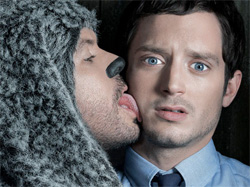
On the one hand, I’m interested in how divisive the show’s premise will be: this is a decidedly weird premise, and the show doesn’t spend any time trying to explain or justify it in tonight’s premiere. “Happiness” begins with Elijah Wood’s Ryan imagining his neighbor’s dog Wilfred as a bipedal, pot-smoking dude in a dog suit – creator/producer Jason Gann, to be specific – and simply moves on from there.

However, on the other hand, I’m wondering what those expecting something truly bizarre are going to think when they discover that Wilfred isn’t as weird as its premise might indicate. Now, don’t get me wrong: this is still a weird show, and all three episodes sent to critics feature moments which play on the premise quite directly. And yet, at the same time, all three episodes boil down to some pretty general themes, and this is at its core the story of a depressed man exploring his identity with the help of a friend. That the friend is imaginary, and that he is actually a dog, is not really the point of it all, which was kind of surprising given that “Guy in a Dog Suit” was pretty much all I knew about the show going in.

While I find Wilfred to be occasionally amusing, and certainly think that the premise holds narrative potential, what I’ve seen so far ends up coasting on the premise without really exploring it to any large degree. Individual setpieces may signal where the show may succeed in the future, and Wood and Gann may be strong anchors around which to build a larger comic world, but this is a surprisingly small show given its larger-than-life premise.

And while that may benefit that show in the end, it has resulted in a bit of a slow start that might engender a mixed reaction.

Continue reading

8 Comments

Filed under Wilfred

Season Finale: Game of Thrones – “Fire and Blood”

“Fire and Blood”

June 19th, 2011

“There you will see what life is worth when all the rest is gone.”

Earlier this week, I rewatched last week’s penultimate episode, “Baelor,” with my brother who was seeing it for the first time. Generally, I’ve been watching Game of Thrones alone, and any interaction with other viewers has been done online (or, if done in person, was done with people who I had previously interacted with online). For the first time, I was sitting in the same room as another viewer as we watched the show, and the experience made clear what I had known from the beginning but had never seen quite so clearly visible: Game of Thrones is a show that every single viewer likely considers differently.

It is not just that we can separate between readers and non-readers, although that is certainly the most obvious distinction to be made. Rather, we need to also consider questions of genre, gender, sexual content, race, and other qualities which have been called into question over the course of the season: regardless of whether I individually had concerns with the show’s use of fantasy, or its sexposition, or the Othering of the Dothraki, the fact is that those concerns existed, and have created a divisive response even among those who generally like the show.

In a piece earlier this week, friend of the blog Cory Barker wrote about his ambivalence towards the series, and kept trying to find reasons for it within the text. While his process was enlightening, he couldn’t find the silver bullet: there was no one part of the show that was creating a lack of an emotional connection. How we view the series can be defined by issues like genre which are inherent to the text itself, or issues like viewing patterns which are entirely extratextual but can define one’s experience with the text. My brother, for example, watched the season on a staggered schedule of short marathons, while my parents watched it on a weekly basis; as a result, they remembered different things, retaining different parts of the show that were highlighted by their personal experience with the text.

I raise all of these points because after a season of open interpretation, at least for those who hadn’t read the books, there is something almost prescriptive about “Fire and Blood.” While “Baelor” delivered a fatal twist, and suggested a certain degree of carnage to come in the weeks ahead, “Fire and Blood” steps back to serve as a more traditional denouement, laying out the various threads which will be followed into a second season. Rightly treating the fate of Ned Stark as the season’s climax, it seeks to explore the scenario that Mirri Maz Duur lays out to Dany early in the episode: what is the worth of each of these characters and these storylines in light of recent events? It’s a moment where the show actually has to step forward and proclaim its identity in order to convince the skeptics that this is a show worth watching, and to convince the believers that their faith has not been misplaced as the show transitions into the next stage of its narrative.

“Fire and Blood” doesn’t beat around the bush: it shows its hand from its bloody opening to its fiery conclusion, laying out a pretty detailed framework for what the second season of the show will look like. However, it never feels like an artificial framework, and that sense of interpretation never disappears even as the storyline becomes less open-ended. Serving as a fitting bookend to what I personally feel was a very strong first season, “Fire and Blood” reinforces central themes and delivers on what matters most: reminding us why these characters are following the path they’re on, and informing us why we want to follow that path next season.

Continue reading

30 Comments

Filed under Game of Thrones

Cultural Catchup Project: “Flooded” (Buffy the Vampire Slayer)

“Flooded”

June 13th, 2011

You can follow along with the Cultural Catchup Project by following me on Twitter (@Memles), by subscribing to the category’s feed, or by bookmarking the Cultural Catchup Project page where I’ll be posting a link to each installment.

Thus far, Buffy the Vampire Slayer’s sixth season has been strikingly “realistic.” It sort of reminds me of the fourth season, in that Buffy spent the first set of episodes battling “real world” forces as much as demonic ones. There, the traditional college experience was framed through the eyes of the Slayer, while here Buffy’s resurrection from heaven is almost being framed as the transition into the adult realities of parenting, home ownership, and everything in between. Whereas Buffy’s role has more often than not been framed in terms of general responsibility, a task that she has always been able to live up to, the show is reframing that role in the context of financial responsibility.

While “After Life” very much focused on the ways in which reality itself has become a burden for Buffy in light of her ordeal, “Flooded” makes reality a bit less philosophical and a bit more…well, real. We could argue the same for the season itself, actually, given how the episode uses a fairly typical Monster-of-the-Week and a number of private conversations to set a pretty clear foundation for the season that follows. It’s too early to pass judgment on The Trio, and on the direction the season seems to be heading in, but the best thing I can say about “Flooded” is that it never gave me pause. Burdened by exposition, the episode nonetheless found a fair deal of poignancy in what could be considered a mundane premise, and created a great deal of interest (and a moderate amount of excitement) for what is to come.

Continue reading

36 Comments

Filed under Cultural Catchup Project

Game of Thrones – “Baelor”

“Baelor”

June 12th, 2011

“I learned how to die a long time ago.”

It has been a bit of an adventure tiptoeing around the events of “Baelor” over the past eight weeks.

It’s been a bit of a game, honestly – from the moment the show was announced, people who had read the books were well aware that this episode was going to come as a shock to many viewers. This was the moment when the show was going to be fully transformed from a story about action to a story about consequences, and the point at which the series would serve notice to new viewers that this is truly a no holds barred narrative.

On some level, I don’t know if I have anything significant to add to this discussion: as someone who read the books, I knew every beat this episode was going to play out, and can really only speak to execution as opposed to conception. The real interest for me is in how those without knowledge of the books respond to this particular development, and how it alters their conception of the series. While I don’t want to speak for them, I am willing to say that “Baelor” was very elegant in its formation, rightly framing the episode as a sort of memorial to that which we lose at episode’s end.

And now, if you’ll excuse me, I’ll save my other thoughts for after the break so that I can finally talk about this without fear of spoiling anyone.

Continue reading

30 Comments

Filed under Game of Thrones

Midseason Finale: Doctor Who – “A Good Man Goes to War”

“A Good Man Goes to War”

June 11th, 2011

My choice not to review “The Rebel Flesh” and “The Almost People” is partly due to the awkwardness created by BBC America making the idiotic decision to take a one-week hiatus over Memorial Day Weekend, but I’ve also got to be honest: I didn’t think they were very good.

I saw a Twitter conversation go by, I think involving Jeremy Mongeau, and it really captured what I think the problem was. He made the argument, if memory serves me correctly, that serialization has actually damaged the show through the first half of the sixth series: everything has been so caught up in laying groundwork for future events or setting up the seasonal arc that it doesn’t really have time to breathe (or, if you’re “The Curse of the Black Spot,” was kind of just too dull to stand out).

Even if we argue that the serial elements have remained intriguing (which I would), and even if “The Doctor’s Wife” was a really compelling standalone that spoke to overarching themes in a strong fashion (which it was), “The Rebel Flesh” and “The Almost People” were like a narrative fetchquest. The Doctor needed to learn more about the flesh, and therefore traveled to where it first originated in order to better understand it, and a story had to be created around that particular event. It just seemed like Matthew Graham’s script never quite managed to make the characters compelling enough, implying a sense of depth instead of actually showing it to us.

Did the two-parter lay some important groundwork for explaining the Doctor’s “death” back in the premiere? Absolutely. And did it quite effectively transition into the reveal that Amy has been flesh since the beginning of the season? Yes. But it becomes a two-hour exhibit in exposition when “A Good Man Goes to War” begins, a too-long detour in a season that seemed to lose its momentum. Mind you, Steven Moffat regains that momentum in about three minutes and forty seconds, give or take a minute or two, and “A Good Man Goes to War” is a stellar effort that benefits from having some truly substantial exposition to relay.

It also tells a compelling story to go along with it, one that we can be certain will resonate both in the fall and beyond.

Continue reading

11 Comments

Filed under Doctor Who

Cultural Catchup Project: The Disc Stands Alone (Angel)

The Disc Stands Alone

June 10th, 2011

You can follow along with the Cultural Catchup Project by following me on Twitter (@Memles), by subscribing to the category’s feed, or by bookmarking the Cultural Catchup Project page where I’ll be posting a link to each installment.

I’ve been falling behind a bit on my Angel catchup, although it isn’t without reason. After finishing the first disc of Season 3, I found myself confronting three very different episodes that were slightly more distinctive than I might have expected. Some offer standalone stories which gesture towards future developments, some look to focus on our supporting characters and their journey to this point, and some offer a more general thematic consideration as facilitated through a carefully designed monster of the week.

There just wasn’t any sort of hook for me to focus on which would unite “That Vision Thing,” “That Old Gang of Mine,” and “Carpe Noctem,” and the recent heatwave zapped away my energy to dive any further into the series to try to find that thread.

And so, while I would like to offer something more, here’s a fairly basis episode-by-episode rundown of the remainder of Disc 1.

Continue reading

12 Comments

Filed under Cultural Catchup Project

Game of Thrones – “The Pointy End”

“The Pointy End”

June 5th, 2011

“Written by George R.R. Martin”

The credits for Game of Thrones has always read “Created by David Benioff and D.B. Weiss,” but the question of authorship has always been considerably more complicated. The fact is that this is very clearly George R.R. Martin’s world, and George R.R. Martin’s characters, and even George R.R. Martin’s story – while we can certainly argue that Benioff and Weiss have taken certain liberties, adding scenes and shifting character allegiances, it has not utterly transformed Martin’s vision. And yet, at the same time, we can’t say that this is Martin’s show, as he was ancillary to the myriad of decisions which move beyond the initial creation to the execution and design. A Song of Ice and Fire may be his story, but Game of Thrones is not his television show, and there’s an odd shared ownership of Westeros that has been evident throughout the season.

I say evident, mind you, and not problematic. The scenes that have been added have been strong, and the decisions made have been mostly logical if not necessarily ideal in every instance (or for every fan). However, here you have an instance where the person doing the adaptation is Martin himself, given a chance to return to key moments and characters and tell the same story all over again. And yet, he’s now working within someone else’s show even when he’s working within his own story, an intriguing scenario that I thought going in might make for an intriguing case study.

However, there’s honestly nothing to really see here: while this is a very strong outing, and maintains the momentum from last week’s episode quite brilliantly even as it hits the fast forward button on the narrative action (and thus risks missing key pieces of the puzzle), I don’t think we see some sort of crisis of authorship. Martin’s return coincides with the period where exposition goes out the window, and where major story events are starting to take shape. It is a period where characters are making decisions instead of pondering them, and where key themes are beginning to filter throughout the storylines at a rapid pace, and so any authorship is swallowed up by the sheer presence of the realm and those outside its borders who threaten it.

In other words, it’s just as Martin intended it, and thus as Benioff and Weiss intended it as well.

Continue reading

16 Comments

Filed under Game of Thrones

A Comic Transition Plan: Season Two of CTV’s Dan for Mayor

Review: Dan for Mayor Season Two

June 5th, 2011

As CTV’s Dan for Mayorone of my Top 10 shows of 2010, if you non-Canadians remember – returns for its second season, things have changed.

It isn’t just that the eponymous Dan has now officially become mayor of the fictional Wessex, Ontario. The first season was built around that campaign, with all of the show’s characters eventually taking some sort of role in its success. Now, with Dan having taken on the office of Mayor, the challenge facing the show’s writers was how to keep their favorite characters around.

Their solution is more functional than elegant, and it raises a number of interesting questions related to seriality in situation comedies. Treating the first season as a prologue of sorts, tonight’s premiere (airing at 7:30 ET on CTV) wastes no time finding ways to re-establish spaces in which these characters can interact on a regular basis. It’s a transparent re-ordering of the series, one that makes the premiere a bit jarring, but it also transitions the show into something simpler, and more sustainable, than what came before.

And, thankfully, it still manages to be plenty charming in the process.

Continue reading

2 Comments

Filed under Dan for Mayor

Summer Premiere: Men of a Certain Age – “The Great Escape”

“The Great Escape”

June 1st, 2011

Given that I already offered a general opinion that “The Great Escape” is a tremendous return for the show’s second season, I don’t expect to say a great deal about the episode itself.

However, I feel that this episode more than any other captures the sort of “coming of age” theme that I highlighted in my pre-air review, creating a set of circumstances in which all of the characters prepare themselves to make an important life change before suddenly realizing that the moment has passed.

It’s oddly one of the most overtly thematic episodes that this subtle show has ever done, but its broad moments are triggered by such subtle observations that it never betrays what makes the series so compelling.

Continue reading

Leave a comment

Filed under Men of a Certain Age


