Tag Archives: Entertainment

Sons of Anarchy – “Culling”

“Culling”

November 24th, 2009

It’s been a couple of weeks since I’ve checked in on Sons of Anarchy, primarily because I’ve run out of superlative things to say about the show. Right now, the show is riding a wave of momentum that feels almost Wire-esque, relying less on twists or turns (which would perhaps illicit more of an immediate desire to write about it) and more on a clear depiction of SAMCRO accomplishing what they want to accomplish in the form of some really compelling asskickery.

“Culling” is the first time in a few episodes where things, you could argue, go wrong, but what’s most intriguing is how uniquely situated the audience is within this story from a traditional law and order perspective. Because our point of view lies with the Sons, who are in this for vengeance over justice, we root against the ATF and become legitimately concerned when the Charming P.D. enter into the equation. The show has us cheering things that television doesn’t necessarily always condition us to cheer, and it makes for an episode that builds tension not by having things go terribly wrong but rather having the definition of justice become a debatable topic on which different characters have very different perspectives.

It’s the complicated web the show has been spinning with shocking clarity all season, and it’s making for an enormously entertaining march to the finale.

Continue reading

Leave a comment

Filed under Sons of Anarchy

When Worlds Converge: Futures of Entertainment at Cultural Learnings

One of the reasons I write about television is in order to engage with a larger community of both television viewers and television critics. While there is no doubt a personal desire to consider the medium more carefully nearly every day, it’s also about contributing to a broader critical discourse on television that extends from traditional critics to television bloggers to message board commenters.

However, one of the things that has been missing within my academic experience (which is only rarely a topic of discussion on the blog, as regular readers will know) is that same sense of community when it comes to analyzing television. Working within an English department as an island of television studies has made me more defensive than I’d like to admit, and while being forced to justify my projects has helped shape my perspectives on television it has also led to a lack of considerable outside input.

So, this weekend was one of those moments where my current academic work was put on hold as I took advantage of the wonders of Twitter to participate from afar in discussions occurring during Futures of Entertainment 4, a conference hosted by MIT’s Convergence Culture Consortium and designed to engage scholars and industry figures in discussions about, well, the future of entertainment. And, as lame as it sounds, it really did feel like a convergence of my academic interest in television and my work here at Cultural Learnings. While the discussions used theoretical ideas that are uncommon in television criticism, the conversation always went beyond theory to application, with panel members including representatives from the BBC and from companies that actually produce the types of content being discussed.

The resulting conversationswere  different from what I’m used to but not entirely foreign: there was a lengthy discussion about Joss Whedon’s future in television considering Dollhouse’s cancellation, and while the discussion jettisoned subjective analysis of the series it nonetheless considered the potential of online business models and the changing metrics networks use to determine a series’ fate, the same types of things that critics and bloggers alike have been discussing since the show was axed. It was one of many conversations that made me both appreciative of the chance to contribute to the amazing discussion between these top academic/industry minds in Cambridge and extremely proud to be part of a similar sort of community through my regular reviews and analysis here at Cultural Learnings each day.

As a result, I wanted to be able to reflect the convergence of sorts between the two worlds, so I put together a series of “FOE4 Musings” that focus on shows/situations I cover here on the blog from some new perspectives inspired by the crosstalk on Twitter during the conference.

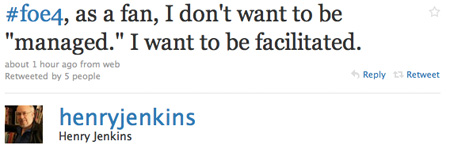
Chuck vs. Fan Management vs. Fan Facilitation analyzed the failure of NBC, in the wake of the “Save Chuck” campaign, to leverage this fan support in a substantial fashion, inspired by a distinction made between management and facilitation by Henry Jenkins.

Glee and the Limitations of Reality Competition Narrative analyzed the degree to which Glee’s storytelling, along with its business strategy, refers to the successful formula of American Idol, inspired by a tweet from Ivan Askwith.

AMC’s The Prisoner and Transmedia Participation analyzed the potential for transmedia storytelling within AMC’s remake, and the ways the show’s schedule/writing worked against audience expectations, inspired by the panel on Transmedia play.

These articles are also all collected on the new “Articles” page, where readers old and new can visit (or revisit) some of the broad pieces of analysis that I’ve written over the past three years here at Cultural Learnings.

I don’t pretend that any of these pieces from this weekend are comprehensive, but they allowed me to consider some subjects common to the blog in a new light, and I can only hope that they stimulate 1/1000th of the discussion that some of the tweets from this weekend did. Any comments, from both old and new readers alike, are more than welcome.

I want to thank everyone who took part in the conversation at FOE4 for helping create a really fantastic experience that offered me far more inspiration than could be put into three posts; I can only hope that I’ll be able to attend FOE5 in person, and be able to offer more considerable insight into these fascinating discussions.


Leave a comment

Filed under Cultural Learnings

The Amazing Race Season 15 – “Episode 10 (Czech Republic)”

“We’re Not Working with Anybody, Ever, Anymore!”

November 22nd, 2009

When we get this close to the end of The Amazing Race, the show’s interest in its characters begins to shift. At certain points, the show allows the racers to appear as comrades, laughing together and competing against the race itself more against each other. However, by the time you get to the final four teams, the show wants every chance to pit the teams against one another in a fight to get to the end, trying to breed the sort of competitive fire that you want to see at this stage in the game.

And while most of the google hits from last week’s post seemed to indicate that the biggest piece of news from the leg was crotch censorship, the real story was the way the producers turned Dan and Flight Time’s altercation into a sign that, from this point forward, things are personal. In reality, the clip was only really edited this way (Big Easy clarified, as they did at the start of this leg, that they had no personal vendetta), but what it does signal is that all bets are officially off.

And this week, as the teams head to the Czech Republic, we realize that this season these teams are perfectly built in order to enter into this competitive stage. There is no team in this race that is what one would call a “feel good” team, and the result is that we’re effectively watching to see how well these teams are able to embrace this competitive spirit. And while this might not fit into a narrative of personal achievement or self-realization, it does fit into what makes these final legs of the race suspenseful: all of these teams are both ultimately capable of being competitive (athletic and strong-minded), but they also tend to create an enormous amount of drama in the process.

As someone who likes this competitive side of the race, I’m pleased by this, but I can see how someone looking for more of a fan favourite finish to the race may be disappointed.

Continue reading

1 Comment

Filed under The Amazing Race

FOE4 Musings: AMC’s The Prisoner and Transmedia Participation

AMC’s The Prisoner and Transmedia Paticipation

November 21st, 2009

In this week’s review of AMC’s remake of The Prisoner, I wrote at length about what I saw as a failure of the show’s narrative: in my eyes, the series struggled due to a lack of information that resulted in no emotional connection with the characters and, as a result, no real connection to the story. I resisted the argument that the series’ sense of mystery, and its complex thematic conclusion, justify this structure, and friend of the blog David J. Loehr brought up a great example to support my point:

It makes me think of Hitchcock’s example of the “bomb under the table” idea, that you can show ten minutes of two men having the most boring lunchtime conversation ever and BOOM, their table blows up. That’s a cheap thrill at the end of ten boring minutes. Or you could show the bomb under the table, then continue the exact same scene, boring conversation and all, except now it’s fraught with tension as you wait for the bomb to go off. The sixth episode is the bomb, at least in this example if not in modern lingo.

However, based on conversations I had with some of the always great posters at NeoGAF and today’s Futures of Entertainment 4 panel on Producing Transmedia Experiences: Participation and Play, I’m starting to understand why some have argued that the series was actually a success. It seems that those who enjoyed the miniseries are those who so inherently bought into the sense of mystery and intrigue (inspired both by the density of this miniseries and the decades of debate over the meaning of the original series) to the point where they began to see narrative gaps as clues, and inconsistencies as paradoxes meant to be seen as part of the broader narrative.

I would argue this was not by design, and that these viewers are taking poor execution and turning it into a game that the writers and directors didn’t actually create. They have effectively “gamed” the miniseries, taking a trend that is popular within serial dramas like Lost and applying it regardless of whether it is actually part of an intended transmedia experience.

It’s a behaviour that indicates television has become an environment of “game” (by providing a clear sense of how audience can participate in the construction of narrative) or be “gamed,” and that AMC missed an opportunity to improve the response and increase the impact of the miniseries by not actively pursuing this avenue.

Continue reading

2 Comments

Filed under The Prisoner (2009)

FOE4 Musings: FOX’s Glee and the Limitations of Reality Competition Narrative

Glee and the Limitations of Reality Competition Narrative

November 21st, 2009

Following along with this weekend’s Futures of Entertainment 4 Conference at MIT (through the Twitter Hashtag #foe4) has been a really unique experience in many ways, engaging with an academic community I’ve only seen from afar in the past, but there are times when the topics being discussed feel almost too familiar.

By nature of the number of reviews I write about particular shows, I usually end up attacking them from nearly every conceivable angle, but there’s something about Glee that seems to inspire more angles than seem physically possible. The show has created a lot of controversy with its struggle to find a clear sense of its identity from the narratological point of view, which is the angle we television critics have been considering most carefully, but as discussed both yesterday (in the context of its use of music/iTunes to create transmedia engagement) and today (in its engagement with culture) during the conference its brand strategy has never had the same identity crisis.

I want to pick up on something that Ivan Askwith said during the discussion of the series’ engagement with culture, as he argued the following:

I am going to investigate this further, as it implicitly argues that the series’ narrative struggles are the result of an attempt to engage with a manufactured narrative structure (that will in the Spring be the show’s lead-in), a fact which is both understandable (network synergy and business logic) and complicated by the needs of serialized drama over reality programming from a narrative point of view.

Continue reading

2 Comments

Filed under American Idol, Glee

Inanity, Intrigue and Inigo Montoya: A Cultural Learnings Reality Roundup

Inanity, Intrigue and Inigo Montoya

November 20th, 2009

In the promos for the season finale of Season Six of Project Runway, Lifetime uses dramatic music and a deep-voiced announcer to try to build suspense for the big reveal. However, in their language, they have something wrong: they create anticipation for the reveal of who is “the next big name in fashion,” and my immediate response is “who cares?”

See, what works about Project Runway is that it transfers the aesthetics of the fashion industry into terms that are unrelated to the fashion industry. I know nothing about fashion, but I know a lot about what Nina Garcia likes to see in fashion, or what the series values in terms of creativity. It’s created an audience that, even if they have no knowledge of the fashion industry, have gained knowledge of what Project Runway considers fashion. As such, rather than caring about what these young designers do in the context of the fashion industry, we care about how they situate themselves within the show’s cast of characters from seasons past. For a viewer like me, Bryant Park is the setting of the finale of Project Runway, not a global fashion event, which is why Lifetime language is demonstrative of the season’s failures: I don’t care if they’re a big name in fashion, I want them to be a big name for Project Runway.

And I can confirm that Irina, Althea and Carol Hannah will not be names to remember, a fact which has more to do with the way the show treated them than it does with their individual personalities and talent. And while we’ll never know if this season would have been more interesting if it were in New York, and if the production company hadn’t changed, what we do know is that Season Six failed to provide both the next big name in fashion and a single memorable name for this franchise.

[A few more thoughts on Project Runway, and then some thoughts on both Top Chef and Survivor, with spoilers after the jump…]

Continue reading

3 Comments

Filed under Project Runway, Survivor, Top Chef

FOE4 Musings: Chuck vs. Fan Management vs. Fan Facilitation

Chuck vs. Fan Management vs. Fan Facilitation

November 20th, 2009

Currently ongoing at MIT, the Futures of Entertainment 4 Conference is a gathering of academics, industry leaders, and interested parties for a discussion of how “the creation of transmedia storyworlds, understanding how to appeal to migratory audiences, and the production of digital extensions for traditional materials are becoming the bread and butter of working in the media.” And while I’m not at the conference myself, through the joys of the #FoE4 Hashtag on Twitter and some extensive liveblogging it’s as if I am, which is a wonderful feeling for an academic who is isolated from these types of major conferences by geography and funding both.

However, as regular readers of Cultural Learnings know, I rarely engage in wholly academic discussions in this setting, and in terms of this conference I’m particularly interested in the convergence between the discussions being held at the conference and my own experience looking at both television and the culture that surrounds it. In particular, this morning’s panel (moderated by friend of the blog Jason Mittell) on transmedia storytelling from the perspective of the producers (both in terms of third party companies who work on tie-in websites, etc., and those who are in charge of organizing those efforts) raised an important question that perhaps Henry Jenkins put best in a tweet:

There’s obviously an ideological difference between the two terms, one designed to control and the other designed to empower, and in an example like NBC’s Chuck (which, as announced yesterday, is returning in January) we can use these terms to describe the challenge facing the show’s relaunch.. The successful fan campaign which “saved” the show and earned it a third season was facilitated indirectly, as fans created their own transmedia experience by taking product placement and turning it into their own mini-marketing campaign.

And, as a result, NBC is in a position where Fan Facilitation and Fan Management start to blur, as the existence of an existing fan base more often inspires networks to attempt to control and manipulate that group rather than understanding the intelligence implied in their earlier behaviour and using that to their advantage, risking turning them away and squandering the potential they offer.

Continue reading

11 Comments

Filed under Chuck

V – “A Bright New Day”

“A Bright New Day”

November 17th, 2009

In its first four episodes, V has one of the toughest tasks in network television: it needs to both create a sense of momentum (in order to continue to engage viewers) and also leave viewers wanting more (so that they’ll come back when the show returns in March to finish its first season). What’s been clear thus far for the series is that it is sort of trapped between the two tasks, unwilling to blow its metaphorical load but also unwilling to slow things down to fully pull out the most interesting elements of the show’s mythology. It’s led to a methodical but unfocused start to the series, and unfortunately one which hasn’t yet pulled me in to the degree that it seems to want to.

The problem with “A Bright New Day” isn’t that it is doing anything particularly wrong with this premise, but rather that it feels entirely inorganic when introducing any sort of new developments. There is nothing elegant about this show, and while it (unlike FlashForward) has done well to keep its stories more inherently related to the plot of the series it has done nothing to make some of those inherently relevant stories entertaining (although parts of this episode are on the right path). The show is so desperate to show us certain things, and to have certain characters be in certain situations, that it doesn’t really care how it accomplishes it.

And while a more cheesy, 80s inspired series with some flair could easily get away with this, a show that purports to take itself seriously is going to run into a narrative brick wall, hiatus or no hiatus.

Continue reading

1 Comment

Filed under V

The Big Bang Theory – “The Adhesive Duck Deficiency”

“The Adhesive Duck Deficiency”

November 16th, 2009

I’ve not been remiss in noticing that the Sheldon/Penny shipping community has taken an interest in these reviews, and I want to make sure they know that I always appreciate the comments. And, because I’ve been following along with the group, alarm bells went off when this week’s episode of The Big Bang Theory separated Sheldon and Penny from the rest of the group. In some ways, the episode’s opening scenes actually played out like fan fiction, and we were reminded that, as usual, this sort of pairing is when the show is at its best (even if I feel as if the show will never, ever, take this relationship to anything beyond a tenuous mutual tolerance).

However, unfortunately for this episode, something about the storyline never quite lived up to its full potential, and more problematically the other half of the episode was the epitome of half-baked (yeah, I went there). While the Sheldon and Penny storyline was enjoyable in the way that Sheldon stories always are, and Jim Parsons is as hilarious as ever, it lacked (until the end) the heart of their more enjoyable plots. And since the show’s two most interesting characters in terms of creating different dynamics were on their own, this left the rest of the guys to fend for themselves.

And while Sheldon and Penny might be a good combination for the show’s comic potential, nothing can give me back the time spent on the other half of this episode.

Continue reading

5 Comments

Filed under The Big Bang Theory

Dexter – “Road Kill”

dextertitle

“Road Kill”

November 15th, 2009

I spent part of last week finishing up the fifth season of Six Feet Under, which has long been half finished after a lengthy marathon session of the entire series just proved dire last summer, resulting in “Depressive Melodrama Burnout” (DMB, for short). Returning to that show was a reminder of just how amazing Michael C. Hall can be, and how in some ways I wish that Dexter could feel as…progressive as Six Feet Under often did. Say what you will about Alan Ball’s incessant refusal to allow his characters to be happy, but the sense of growth in David as a character (and, not to spoil anything, a late series regression) helped to provide a sense that the collective weight of the show was actually having an impact on his psyche.

Dexter, as a series, is like a masochistic, homicidal version of “Will it float?” where the writers throw various circumstances at Dexter to see whether it will mix with his existing psychotic personality. The argument the fourth season has been making thus far is that Dexter is not aware of how much his personality has actually changed, and the Trinity Killer is a sign that perhaps there is some secret switch that will help reconcile his new life in the suburbs with his murderous impulses (and actions). And, now into the show’s fourth season, the psychological experiment at the centre of the show is downright uninteresting to the point where last week’s violation of Harry’s code is about a season and a half behind the times: we’ve been waiting for Dexter to realize that the code is flawed, and develop his own, since the start of the third season, but the show is formulaic to the point where that would disrupt the flow of the story.

“Road Kill” works as an episode because it completely sidelines Dexter’s predictable responses in favour of the unpredictability of the Trinity Killer. To do so, of course, the show has to admit that the actual impact of killing a mostly innocent man is entirely counterproductive to the show’s intentions, instead heading to Tampa in order to delve into the psyche of a character that, in being new and interesting, the writers actually seem interested by. The rest of the episode isn’t nearly as interesting, but letting Hall and Lithgow go on a road trip together is a recipe for success, if limited by the show’s current focus.

Continue reading

3 Comments

Filed under Dexter