Tag Archives: Television

Cultural Catchup Project: New Beginnings in “The Freshman” and “City Of” (Buffy and Angel)

New Beginnings in “The Freshman” and “City Of”

June 19th, 2010

You can follow along with the Cultural Catchup Project by following me on Twitter (@Memles), by subscribing to the category’s feed, or by bookmarking the Cultural Catchup Project page where I’ll be posting a link to each installment.

It’s only fitting that, as Buffy and Angel’s paths diverge into two separate series, the Cultural Catchup Project forces them back together for the sake of analysis.

There is no plot-based connection between “The Freshman,” Buffy’s fourth season premiere, and “City Of,” Angel’s “pilot” of sorts which started off its first season: while there is a brief moment shared between the two episodes, it is an easter egg more than a substantial development. However, both episodes tell more or less the same story: our protagonist moves onto a new stage in their life in an unfamiliar location and struggles to reconcile their past life with their present situation.

In that sense, both episodes serve the function of a pilot: while “The Freshman” isn’t debuting a new series, it is ushering in a new era for Buffy, as she heads down the road to UC Sunnydale and discovers that it is truly a “whole new world” in more ways than she bargained for. And “City Of,” while unique in that Buffy viewers have a greater understanding of Angel and Cordelia’s characters than those tuning in for the first time, still needs to introduce Angel’s current goals and set up just what kind of show Angel wants to be.

And while both episodes were entertaining, I’m going to make the argument that neither of them were actually that successful when considered as the beginning of their respective seasons.


Continue reading

82 Comments

Filed under Cultural Catchup Project

All-Stars, No Story: Confusion reigns over So You Think You Can Dance Season 7

All-Stars, No Story: SYTYCD Season 7

June 16th, 2010

When it was announced that So You Think You Can Dance would be changing its structure for its seventh season, in theory there shouldn’t be any complaints: after all, many of the show’s fans were frustrated by the sixth season, where the series felt stale for the first time. However, that staleness wasn’t really the result of the show’s structure so much as the decision to schedule the series in the fall (only weeks after the fifth season ended) and an unfortunate new stage which sucked some of the life out of the series. We were suffering from fatigue more than anything else, and while some small changes could bring us back to the franchise it seems as if Nigel Lythgoe decided to throw the baby out with the bathwater.

While we’ve known for a while that the series was throwing out its Top 20 structure and going with a Top 10 (in fact a Top 11) and teaming up the individual competitors with All-Stars from previous seasons, it wasn’t entirely clear just how that would work. The show is still a collection of 11 dance routines as it was before, but there are newfound conflicts in who we’re supposed to be paying attention to (the competitor or the All-Stars), and with Mia Michaels sitting in for Mary Murphy there is simply something different in the air.

And it’s proving to be, at least right now, a diversion from what used to make the show so engaging – while my choice of title may make it seem like the problem is that the show is focusing too much on the All-Stars (I couldn’t resist the play on No Guts, No Glory), the truth is that they didn’t focus on the all-stars at all, which is even more distracting and confusing for audiences and judges alike.

Continue reading

4 Comments

Filed under So You Think You Can Dance

Off-Site Learnings: Glee’s Impact on Television Development

I was in transit when last week’s episode of the (excellent) Firewall and Iceberg podcast was posted, and during that trip I wrote a piece for Jive TV which discussed what Glee’s impact will be on television development; little did I know that Alan and Dan had discussed the same issue during that episode, which makes my piece a response of sorts to their comments.

It’s ultimately in agreement: Glee’s legacy will not be the renaissance of the high school comedy nor the arrival of the television musical. However, I would argue that there are more essential, rather than definitional, elements of the series which could inspire future development, allowing networks to tap into what makes Glee so successful without necessarily selling iTunes downloads or breaking out into song.

For more on the subject, check out “Has U.S. TV been Forever Changed by Glee?” at Australia’s Jive TV:

However, what remains to be determined is how much Glee has changed the television industry: while the success of a show like Modern Family can be billed the renaissance of the family sitcom, it’s not quite so easy to identify what other networks will attempt to emulate within Glee’s central premise. There isn’t going to be a sudden influx of musicals on television, as Glee’s most definitive quality is too unique on the current television landscape to be copied in such a blatant fashion; that being said, networks will still want to try to capture the elusive “Glee audience” that FOX has built over the past year, and they’re going to try to find a way to do it as soon as possible.

Leave a comment

Filed under Glee

Sneak Preview: Rubicon – “Gone in the Teeth”

“Gone in the Teeth”

June 13th, 2010

AMC has officially dubbed their airing of Rubicon’s pilot a month and a half ahead of its premiere as a “sneak preview,” but I think a “teaser trailer” may be a more accurate description of the episode in question. A good teaser trailer shows you atmospheric scenes which give you a sense of the mood a particular movie or television series is going for, but really doesn’t tell you much about the plot in question: for example, HBO’s teaser trailer for Game of Thrones, the much-anticipated adaptation of George R.R. Martin’s A Song of Ice and Fire, shows a few key images and establishes the series’ tagline.

Considering this, it’s fair to say that my use of the designation for “Gone in the Teeth” is symptomatic of my frustration with the enigmatic lack of clarity which pervades this series. If a show’s pilot is supposed to be a teaser trailer, an aesthetic exercise designed to build hype, then I would consider this to be moderately successful: there was absolutely nothing here which would keep me from tuning into the series in August. However, a pilot needs to be something more than a teaser trailer, and the series’ shortcuts in establishing both its central character and its central conspiracy show a lack of elegance which does little to convince me that this belongs in the same breath as AMC’s other original series.

Continue reading

6 Comments

Filed under Rubicon

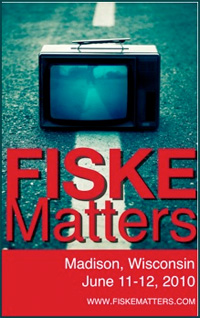
Fiske-ian Learnings: Reflections on Fiske Matters

While I don’t often delve too far into my academic experiences here at Cultural Learnings, this past weekend offered an interesting convergence of my various different hats, and since I’m going to be more academically involved in television studies in the years ahead I figure now seems like a good time to introduce some of that material here at the blog.



I was in Madison, Wisconsin over the weekend for Fiske Matters, a conference celebrating the legacy of John Fiske, professor emeritus at University of Wisconsin-Madison and considered to be one of the most influential figures in cultural and media studies. In particular, the conference was organized to commemorate the ten-year anniversary of his retirement from academia, and to begin the process of rescuing his work from a few decades of reductive criticism which has unfairly marginalized his contribution to the field.

The majority of people at the conference were themselves products of Fiske’s influential work: most of the attendees were former students, many of whom are now prominent academics within the field and who continue to rely on his teachings when inspiring a new era of scholars. And while I never had the pleasure of studying with Fiske, nor have I ever learned about Fiske in any of my direct academic experience, the conference was a fantastic introduction into the collaborative, creative and engaged academic environment which owes a great deal to Fiske’s work in the field.

I’m not going to be posting my entire presentation (for reasons I’ll get to beneath the fold), but I do want to discuss my paper and then raise some of my observations from the weekend which will hopefully be relevant to both academics and readers who may not be academics but might be interested in seeing how television and media are filtered through an academic lens.

Continue reading

4 Comments

Filed under Cultural Studies

Season Finale: Justified – “Bulletville”

“Bulletville”

June 8th, 2010

I think an “I told you so” is in order (albeit a little bit late, as I didn’t get to the finale until this weekend).

I wrote at length earlier this spring about how Justified’s gradual serialization was nothing to be alarmed about, and could actually result in a stronger serialized core to the series by allowing us to spend time with the characters outside of the demands of long-term storylines, and “Bulletville” is the definitive example of the complexities of this form of narrative pleasure (or the pleasure of this narrative complexity – works either way).

Perhaps the best way to describe it is a sort of abstract serialization: while there are parts of the narrative which present clear actions and consequences, there are others which build on small moments, actions which have no immediate ramifications but which at some point in the story merge with serialized arcs and contribute to a meaningful image of setting or character.

In its first season finale, Justified did everything they needed to do to bring it all together: in fact, there was so many moving pieces here that parts of the series which one would have presumed to be central in a finale like this one (especially if the show were as generic a procedural as some presumed it to be) were left to small moments, actions within a larger whole, leaving “Bulletville” to mirror the events of the series’ pilot but with newfound, and pretty fantastic, complexity.

Continue reading

4 Comments

Filed under Justified

Season Finale: Breaking Bad – “Full Measure”

“Full Measure”

June 13th, 2010

“We had a good run…but it’s over.”

When I sat down at about 3:00 am last night to watch the Breaking Bad finale after arriving home from my trip to Madison, I discovered that AMC was showing “Shut the Door. Have a Seat,” Mad Men’s third season finale. It took me a good ten minutes before I managed to turn on my recording of “Full Measure.” There is something exhilarating about that finale, something immensely pleasurable as lingering storylines that were sort of floating their way through the season (Lane’s dissatisfaction, Joan’s marginalization, etc.) become wrapped up in an unforgettable heist narrative which launches the show in a fascinating new direction.

And as I sit down the next day to consider “Full Measure,” I can’t help but make some comparisons, although less in terms of quality (both are great, we don’t need to qualify which is “better”) and more in terms of structure. “Full Measure” is similar to “Shut the Door…” in that it shows our protagonists struggling to respond to a new set of circumstances which threaten them in some capacity, but the world of Mad Men values creativity first and foremost, something which Breaking Bad tends to oppress (as we see with Jesse as the paralyzed artist figure, his youthful drawings or woodcraft projects signs of wasted potential). So while Don and Co. got out of their situation with some creative thinking, and the series found its finale in contrasting the creation of a new direction while simultaneously dissolving another, Walt and Jesse solve their circumstances with a cold dose of reality, and the series finds its finale in doing as it has always done: following through on the social, psychological, and monumental consequences of going down this dangerous path.

The result is a fairly simple tragedy with less than simple ramifications, as “Full Measure” uses the show’s trademark tension to cap off a stunning season of television which went on a run that is most certainly not over as the series heads towards its fourth season with an obnoxious amount of momentum.

Continue reading

5 Comments

Filed under Breaking Bad

Cultural Catchup Project: Decision Time (Buffy and Angel)

Decision Time

June 13th, 2010

You can follow along with the Cultural Catchup Project by following me on Twitter (@Memles), by subscribing to the category’s feed, or by bookmarking the Cultural Catchup Project page where I’ll be posting a link to each installment.

When I sat down to considering the overwhelming amount of feedback in regards to the future of the Cultural Catchup Project, I felt as if I was a supreme court justice considering the fairness of a long-standing law. There were clear arguments from both sides, and it wasn’t as if any one opinion was wrong: for a while, it seemed like my decision would in some way serve as a definitive argument in favour of a particular side, a power that comes with a great responsibility which is a little bit exciting.

However, I realized when I really sat down to consider the situation that it is a power that I am not capable of wielding. What the response to that post demonstrate is that everyone feels differently about this issue, and prioritizing any one person’s opinion or even the majority opinion would be almost impossible. I’d love to be the one to finally determine the absolute best way to watch Buffy the Vampire Slayer and Angel, but it’s impossible to make that determination unless I’ve, you know, actually watched Buffy the Vampire Slayer and Angel in various different configurations with an objective eye towards what I’ve been watching.

And when I really think about it, as much as I remain objective regarding my view of this series due to my position as a critical observer of television, I ultimately want my experience with Buffy and Angel to be as subjective as possible without losing all semblance of objectivity. I want to follow not necessarily what will result in the best experience but rather what will result in the most satisfying experience even if it is objectively inferior to other alternatives.

As a result, I can officially announce that…

Continue reading

31 Comments

Filed under Cultural Catchup Project

Season Finale: Glee – “Journey”

“Journey”

June 8th, 2010

“Life only really has one beginning and one end – the rest is just a whole lot of middle.”

In his attempts to inspire his Glee Club to achieve despite the nearly insurmountable odds placed before them at the upcoming Regional championships, Will Schuester makes the above remarks. And while I don’t think this was intentional, there’s a wonderful meta-commentary about the show itself in this statement: sure, the fragmented nature of the first season means that there were really two beginnings and two endings, but at the end of the day everything else was just a whole lot of middle that was more middling than I would have desired.

But if the back nine of Glee’s first season saw the series flipping and flailing wildly as it flew through the air, “Journey” demonstrates that this series knows how to stick a landing; in fact, I’d go so far as to say that the show would be amongst television’s best if they did two-episode seasons made up entirely of premieres and finales. Sure, the episode more or less feels like “Sectionals 2: Electric Bugaloo,” following the same patterns as the fall finale, but there is an unabashed sincerity to its storytelling which remains grounded without having to be undercut at every turn. It makes the show feel like it has earned this blanket sentimentality, that it truly has taken these characters on a journey which has changed their lives.

Matt Zoller Seitz wrote a great essay earlier today about Glee’s radical sincerity, but when I think about it nothing about “Journey” felt radical: so embodying the resiliency of the series’ spirit, and unapologetically engaging in theatrics we might have rolled our eyes at just a year ago, Glee proves that even considering all of the hype and success there remains a confident, passionate, absolutely entertaining series about a glee club that, gosh darn it, refuses to stop believing in itself.

And while I’m still going to dock the series some points for its poor form in the air during its back nine, I’m willing to throw up a good 9.5 or so for its landing, as “Journey” is unquestionably a series high point.

Continue reading

19 Comments

Filed under Glee

Season Finale: United States of Tara – “From This Day Forward”

“From This Day Forward”

June 7th, 2010

I wish that I had more to say about United States of Tara’s second season finale, but for the most part I don’t. This is not to say that the episode wasn’t enjoyable, or well-acted, but rather it seemed that the show had more or less choreographed all of its reveals, and so the primary function of “From This Day Forward” was more or less appearing to reset things to the status quo.

Again, this isn’t a slight on the episode: with some strong performances and some intense emotional moments, I think the series nicely capped off a complex and intriguing second season. The problem is that it works a little bit too hard to get to the point where the Gregson family is dancing wistfully in a beautifully lit backyard, cutting away the clutter of their lives for that brief moment of bliss. I understand the impulse behind that action, and the catharsis of the episode is helped by the calmness of those final moments, but it seems to be putting a button on too many story points which went unresolved or were cast aside with remaining potential. The series kept hinting at hidden motivations or long-kept secrets, and yet after revealing the biggest secret of them all the rest were sort of just chalked up to either misdrection or the frakked up nature of the Gregson family.

There’s something about that which is just a bit too easy, and something which all the catharsis in the world isn’t going to fix, and I feel like the finale needed to acknowledge that just a little bit more.

Continue reading

6 Comments

Filed under United States of Tara