FOE4 Musings: AMC’s The Prisoner and Transmedia Participation

AMC’s The Prisoner and Transmedia Paticipation

November 21st, 2009

In this week’s review of AMC’s remake of The Prisoner, I wrote at length about what I saw as a failure of the show’s narrative: in my eyes, the series struggled due to a lack of information that resulted in no emotional connection with the characters and, as a result, no real connection to the story. I resisted the argument that the series’ sense of mystery, and its complex thematic conclusion, justify this structure, and friend of the blog David J. Loehr brought up a great example to support my point:

It makes me think of Hitchcock’s example of the “bomb under the table” idea, that you can show ten minutes of two men having the most boring lunchtime conversation ever and BOOM, their table blows up. That’s a cheap thrill at the end of ten boring minutes. Or you could show the bomb under the table, then continue the exact same scene, boring conversation and all, except now it’s fraught with tension as you wait for the bomb to go off. The sixth episode is the bomb, at least in this example if not in modern lingo.

However, based on conversations I had with some of the always great posters at NeoGAF and today’s Futures of Entertainment 4 panel on Producing Transmedia Experiences: Participation and Play, I’m starting to understand why some have argued that the series was actually a success. It seems that those who enjoyed the miniseries are those who so inherently bought into the sense of mystery and intrigue (inspired both by the density of this miniseries and the decades of debate over the meaning of the original series) to the point where they began to see narrative gaps as clues, and inconsistencies as paradoxes meant to be seen as part of the broader narrative.

I would argue this was not by design, and that these viewers are taking poor execution and turning it into a game that the writers and directors didn’t actually create. They have effectively “gamed” the miniseries, taking a trend that is popular within serial dramas like Lost and applying it regardless of whether it is actually part of an intended transmedia experience.

It’s a behaviour that indicates television has become an environment of “game” (by providing a clear sense of how audience can participate in the construction of narrative) or be “gamed,” and that AMC missed an opportunity to improve the response and increase the impact of the miniseries by not actively pursuing this avenue.


Continue reading

2 Comments

Filed under The Prisoner (2009)

FOE4 Musings: FOX’s Glee and the Limitations of Reality Competition Narrative

Glee and the Limitations of Reality Competition Narrative

November 21st, 2009

Following along with this weekend’s Futures of Entertainment 4 Conference at MIT (through the Twitter Hashtag #foe4) has been a really unique experience in many ways, engaging with an academic community I’ve only seen from afar in the past, but there are times when the topics being discussed feel almost too familiar.

By nature of the number of reviews I write about particular shows, I usually end up attacking them from nearly every conceivable angle, but there’s something about Glee that seems to inspire more angles than seem physically possible. The show has created a lot of controversy with its struggle to find a clear sense of its identity from the narratological point of view, which is the angle we television critics have been considering most carefully, but as discussed both yesterday (in the context of its use of music/iTunes to create transmedia engagement) and today (in its engagement with culture) during the conference its brand strategy has never had the same identity crisis.

I want to pick up on something that Ivan Askwith said during the discussion of the series’ engagement with culture, as he argued the following:

I am going to investigate this further, as it implicitly argues that the series’ narrative struggles are the result of an attempt to engage with a manufactured narrative structure (that will in the Spring be the show’s lead-in), a fact which is both understandable (network synergy and business logic) and complicated by the needs of serialized drama over reality programming from a narrative point of view.

Continue reading

2 Comments

Filed under American Idol, Glee

Inanity, Intrigue and Inigo Montoya: A Cultural Learnings Reality Roundup

Inanity, Intrigue and Inigo Montoya

November 20th, 2009

In the promos for the season finale of Season Six of Project Runway, Lifetime uses dramatic music and a deep-voiced announcer to try to build suspense for the big reveal. However, in their language, they have something wrong: they create anticipation for the reveal of who is “the next big name in fashion,” and my immediate response is “who cares?”

See, what works about Project Runway is that it transfers the aesthetics of the fashion industry into terms that are unrelated to the fashion industry. I know nothing about fashion, but I know a lot about what Nina Garcia likes to see in fashion, or what the series values in terms of creativity. It’s created an audience that, even if they have no knowledge of the fashion industry, have gained knowledge of what Project Runway considers fashion. As such, rather than caring about what these young designers do in the context of the fashion industry, we care about how they situate themselves within the show’s cast of characters from seasons past. For a viewer like me, Bryant Park is the setting of the finale of Project Runway, not a global fashion event, which is why Lifetime language is demonstrative of the season’s failures: I don’t care if they’re a big name in fashion, I want them to be a big name for Project Runway.

And I can confirm that Irina, Althea and Carol Hannah will not be names to remember, a fact which has more to do with the way the show treated them than it does with their individual personalities and talent. And while we’ll never know if this season would have been more interesting if it were in New York, and if the production company hadn’t changed, what we do know is that Season Six failed to provide both the next big name in fashion and a single memorable name for this franchise.

[A few more thoughts on Project Runway, and then some thoughts on both Top Chef and Survivor, with spoilers after the jump…]

Continue reading

3 Comments

Filed under Project Runway, Survivor, Top Chef

FOE4 Musings: Chuck vs. Fan Management vs. Fan Facilitation

Chuck vs. Fan Management vs. Fan Facilitation

November 20th, 2009

Currently ongoing at MIT, the Futures of Entertainment 4 Conference is a gathering of academics, industry leaders, and interested parties for a discussion of how “the creation of transmedia storyworlds, understanding how to appeal to migratory audiences, and the production of digital extensions for traditional materials are becoming the bread and butter of working in the media.” And while I’m not at the conference myself, through the joys of the #FoE4 Hashtag on Twitter and some extensive liveblogging it’s as if I am, which is a wonderful feeling for an academic who is isolated from these types of major conferences by geography and funding both.

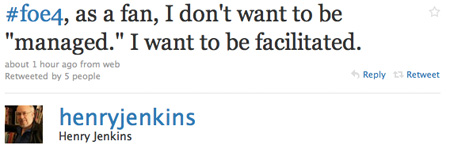
However, as regular readers of Cultural Learnings know, I rarely engage in wholly academic discussions in this setting, and in terms of this conference I’m particularly interested in the convergence between the discussions being held at the conference and my own experience looking at both television and the culture that surrounds it. In particular, this morning’s panel (moderated by friend of the blog Jason Mittell) on transmedia storytelling from the perspective of the producers (both in terms of third party companies who work on tie-in websites, etc., and those who are in charge of organizing those efforts) raised an important question that perhaps Henry Jenkins put best in a tweet:

There’s obviously an ideological difference between the two terms, one designed to control and the other designed to empower, and in an example like NBC’s Chuck (which, as announced yesterday, is returning in January) we can use these terms to describe the challenge facing the show’s relaunch.. The successful fan campaign which “saved” the show and earned it a third season was facilitated indirectly, as fans created their own transmedia experience by taking product placement and turning it into their own mini-marketing campaign.

And, as a result, NBC is in a position where Fan Facilitation and Fan Management start to blur, as the existence of an existing fan base more often inspires networks to attempt to control and manipulate that group rather than understanding the intelligence implied in their earlier behaviour and using that to their advantage, risking turning them away and squandering the potential they offer.

Continue reading

11 Comments

Filed under Chuck

30 Rock – “Sun Tea”

“Sun Tea”

November 19th, 2009

This is “Green Week” on NBC, which means that every show has some sort of environmental sustainability storyline in it. And while the shows did similar episodes a few seasons ago (The Office did its “Survivorman” parody and 30 Rock did the great “Greenzo”), it’s a well that has quite a bit of content in it, depending on how the shows wants to go about it.

While The Office (which I won’t be reviewing tonight, although I’ll probably throw some thoughts onto the end of the page) simply used it as a theme for the cold open (as it did with Halloween), 30 Rock takes a more continuous and as a result scattered approach. Giving Kenneth the task of “greening” 30 Rock felt forced, and while the episode wanted to try to make it seem subversive and clever the show has done too many similar things before.

However, continuing last week’s improvement on the season as a whole, this week had a cohesive point of view if we ignore the environmental side of things, presenting two stories that allowed for both some brilliant absurdity and actions which are driven by character rather than plot. And, just when you think that the environmental story is entirely worthless, the show spins off a few random parts of other scenes into the storyline and helps bring everything full circle in a sequence that actually is as clever as it wants it to be.

Plus, Teddy Ruxpin was a frakkin’ lawyer.

Continue reading

1 Comment

Filed under 30 Rock

Chuck Season 3 Premiere Date Set: 2-Night Event on January 10th/11th, 2010

Chuck Season 3 Premiere Details

November 19th, 2009

Just an hour after the news breaks about Lost’s sixth season premiere, another internet criticism favourite breaks similar news. After rumours of the show gaining an order for six additional episodes broke about a month ago, it was expected that the show would be moved up from its schedule March premiere date, and today’s news of a two-night, three-hour premiere event of sorts confirms those expectations.

And yes, you read that correctly: in the spirit of 24 (and launching around the same time, really), Chuck will be airing a two-hour season premiere (which is actually two episodes, as they had not planned for a lengthy premiere) on Sunday, January 10th, at 9pm before moving to their regular timeslot with a third new episode on Monday, January 11th, at 8pm. Now, there’s something to be said about this strategy: it creates more of an “event” style premiere to capture people’s attention, which is why 24 has been doing them for a while, and it also ensures that the show gets some plot momentum going into the Olympics break in February.

However, there’s enough concerns surrounding this move for my excitement to be tempered by at least a little bit of concern, as I’ll discuss after the break.

Continue reading

4 Comments

Filed under Chuck

Lost Season Six Premieres Tuesday, February 2nd, 2010

Lost Season Six Premiere Date + Ramifications

November 19th, 2009

Well, there’s finally a date. On Groundhog Day, 2010, Lost returns for its sixth and final season with a two-hour finale on a new night (Tuesdays) and at a new time (9pm Eastern), and…well, it doesn’t really matter.

See, I’m as excited as everyone else is about Lost’s final season, and since my Tuesday viewing schedule is more open than Wednesday I’m pleased to have the show making the move to the night. However, this season isn’t about ratings, or timeslots, or really anything: Lost is getting a final season that is for the fans, not to prove anything to Nielsen or anyone else, and the result is that this move says less about Lost and more about the remainder of ABC’s lineup.

As such, while this is certainly exciting news (only 75 days away!), I want to take some time to discuss what this means for some of ABC’s other shows that will be affected (or won’t be affected) by this change.

Continue reading

4 Comments

Filed under Lost

Modern Family – “Great Expectations”

“Great Expectations”

November 18th, 2009

In terms of the great comedy battle of 2009, which continues to rage amongst shows both new and old, Modern Family is at a distinct disadvantage: with Parks and Recreation delivering some legitimately great comedy and Community doing a really compelling and confident meta-storyline, the simplicity of this show is a disadvantage in terms of being flashy. There comes a point where the hype surrounding the show creates greater expectations than the storylines themselves can live up to in terms of their premise, requiring viewers to appreciate the strong execution where originality isn’t overtly present.

“Great Expectations” is a solid episode of the show, featuring a number of fun loving gags and a couple of big guest stars, but nothing stands out as particularly stunning as compared to some of the other comedies. In this instance, I think there was enough nuance to each individual story to continue to prove how strong the writers understand these characters, but it nonetheless follows similar patterns to what we’ve seen in the past. I think it’s one of their stronger episodes due to a nice role reversal, but it’s not reaching as high as some of the other comedies are right now.

Continue reading

2 Comments

Filed under Modern Family

Glee – “Ballad”

“Ballad”

November 18th, 2009

If you were to go back to the pilot, you would believe that Rachel Berry was the heart and soul of Glee. At that point, she was the person who most believed in Glee club, who saw it as the only place where she wasn’t the subject of ridicule and where she could express herself in the way she most desired.

But since that point, Rachel has become almost heartless. She turned her back on Glee club to join Sandy Ryerson’s musical, and she’s generally judgmental and frustrating before she’s caring or supportive. And yet, because Rachel is the strongest soloist (only Mercedes) on Glee, she’s remained at the centre of storylines and the club itself even while she seems convinced it’s actually holding her back from something better. It’s created a scenario where Rachel isn’t actually likeable, which is somewhat problematic if she’s supposed to be our heroine.

“Ballad” is a continuation of this theme, as a Glee Club exercise has everyone singing emotional ballads that bring out their deepest insecurities (in pretty uniformly effective ways) while Rachel is stuck in a “Hot for Teacher” scenario that never successfully bridges the comic and the dramatic (tears aside). I’m all for the show integrating more comedy than last week’s more emotional episode, and parts of this week’s entry nicely balance the two even with a lot of musical numbers involved, but Rachel’s storyline is effectively emotion-free, something that’s going to grow more and more problematic as we move forward.

Continue reading

6 Comments

Filed under Glee

Review: AMC’s The Prisoner – I Know There’s An Answer (But Ask Better Questions)

Review: AMC’s The Prisoner

November 18th, 2009

“There’s something thrilling about honesty.”

There’s a moment in the final hour of AMC’s remake of The Prisoner where I started to realize where its real problem lies. This is not to say that I haven’t been realizing the show’s problems from the word go, as the first five hours of the show were highly problematic, but when Ian McKellen’s 2 utters the above line I realized that this is where the intentions of the miniseries went awry.

There are problems with the thematic content of this miniseries, but the real problem is how the writer chose to structure this story in order to create a sense of mystery that was ultimately more vague than it was exciting. In the eyes of the writers, the climax of this story is when the story becomes clear to the audience, and the purpose of the rest of the miniseries is to effectively buy time and confuse us until we’re so desperate for clarity that when we receive it we give ourselves over to the truth. And, to some degree, the strategy worked: the final hour was, in fact, the best of this miniseries primarily because it was finally revealing and engaging with the larger thematic issues being discussed.

However, the problem with this strategy is that the cloudiness of the first four and a half hours of the miniseries not only made us hunger for thrills but also destroyed any sense of thematic consistency and, as a result, destroyed audience interest. While the theme presented at the end of the miniseries is actually compelling, it was so wholly absent for the first four hours (in particular) that it ends up depending entirely on the audience’s willingness to slog through an abstract and experimental four hours where the writer keeps adding new elements to the series when it’s in some way convenient for them as opposed to when it feels earned or natural.

While the miniseries eventually creates a compelling image of modern society, it’s an image that does little to make the first hour hours any better, and in some ways makes them even more irrelevant. It results in a miniseries that is the absolute worst sort of failure, where an intriguing idea and a couple of strong performances are executed in such a way to rob them of any potential to move their intended audience.

Continue reading

17 Comments

Filed under The Prisoner (2009)